


Wydawcy
Katalog tematyczny
- Archeologia (109)
- Ekonomia, finanse, business (13704)
- Filozofia (1445)
- Historia (3040)
- Języki i językoznawstwo (2356)
- Lifestyle, hobby i rozrywka (475)
- Medycyna (9704)
- Nauki humanistyczne (4)
- Nauki o Ziemi i środowisku (2638)
- Nauki ścisłe (20412)
- Astronomia (294)
- Biologia (5119)
- Chemia (6540)
- Chemia analityczna (361)
- Chemia fizyczna (346)
- Chemia nieorganiczna (137)
- Chemia organiczna (535)
- Krystalografia (27)
- Minerologia (46)
- Fizyka (3309)
- Matematyka (4574)
- Nauki ścisłe, ogólnie (503)
- Nauki społeczne (8486)
- Nauki techniczne (13450)
- Prawo (1696)
- Publikacje informacyjne i interdyscyplinarne (1288)
- Religia i wierzenia (917)
- Technika komputerowa (4067)
- Zdrowie, relacje międzyludzkie i rozwój osobisty (657)





Informacje szczegółowe o książce
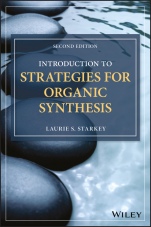
Introduction to Strategies for Organic Synthesis
ISBN 9781119347248
Autor: Laurie S. Starkey
Wydawca: Wiley
Dostępność: 3-6 tygodni
Cena: 332,85 zł
Przed złożeniem zamówienia prosimy o kontakt mailowy celem potwierdzenia ceny.
ISBN13: |
9781119347248 |
ISBN10: |
1119347246 |
Autor: |
Laurie S. Starkey |
Oprawa: |
Paperback |
Rok Wydania: |
2018-06-08 |
Numer Wydania: |
2nd Edition |
Ilość stron: |
432 |
Wymiary: |
243x150 |
Tematy: |
PN |
BRIDGING THE GAP BETWEEN ORGANIC CHEMISTRY FUNDAMENTALS AND ADVANCED SYNTHESIS PROBLEMS
Introduction to Strategies for Organic Synthesis bridges the knowledge gap between sophomore–level organic chemistry and senior–level or graduate–level synthesis to help students more easily adjust to a synthetic chemistry mindset. Beginning with a thorough review of reagents, functional groups, and their reactions, this book prepares students to progress into advanced synthetic strategies. Major reactions are presented from a mechanistic perspective and then again from a synthetic chemist′s point of view to help students shift their thought patterns and teach them how to imagine the series of reactions needed to reach a desired target molecule.
Success in organic synthesis requires not only familiarity with common reagents and functional group interconversions, but also a deep understanding of functional group behavior and reactivity. This book provides clear explanations of such reactivities and explicitly teaches students how to make logical disconnections of a target molecule.
This new Second Edition of Introduction to Strategies for Organic Synthesis:
Reviews fundamental organic chemistry concepts including functional group transformations, reagents, stereochemistry, and mechanisms Explores advanced topics including protective groups, synthetic equivalents, and transition–metal mediated coupling reactions Helps students envision forward reactions and backwards disconnections as a matter of routine Gives students confidence in performing retrosynthetic analyses of target molecules Includes fully–worked examples, literature–based problems, and over 450 chapter problems with detailed solutions Provides clear explanations in easy–to–follow, student–friendly language Focuses on the strategies of organic synthesis rather than a catalog of reactions and modern reagentsThe prospect of organic synthesis can be daunting at the outset, but this book serves as a useful stepping stone to refresh existing knowledge of organic chemistry while introducing the general strategies of synthesis. Useful as both a textbook and a bench reference, this text provides value to graduate and advanced undergraduate students alike.
Preface xix
Acknowlegments xxi
CHAPTER 1 Synthetic Toolbox 1: Retrosynthesis and Protective Groups 1
1.1 Retrosynthetic Analysis 3
1.2 Protective Groups 11
CHAPTER 1 Problems Protective Groups 19
CHAPTER 2 Synthetic Toolbox 2: Overview of Organic Transformations 21
2.1 Nucleophiles and Electrophiles 23
2.2 Oxidation and Reduction Reactions 27
CHAPTER 2 Problems Nucleophiles, Electrophiles, and Redox 41
CHAPTER 3 Synthesis of Monofunctional Target Molecules (1–FG TMs) 45
3.1 Synthesis of Alcohols (ROH) and Phenols (ArOH) 47
3.2 Synthesis of Alkyl (RX) and Aryl Halides (ArX) 61
3.3 Synthesis of Ethers (ROR ) 67
3.4 Synthesis of Thiols (RSH) and Thioethers (RSR´) 73
3.5 Synthesis of Amines (RNH2) and Anilines (ArNH2) 77
3.6 Synthesis of Alkenes (R2C¨TCR2) 85
3.7 Synthesis of Alkynes (RC CR ) 93
3.8 Synthesis of Alkanes (RH) 97
3.9 Synthesis of Aldehydes and Ketones (RCHO, R2C¨TO) 105
3.10 Synthesis of Carboxylic Acids (RCO2H) 117
3.11 Synthesis of Carboxylic Acid Derivatives 125
CHAPTER 3 Problems 1–FG TMs 139
CHAPTER 4 Synthesis of Target Molecules with Two Functional Groups (2–FG TMs) 143
4.1 Synthesis of ©\Hydroxy Carbonyls and , ©\Unsaturated Carbonyls 145
4.2 More Enolate Reactions: Synthesis of 1,3©\Dicarbonyls, 1,5©\Dicarbonyls, and Cyclohexenones 157
4.3 Illogical 2©\Group Disconnections: Umpolung (Polarity Reversal) 171
CHAPTER 4 Problems 2–FG TMs 183
CHAPTER 5 Synthesis of Aromatic Target Molecules 187
5.1 Electrophilic Aromatic Substitution (ArH + E+ ArE) 189
5.2 Synthesis of Aromatic TMs via Diazonium Salts (ArN2 + + Nu: ArNu) 201
5.3 Nucleophilic Aromatic Substitution (ArX + Nu: ArNu) 205
CHAPTER 5 Problems Aromatic TMs 209
CHAPTER 6 Synthesis of Compounds Containing Rings 211
6.1 Synthesis of Cyclopropanes 213
6.2 Synthesis of Cyclobutanes 215
6.3 Synthesis of Five©\Membered Rings (Radical Cyclization Reactions) 217
6.4 Synthesis of Six©\Membered Rings (Diels Alder Reaction) 221
CHAPTER 6 Problems Cyclic TMs 231
CHAPTER 7 Predicting and Controlling Stereochemistry 235
7.1 Reactions that Form Racemates 237
7.2 SN2 Mechanism: Backside Attack 243
7.3 Elimination Mechanisms 245
7.4 Additions to Alkenes and Alkynes 247
7.5 Additions to Carbonyls 251
7.6 Additions to Enolates: Aldol Stereochemistry 257
7.7 Enantioselectivity and Asymmetric Syntheses 261
CHAPTER 7 Problems Stereochemistry 269
CHAPTER 8 Transition Metal–Mediated Carbon Carbon Bond Formation 273
8.1 Transition Metal Coordination Complexes 275
8.2 Organometallic Reaction Mechanisms 283
8.3 Carbonylation and Decarbonylation 291
8.4 (ArX + Alkene Ar©\Alkene) 295
8.5 Palladium©\Catalyzed Cross©\Coupling Reactions (RX + R M R©\R ) 297
8.6 Olefin Metathesis Reactions 303
8.7 Retrosynthesis: Disconnections Based on Metal–Mediated Reactions 307
CHAPTER 8 Problems Transition Metal–Mediated Synthesis 309
SOLUTIONS TO PROBLEMS 313
Index 389
LAURIE S. STARKEY, PHD, is a Professor of Organic Chemistry at California State Polytechnic University, Pomona, where she has been teaching organic chemistry and organic synthesis since 1996. Her research focuses on chemical education, including the development and assessment of online learning tools and the creation of educational videos and animations. Dr. Starkey was awarded the Cal Poly Pomona College of Science′s Distinguished Teaching Award in 2000, and the Provost′s Award in Teaching Excellence in 2013.
Koszyk
Książek w koszyku: 0 szt.
Wartość zakupów: 0,00 zł
Informacje


Kontakt
Gambit
Centrum Oprogramowania
i Szkoleń Sp. z o.o.
Al. Pokoju 29b/22-24
31-564 Kraków
Siedziba Księgarni
ul. Kordylewskiego 1
31-542 Kraków
+48 12 410 5991
+48 12 410 5987
+48 12 410 5989
Subskrypcje
Administratorem danych osobowych jest firma Gambit COiS Sp. z o.o. Na podany adres będzie wysyłany wyłącznie biuletyn informacyjny.
Autoryzacja płatności

Informacje na temat autoryzacji płatności poprzez PayU.

© Copyright 2012: GAMBIT COiS Sp. z o.o. Wszelkie prawa zastrzeżone.
Projekt i wykonanie: Alchemia Studio Reklamy