


Wydawcy
Katalog tematyczny
- Archeologia (109)
- Ekonomia, finanse, business (13704)
- Filozofia (1445)
- Historia (3040)
- Języki i językoznawstwo (2356)
- Lifestyle, hobby i rozrywka (475)
- Medycyna (9704)
- Nauki humanistyczne (4)
- Nauki o Ziemi i środowisku (2638)
- Nauki ścisłe (20412)
- Nauki społeczne (8486)
- Nauki techniczne (13450)
- Prawo (1696)
- Publikacje informacyjne i interdyscyplinarne (1288)
- Religia i wierzenia (917)
- Technika komputerowa (4067)
- Zdrowie, relacje międzyludzkie i rozwój osobisty (657)





Informacje szczegółowe o książce
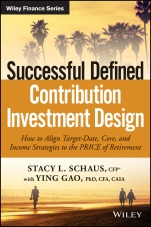
Successful Defined Contribution Investment Design: How to Align Target–Date, Core, and Income Strategies to the PRICE of Retirement
ISBN 9781119298564
Autor: Stacy L. Schaus, Ying Gao
Wydawca: Wiley
Dostępność: 3-6 tygodni
Cena: 313,95 zł
Przed złożeniem zamówienia prosimy o kontakt mailowy celem potwierdzenia ceny.
ISBN13: |
9781119298564 |
ISBN10: |
1119298563 |
Autor: |
Stacy L. Schaus, Ying Gao |
Oprawa: |
Hardback |
Rok Wydania: |
2017-03-14 |
Ilość stron: |
384 |
Wymiary: |
235x161 |
Tematy: |
KF |
An innovative tool for building DC plans
Successful Defined Contribution Investment Design is the DC plan guidebook for structuring and implementing a 401(k) or other defined contribution (DC) pension plan for the needs of today′s employees. Action–oriented, cohesive coverage gives you the knowledge and practical tools to help improve retirement income security for your employees by creating an objective–aligned DC plan. Specifically written as a step–by–step resource for plan sponsors and facilitating professionals, this innovative research takes you through its unique framework for designing a plan, complete with tested methodologies and analytic techniques for streamlining plan monitoring and management. Keep this illuminating volume at your fingertips to:
Design a DC plan from scratch with the assurance of a tested framework for evaluation and structure Apply leading–edge methodologies for evaluating fund choices during selection and ongoing assessment Get an inside perspective on how leading companies and consultants around the world approach DC planningWorkers have only one chance to save for retirement help them get it right with Successful Defined Contribution Investment Design.
Acknowledgments xv
Introduction 1
How This Book Is Organized and How to Use It 3
A Continuing Commitment to Meet the Need for Information 6
Why Should You Read This Book? 7
PART ONE DC Plans: A Cornerstone of Retirement 9
CHAPTER 1 DC Plans Today 11
Preface: A Career and a New Form of Pension Plan Are Born 11
DC Plans: Becoming the New Reality . . . No Turning Back 13
Setting Goals for Success: Income Replacement Targets 14
Reducing DC Litigation Risk: Process and Oversight 16
Who s a Fiduciary? 17
How to Approach Outsourcing DC Plan Resources 19
Hiring an Investment Consultant 20
Getting Started: Setting an Investment Philosophy and Governance Structure 20
PIMCO Principles for DC Plan Success: Building and Preserving Purchasing Power 25
Maximizing DC Savings: Just Do It! 27
In Closing 32
Questions for Plan Fiduciaries 33
CHAPTER 2 Aligning DC Investment Design to Meet the PRICE of Retirement 35
Begin with the End in Mind 37
What Is a Reasonable Pay Replacement Target? 39
Calculating the Income Replacement Rates 42
Historic Cost of Retirement: PRICE Is a Moving Target 44
A Focus on Income, Not Cost 47
PRICE–Aware: Applying PRICE to Consider DC Assets and Target–Date Strategies 48
Evaluating Glide Paths 50
Tracking DC Account Balance Growth Relative to PRICE 54
Summary: The Importance of Knowing Your PRICE 55
In Closing 55
Questions for Plan Fiduciaries 56
Note 56
CHAPTER 3 Plan Investment Structure 57
Tiers and Blends: Investment Choices for DC Participants 60
Tier I: Do–It–for–Me Asset Allocation Investment Strategies 61
Tier II: Help–Me–Do–It Stand–Alone or Core Investment Options 67
Tier III: Do–It–Myself Mutual–Fund–Only or Full Brokerage Window 90
Considering an Outsourced Chief Investment Offi cer 91
In Closing 93
Questions for Plan Fiduciaries 94
Notes 94
CHAPTER 4 Target Date Design and Approaches 95
Target–Date Structures Vary by Plan Size 100
Custom Target–Date Strategies 101
Semicustom Target–Date 102
Packaged Target–Date 103
Target–Date Selection and Evaluation Criteria 104
No Such Thing as Passive 105
Low Cost and Low Tracking Error Does Not Equal Low Risk 106
Framework for Selecting and Evaluating Target–Date Strategies: Three Active Decisions Plan Sponsors Must Make 107
Active Decision #1: How Much Risk Can Plan Participants Take? 108
Active Decision #2: How Is the Risk Best Allocated across Investment Choices? 114
Active Decision #3: Should Risk Be Actively Hedged? 119
Tail–Risk Hedging Strategies 119
Insurance 120
Target–Date Analytics: Glide Path Analyzer (GPA) and Other Tools 120
Global DC Plans: Similar Destinations, Distinctly Different Paths 121
In Closing 123
Questions for Plan Fiduciaries 124
Notes 125
PART TWO Building Robust Plans: Core Investment Offerings 127
CHAPTER 5 Capital Preservation Strategies 129
Capital Preservation: Importance 130
Capital Preservation: What Is Prevalent and What Is Preferred? 131
The $1 NAV: Shared by Stable Value and MMFs 132
Stable Value Offers More Opportunity in a Low–Interest–Rate Environment 135
Looking Forward: The Changing Role of Stable Value 138
Making Low–Risk Decisions: Views from the Field 140
White Labeling: A Capital Preservation Solution 143
An Analytic Evaluation of Capital Preservation Solutions 144
Short–Term, Low–Duration, and Low–Risk Bond Strategies 146
Inclusion of Stable Value in Custom Target–Date or Other Blended Strategies 149
In Closing 152
Questions for Plan Fiduciaries 152
Note 153
CHAPTER 6 Fixed–Income Strategies 155
What Are Bonds, and Why Are They Important for Retirement Investors? 157
What Are the Different Types of Bonds in the Market? 158
What Types of Bonds Should Be Offered to DC Participants? 161
Investment–Grade and High–Yield Credit 165
Bond Investment Strategies: Passive versus Active Approaches 166
Analytic Evaluation: Comparing Bond Strategies 176
Fixed Income within Target–Date Glide Paths 178
Observations for Fixed Income Allocation within Target–Date Strategies 179
In Closing 181
Questions for Plan Fiduciaries 181
CHAPTER 7 Designing Balanced DC Menus: Considering Equity Options 183
What Are Equities and How Are They Presented in DC Investment Menus? 184
Getting the Most out of Equities 190
Consider Dividend–Paying Stocks 194
Evaluating Equity Strategies 194
Less Is More: Streamlining Equity Choices 197
Shift to Asset–Class Menu May Improve Retirement Outcomes 197
Active versus Passive The Ongoing Debate 197
Strategic Beta: Consider Adding Fundamentally Weighted Equity Exposure 204
Currency Hedging: An Active Decision 205
Observations for Equity Allocations within Target–Date Strategies 210
In Closing 212
Questions for Fiduciaries 212
Note 213
CHAPTER 8 Inflation Protection 215
What Is Inflation and How Is It Measured? 216
Why Inflation Protection in DC? 217
History of Inflation: Inflation Spikes Underscore Need for Inflation–Hedging Assets 218
Inflation Protection When Accumulating and Decumulating, and in Different Economic Environments 219
Economic Environments Change Unexpectedly and Reward or Punish Various Asset Classes 221
Consultants Favor TIPS, Multi–Real–Asset Strategies, REITs, and Commodities 223
How Should Plan Sponsors Address Inflation Risk in DC Portfolios? 226
Implementation Challenges 228
Evaluating Real Asset Strategies 229
Summary Comparison of Individual and Multi–Real–Asset Blends 232
Inflation–Hedging Assets in Target–Date Glide Paths 235
Observations for Inflation–Hedging Assets in Target–Date Glide Paths 236
In Closing 238
Questions for Fiduciaries 238
CHAPTER 9 Additional Strategies and Alternatives: Seeking Diversification and Return 239
What Are Alternative Assets? 240
A Wider Lens on Alternatives 242
Consultant Support for Additional Strategies and Alternatives 244
Back to Basics: Why Consider Alternatives? 247
Liquid Alternatives: Types and Selection Considerations 252
Important Characteristics in Selecting Alternatives: Consultant Views 256
Illiquid Alternatives: Types and Considerations 259
Contrasting Liquid Alternative Strategies with Hedge Fund and Private Equity Investments 261
In Closing 263
Questions for Plan Fiduciaries 264
PART THREE Bringing It All Together: Creating Retirement Income 265
CHAPTER 10 Retirement Income: Considering Options for Plan Sponsors and Retirees 267
Advisor and Consultant Retirement Income Suggestions 268
Why Don t Retirees Leave Their Assets in DC Plans at Retirement? 272
Retaining a Relationship with Your Employer in Retirement: An Innovative and Caring Plan Sponsor 277
Mutual Benefits: Retaining Retiree Assets May Help Both Retirees and Plan Sponsors 279
Turning DC Assets into a Lifetime Paycheck: Evaluating the DC Investment Lineup for Retiree Readiness 280
Evaluating Portfolio Longevity 285
Turning Defined Contribution Assets into a Lifetime Income Stream: How to Evaluate Investment Choices for Retirees 286
Guarding Retiree Assets against a Sudden Market Downturn: Sequencing Risk 288
Ways to Manage Market and Longevity Risk . . . without Adding In–Plan Insurance Products 289
Living beyond 100: Planning for Longevity 290
Managing Longevity Risk: Considerations for Buying an Annuity 292
Immediate and Deferred Annuities: Why Out–of–Plan Makes Sense 292
In Closing 298
Questions for Plan Fiduciaries 298
Notes 299
CHAPTER 11 A Global View 301
DC Plans: Becoming the Dominant Global Model 302
Retirement Plan Coverage and Participation 305
Investment Default and Growth of Target–Date Strategies 315
Retirement Income: The Global Search for Solutions 319
Defined Ambition in the Netherlands 321
New Solutions in Australia and Beyond: Tontines and Group Self–Annuitization 323
Getting DC Right : Lessons Learned in Chapters 1 through 10 326
Analytic Factors to Consider: Summary by Asset Pillar 333
In Closing 333
Note 335
Closing Comments 337
Priority 1: Increasing Plan Coverage and Individual Savings Rates 338
Priority 2: Moving to Objective–Aligned Investment Approaches 338
Priority 3: Broadening Options for Retirement Income 341
Nudging One Another along a Path to Success 341
Index 343
Stacy L. Schaus is an executive vice president and leads PIMCO′s Defined Contribution Practice working primarily with plan sponsors and consultants. Prior to joining PIMCO in 2006, she was a founder and president of Hewitt Financial Services, which offers DC investment consulting and research as well as brokerage and personal finance services. While at Hewitt, she co–created and launched the Aon Hewitt 401(k) Index to help evaluate how DC participants respond to market changes. She is the founding chair for the Defined Contribution Institutional Investment Association, serves on the executive committee of the Employee Benefit Research Institute, and served as a Financial Planning Association board member. She has 35 years of investment experience and holds an MBA from the Stern School of Business at New York University and an undergraduate degree from the University of California, Santa Barbara.
Ying Gao, who carried out the analytic reporting and modeling contained in this volume, is a vice president in the client analytics group in the Newport Beach office of PIMCO. Her primary areas of focus are financial modeling, asset allocation, and risk management. Prior to joining PIMCO in 2009, Dr. Gao worked with the fixed income portfolio management department at Principal Global Investors and the capital markets group at Federal Home Loan Bank of Des Moines. She has 10 years of investment experience and holds a PhD in economics from Iowa State University. She earned her master′s and undergraduate degrees in finance from Zhejiang University in China.
Koszyk
Książek w koszyku: 0 szt.
Wartość zakupów: 0,00 zł
Informacje


Kontakt
Gambit
Centrum Oprogramowania
i Szkoleń Sp. z o.o.
Al. Pokoju 29b/22-24
31-564 Kraków
Siedziba Księgarni
ul. Kordylewskiego 1
31-542 Kraków
+48 12 410 5991
+48 12 410 5987
+48 12 410 5989
Subskrypcje
Administratorem danych osobowych jest firma Gambit COiS Sp. z o.o. Na podany adres będzie wysyłany wyłącznie biuletyn informacyjny.
Autoryzacja płatności

Informacje na temat autoryzacji płatności poprzez PayU.

© Copyright 2012: GAMBIT COiS Sp. z o.o. Wszelkie prawa zastrzeżone.
Projekt i wykonanie: Alchemia Studio Reklamy