


Wydawcy
Katalog tematyczny
- Archeologia (109)
- Ekonomia, finanse, business (13704)
- Filozofia (1445)
- Historia (3040)
- Języki i językoznawstwo (2356)
- Lifestyle, hobby i rozrywka (475)
- Medycyna (9704)
- Nauki humanistyczne (4)
- Nauki o Ziemi i środowisku (2638)
- Nauki ścisłe (20412)
- Nauki społeczne (8486)
- Nauki techniczne (13450)
- Budownictwo lądowe (1045)
- Chemia przemysłowa (2258)
- Elektronika i telekomunikacja (3287)
- Energetyka (1122)
- Inne nauki stosowane (363)
- Inżynieria biochemiczna (507)
- Inżynieria transportu (232)
- Mechanika i materiały (3316)
- Nauka o środowisku (321)
- Rolnictwo (507)
- Technika, ogólnie (475)
- Prawo (1696)
- Publikacje informacyjne i interdyscyplinarne (1288)
- Religia i wierzenia (917)
- Technika komputerowa (4067)
- Zdrowie, relacje międzyludzkie i rozwój osobisty (657)





Informacje szczegółowe o książce
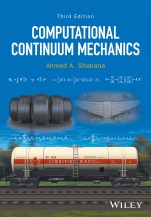
Computational Continuum Mechanics
ISBN 9781119293217
Autor: Ahmed A. Shabana
Wydawca: Wiley
Dostępność: 3-6 tygodni
Cena: 540,75 zł
Przed złożeniem zamówienia prosimy o kontakt mailowy celem potwierdzenia ceny.
ISBN13: |
9781119293217 |
ISBN10: |
1119293219 |
Autor: |
Ahmed A. Shabana |
Oprawa: |
Hardback |
Rok Wydania: |
2018-02-09 |
Numer Wydania: |
3rd Edition |
Ilość stron: |
368 |
Wymiary: |
250x172 |
Tematy: |
TG |
An updated and expanded edition of the popular guide to basic continuum mechanics and computational techniques
This updated third edition of the popular reference covers state–of–the–art computational techniques for basic continuum mechanics modeling of both small and large deformations. Approaches to developing complex models are described in detail, and numerous examples are presented demonstrating how computational algorithms can be developed using basic continuum mechanics approaches.
The integration of geometry and analysis for the study of the motion and behaviors of materials under varying conditions is an increasingly popular approach in continuum mechanics, and absolute nodal coordinate formulation (ANCF) is rapidly emerging as the best way to achieve that integration. At the same time, simulation software is undergoing significant changes which will lead to the seamless fusion of CAD, finite element, and multibody system computer codes in one computational environment. Computational Continuum Mechanics, Third Edition is the only book to provide in–depth coverage of the formulations required to achieve this integration.
Provides detailed coverage of the absolute nodal coordinate formulation (ANCF), a popular new approach to the integration of geometry and analysis Provides detailed coverage of the floating frame of reference (FFR) formulation; a popular, well–established approach for solving small deformation problems Supplies numerous examples of how complex models have been developed to solve an array of real–world problems Covers modeling of both small and large deformations in detail Demonstrates how to develop computational algorithms using basic continuum mechanics approachesComputational Continuum Mechanics, Third Edition is designed to function equally well as a text for advanced undergraduates and first–year graduate students and as a working reference for researchers, practicing engineers, and scientists working in computational mechanics, bio–mechanics, computational biology, multibody system dynamics, and other fields of science and engineering using the general continuum mechanics theory.
PREFACE ix
1 INTRODUCTION 1
1.1 Matrices / 2
1.2 Vectors / 6
1.3 Summation Convention / 11
1.4 Cartesian Tensors / 12
1.5 Polar Decomposition Theorem / 21
1.6 D Alembert s Principle / 23
1.7 Virtual Work Principle / 29
1.8 Approximation Methods / 32
1.9 Discrete Equations / 34
1.10 Momentum, Work, and Energy / 37
1.11 Parameter Change and Coordinate Transformation / 39
Problems / 43
2 KINEMATICS 47
2.1 Motion Description / 48
2.2 Strain Components / 55
2.3 Other Deformation Measures / 60
2.4 Decomposition of Displacement / 62
2.5 Velocity and Acceleration / 64
2.6 Coordinate Transformation / 68
2.7 Objectivity / 74
2.8 Change of Volume and Area / 77
2.9 Continuity Equation / 81
2.10 Reynolds Transport Theorem / 82
2.11 Examples of Deformation / 84
2.12 Important Geometry Concepts / 92
Problems / 94
3 FORCES AND STRESSES 97
3.1 Equilibrium of Forces / 97
3.2 Transformation of Stresses / 100
3.3 Equations of Equilibrium / 100
3.4 Symmetry of the cauchy Stress Tensor / 102
3.5 Virtual Work of the Forces / 103
3.6 Deviatoric Stresses / 113
3.7 Stress Objectivity / 115
3.8 Energy Balance / 119
Problems / 120
4 CONSTITUTIVE EQUATIONS 123
4.1 Generalized Hooke s Law / 124
4.2 Anisotropic Linearly Elastic Materials / 126
4.3 Material Symmetry / 127
4.4 Homogeneous Isotropic Material / 129
4.5 Principal Strain Invariants / 136
4.6 Special Material Models for Large Deformations / 137
4.7 Linear Viscoelasticity / 141
4.8 Nonlinear Viscoelasticity / 155
4.9 A Simple Viscoelastic Model for Isotropic Materials / 161
4.10 Fluid Constitutive Equations / 162
4.11 Navier Stokes Equations / 164
Problems / 164
5 FINITE ELEMENT FORMULATION: LARGE–DEFORMATION, LARGE–ROTATION PROBLEM 167
5.1 Displacement Field / 169
5.2 Element Connectivity / 176
5.3 Inertia and Elastic Forces / 178
5.4 Equations of Motion / 180
5.5 Numerical Evaluation of The Elastic Forces / 188
5.6 Finite Elements and Geometry / 193
5.7 Two–Dimensional Euler Bernoulli Beam Element / 199
5.8 Two–Dimensional Shear Deformable Beam Element / 203
5.9 Three–Dimensional Cable Element / 205
5.10 Three–Dimensional Beam Element / 206
5.11 Thin–Plate Element / 208
5.12 Higher–Order Plate Element / 210
5.13 Brick Element / 211
5.14 Element Performance / 212
5.15 Other Finite Element Formulations / 216
5.16 Updated Lagrangian and Eulerian Formulations / 218
5.17 Concluding Remarks / 221
Problems / 223
6 FINITE ELEMENT FORMULATION: SMALL–DEFORMATION, LARGE–ROTATION PROBLEM 225
6.1 Background / 226
6.2 Rotation and Angular Velocity / 229
6.3 Floating Frame of Reference (FFR) / 234
6.4 Intermediate Element Coordinate System / 236
6.5 Connectivity and Reference Conditions / 238
6.6 Kinematic Equations / 243
6.7 Formulation of The Inertia Forces / 245
6.8 Elastic Forces / 248
6.9 Equations of Motion / 250
6.10 Coordinate Reduction / 251
6.11 Integration of Finite Element and Multibody System Algorithms / 253
Problems / 258
7 COMPUTATIONAL GEOMETRY AND FINITE ELEMENT ANALYSIS 261
7.1 Geometry and Finite Element Method / 262
7.2 ANCF Geometry / 264
7.3 Bezier Geometry / 266
7.4 B–Spline Curve Representation / 267
7.5 Conversion of B–Spline Geometry to ANCF Geometry / 271
7.6 ANCF and B–Spline Surfaces / 273
7.7 Structural and Nonstructural Discontinuities / 275
8 PLASTICITY FORMULATIONS 279
8.1 One–Dimensional Problem / 281
8.2 Loading and Unloading Conditions / 282
8.3 Solution of the Plasticity Equations / 283
8.4 Generalization of The Plasticity Theory: Small Strains / 291
8.5 J2 Flow Theory with Isotropic/Kinematic Hardening / 298
8.6 Nonlinear Formulation for Hyperelastic Plastic Materials / 312
8.7 Hyperelastic Plastic J2 FLOW THEORY / 322
Problems / 326
REFERENCES 329
INDEX 339
Ahmed A. Shabana, PhD, is University Distinguished Professor and the Richard and Loan Hill Professor of Engineering at the University of Illinois at Chicago. Professor Shabana is the author of several books and serves on the Editorial Board of several journals. He served as the Chair of the ASME Design Engineering Division, the Founding Chair of the ASME Technical Committee on Multibody Systems and Nonlinear Dynamics, and the Founding Chair of the ASME International Conference of Multibody Systems, Nonlinear Dynamics, and Control. Professor Shabana is a Fellow of the American Society of Mechanical Engineers (ASME) and a Fellow of the Society of Automotive Engineering (SAE International). He has received several awards, including the Humboldt Prize, the Fulbright Research Scholar Award, the ASME D′Alembert Award, and Honorary Doctorate, Honorary Professorship, and Best Paper Awards, as well as several teaching and research awards from the University of Illinois at Chicago.
Koszyk
Książek w koszyku: 0 szt.
Wartość zakupów: 0,00 zł
Informacje


Kontakt
Gambit
Centrum Oprogramowania
i Szkoleń Sp. z o.o.
Al. Pokoju 29b/22-24
31-564 Kraków
Siedziba Księgarni
ul. Kordylewskiego 1
31-542 Kraków
+48 12 410 5991
+48 12 410 5987
+48 12 410 5989
Subskrypcje
Administratorem danych osobowych jest firma Gambit COiS Sp. z o.o. Na podany adres będzie wysyłany wyłącznie biuletyn informacyjny.
Autoryzacja płatności

Informacje na temat autoryzacji płatności poprzez PayU.

© Copyright 2012: GAMBIT COiS Sp. z o.o. Wszelkie prawa zastrzeżone.
Projekt i wykonanie: Alchemia Studio Reklamy