


Wydawcy
Katalog tematyczny
- Archeologia (109)
- Ekonomia, finanse, business (13704)
- Filozofia (1445)
- Historia (3040)
- Języki i językoznawstwo (2356)
- Lifestyle, hobby i rozrywka (475)
- Medycyna (9704)
- Chirurgia (272)
- Inne gałęzie medycyny (1871)
- Medycyna kliniczna (4187)
- Medycyna niekonwencjonalna (14)
- Medycyna przedkliniczna (269)
- Medycyna, ogólnie (1740)
- Historia medycyny (3)
- Lekarze, sprawy zawodowe (8)
- Medycyna, aspekty prawne (10)
- Służba zdrowia (36)
- Wyposażenie medyczne (157)
- Zdrowie publiczne (460)
- Medyczne służby pomocnicze (745)
- Studia medyczne (16)
- Weterynaria (548)
- Nauki humanistyczne (4)
- Nauki o Ziemi i środowisku (2638)
- Nauki ścisłe (20412)
- Nauki społeczne (8486)
- Nauki techniczne (13450)
- Prawo (1696)
- Publikacje informacyjne i interdyscyplinarne (1288)
- Religia i wierzenia (917)
- Technika komputerowa (4067)
- Zdrowie, relacje międzyludzkie i rozwój osobisty (657)





Informacje szczegółowe o książce
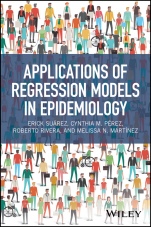
Applications of Regression Models in Epidemiology
ISBN 9781119212485
Autor: Erick Suárez, Cynthia M. Pérez, Roberto Rivera, Melissa N. Martínez
Wydawca: Wiley
Dostępność: 3-6 tygodni
Cena: 622,65 zł
Przed złożeniem zamówienia prosimy o kontakt mailowy celem potwierdzenia ceny.
ISBN13: |
9781119212485 |
ISBN10: |
1119212480 |
Autor: |
Erick Suárez, Cynthia M. Pérez, Roberto Rivera, Melissa N. Martínez |
Oprawa: |
Hardback |
Rok Wydania: |
2017-03-31 |
Ilość stron: |
272 |
Wymiary: |
243x159 |
Tematy: |
MBN |
A one–stop guide for public health students and practitioners learning regression analysis and statistical methods
This book is written for public health professionals and students interested in applying regression models in the field of public health. The academic material is usually covered in the following courses: (i) Applied Regression Analysis, (ii) Advanced Epidemiology, and (iii) Statistical Computing for Applying Statistical Modeling. The book is composed of 13 chapters including an introduction chapter that covers basic concepts of statistics and probability. Among the topics covered are: linear regression model, polynomial regression model, weighted linear regression, methods for selecting the best regression equation, logistic regression model, and Poisson regression model. An example is provided in each chapter that applies the theoretical aspects presented in that chapter. In addition, exercises are included and the final chapter is devoted to the solutions of these academic exercises with answers in all of the major statistical software packages including STATA, SAS, SPSS, and R. It is assumed that readers of this book have a basic course in biostatistics, epidemiology, and introductory calculus. The book will be of interest to anyone looking to understand the statistical fundamentals to support quantitative research in public health.
In addition, this book:
Is based on the authors course notes from 20 years teaching regression modeling in public health courses Provides exercises at the end of each chapter Contains a solutions chapter with answers in STATA, SAS, SPSS, and R Provides real–world public–health applications of the theoretical aspects contained in the chaptersApplications of Regression Models in Public Health is a reference for graduate students in public health and public health practitioners.
Erick Suárez is a Professor of the Department of Biostatistics and Epidemiology at the University of Puerto Rico School of Public Health. He received a Ph.D. degree in Medical Statistics from the London School of Hygiene and Tropical Medicine. He has 29 years of experience teaching biostatistics.
Cynthia M. Pérez is a Professor of the Department of Biostatistics and Epidemiology at the University of Puerto Rico School of Public Health. She received an M.S. degree in Statistics and a Ph.D. degree in Epidemiology from Purdue University. She has 22 years of experience teaching epidemiology and biostatistics.
Roberto Rivera is an Associate Professor at the College of Business at the University of Puerto Rico at Mayaguez. He received a Ph.D. degree in Statistics from the University of California in Santa Barbara. He has more than 5 years of experience teaching statistics courses at the undergraduate and graduate levels.
Dedication
About the Author
Preface
Acknowledgements
Chapter 1: Basic concepts for Statistical Modeling
1.1 Introduction
1.2 Parameter versus statistic
1.3 Probability definition
1.4 Conditional probability
1.5 Concepts of prevalence and incidence
1.6 Random variables
1.7 Probability distributions
1.8 Centrality and dispersion parameters of a random variable
1.9 Independence and dependence of random variables
1.10 Special probability distribution
1.11 Hypothesis testing
1.12 Confidence intervals
1.13 Clinical significance versus statistical significance
1.14 Data management
1.15 What to do when detecting a data issue
1.16 Impact of data issues and how to proceed
1.17 Concept of causality
References
Chapter 2: Introduction to Simple Linear Regression Models
2.1 Introduction
2.2 Specific objectives
2.3 Model definition
2.4 Model assumptions
2.5 Graphic representation
2.6 Geometry of the simple regression model
2.7 Estimation of parameters
2.8 Variance of estimators
2.9 Hypothesis testing about the slope of the regression line
2.10 Coefficient of determination R2
2.11 Pearson correlation coefficient
2.12 Estimation of regression line values and prediction
2.13 Example
2.14 Predictions
2.15 Conclusions
2.16 Practice Exercise
Reference
Chapter 3 : Matrix Representation of the Linear Regression Model
3.1 Introduction
3.2 Specific objectives
3.3 Definition
3.4 Matrix representation of a SLRM
3.5 Matrix arithmetic
3.6 Matrix multiplication
3.7 Special matrices
3.8 Linear dependence
3.9 Rank of a matrix
3.10 Inverse matrix [A–1]
3.11 Application of an inverse matrix in a SLRM
3.12 Estimation of Ò parameters in a SLRM
3.13 Multiple linear regression model (MLRM)
3.14 Interpretation of the coefficients in a MLRM
3.15 ANOVA in a MLRM
3.16 Using indicator variables (Dummy Variables)
3.17 Polynomial regression models
3.18 Centering
3.19 Multicollinearity
3.20 Interaction terms
3.21 Conclusion
3.22 Practice Exercise
Reference
Chapter 4 : Evaluation of Partial Tests of Hypotheses in a MLRM
4.1 Introduction
4.2 Specific objectives
4.3 Definition of partial hypothesis
4.4 Evaluation process of partial hypotheses
4.5 Special situations
4.6 Examples
4.7 Conclusion
4.8 Practice exercise
Reference
Chapter 5 : Selection of Variables in a Multiple Linear Regression Model
5.1 Introduction
5.2 Specific Objectives
5.3 Selection of variables according to the study objectives
5.4 Criteria for selecting the best regression model
5.5 Stepwise method in regression
5.6 Limitations of stepwise methods
5.7 Conclusion
5.8 Practice exercise
References
Chapter 6 : Correlation Analysis
6.1 Introduction
6.2 Specific objectives
6.3 Main correlation coefficients based on SLRM
6.4 Major correlation coefficients based on MLRM
6.5 Partial correlation coefficient
6.6 Significance Tests
6.7 Suggested Correlations
6.8 Example
6.9 Conclusion
6.10 Practice Exercise
Reference
Chapter 7 : Strategies for assessing the adequacy of the Linear Regression Model
7.1 Introduction
7.2 Specific objectives
7.3 Residual definition
7.4 Initial exploration
7.5 Initial considerations
7.6 Standardized residual
7.7 Jackknife residuals (R–Student residuals)
7.8 Normality of the errors
7.9 Correlation of Errors
7.10 Criteria for detecting outliers, leverage, and influential points
7.11 Leverage values
7.12 Cook s distance
7.13 COV RATIO
7.14 DFBETAS
7.15 DFFITS
7.16 Summary of the results
7.17 Multicollinearity
7.18 Transformation of variables
7.19 Conclusion
7.20 Practice Exercise
Reference
Chapter 8 : Weighted Least Squares Linear Regression
8.1 Introduction
8.2 Specific objectives
8.3 Regression model with transformation into the original scale of Y
8.4 Matrix Notation of the Weighted Linear Regression Model
8.5 Application of the WLS model with unequal number of subjects
8.6 Applications of the WLS model when variance increases
8.7 Conclusions
8.8 Practice Exercise
Reference
Chapter 9 : Generalized Linear Models
9.1 Introduction
9.2 Specific objectives
9.3 Exponential Family of Probability Distributions
9.4 Exponential Family of Probability Distributions with Dispersion
9.5 Mean and Variance in EF and EDF
9.6 Definition of a Generalized Linear Model
9.7 Estimation Methods
9.8 Deviance calculation
9.9 Hypothesis Evaluation
9.10 Analysis of Residuals
9.11 Model Selection
9.12 Bayesian Models
9.13 Conclusions
Reference
Chapter 10 : Poisson Regression Models for Cohort Studies
10.1 Introduction
10.2 Specific Objectives
10.3 Incidence Measures
10.4 Confounding variable
10.5 Stratified analysis
10.6 Poisson regression model
10.7 Definition of Adjusted Relative Risk
10.8 Interaction assessment
10.9 Relative Risk Estimation
10.10 Implementation of the Poisson regression model
10.11 Conclusion
10.12 Practice Exercise
Reference
Chapter 11 : Logistic Regression in Case–Control Studies
11.1 Introduction
11.2 Specific Objectives
11.3 Graphical Representation
11.4 Definition of the Odds Ratio
11.5 Confounding assessment
11.6 Effect Modification
11.7 Stratified analysis
11.8 Unconditional Logistic Regression Model
11.9 Types of logistic regression models
11.10 Computing the ORcrude
11.11 Computing the adjusted OR
11.12 Inference on OR
11.13 Example of the application of ULR model–binomial case
11.14 Conditional logistic regression model
11.15 Conclusions
11.16 Practice Exercise
Reference
Chapter 12 : Regression models in a cross–sectional study
12.1 Introduction
12.2 Specific Objectives
12.3 Prevalence estimation using the normal approach
12.4 Definition of the magnitude of the association
12.5 POR Estimation
12.6 Prevalence Ratio
12.7 Stratified analysis
12.8 Logistic Regression Model
12.9 Conclusions
12.10 Practice Exercise
Reference
Chapter 13 : Solutions to Practice Exercises
Chapter II: Practice exercise
Chapter III: Practice exercise
Chapter IV: Practice exercise
Chapter V: Practice exercise
Chapter VI: Practice exercise
Chapter VII: Practice exercise
Chapter VIII: Practice exercise
Chapter X: Practice exercise
Chapter XI: Practice exercise
Chapter XII: Practice exercise
Index
Erick Suárez is a Professor of the Department of Biostatistics and Epidemiology at the University of Puerto Rico School of Public Health. He received a Ph.D. degree in Medical Statistics from the London School of Hygiene and Tropical Medicine. He has 29 years of experience teaching biostatistics.
Cynthia M. Pérez is a Professor of the Department of Biostatistics and Epidemiology at the University of Puerto Rico School of Public Health. She received an M.S. degree in Statistics and a Ph.D. degree in Epidemiology from Purdue University. She has 22 years of experience teaching epidemiology and biostatistics.
Roberto Rivera is an Associate Professor at the College of Business at the University of Puerto Rico at Mayaguez. He received a Ph.D. degree in Statistics from the University of California in Santa Barbara. He has more than 5 years of experience teaching statistics courses at the undergraduate and graduate levels.
Koszyk
Książek w koszyku: 0 szt.
Wartość zakupów: 0,00 zł
Informacje


Kontakt
Gambit
Centrum Oprogramowania
i Szkoleń Sp. z o.o.
Al. Pokoju 29b/22-24
31-564 Kraków
Siedziba Księgarni
ul. Kordylewskiego 1
31-542 Kraków
+48 12 410 5991
+48 12 410 5987
+48 12 410 5989
Subskrypcje
Administratorem danych osobowych jest firma Gambit COiS Sp. z o.o. Na podany adres będzie wysyłany wyłącznie biuletyn informacyjny.
Autoryzacja płatności

Informacje na temat autoryzacji płatności poprzez PayU.

© Copyright 2012: GAMBIT COiS Sp. z o.o. Wszelkie prawa zastrzeżone.
Projekt i wykonanie: Alchemia Studio Reklamy