


Wydawcy
Katalog tematyczny
- Archeologia (109)
- Ekonomia, finanse, business (13704)
- Filozofia (1445)
- Historia (3040)
- Języki i językoznawstwo (2356)
- Lifestyle, hobby i rozrywka (475)
- Medycyna (9704)
- Nauki humanistyczne (4)
- Nauki o Ziemi i środowisku (2638)
- Nauki ścisłe (20412)
- Nauki społeczne (8486)
- Nauki techniczne (13450)
- Prawo (1696)
- Publikacje informacyjne i interdyscyplinarne (1288)
- Religia i wierzenia (917)
- Technika komputerowa (4067)
- Zdrowie, relacje międzyludzkie i rozwój osobisty (657)





Informacje szczegółowe o książce
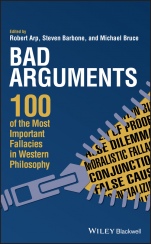
Bad Arguments: 100 of the Most Important Fallacies in Western Philosophy
ISBN 9781119165781
Autor: Robert Arp, Steven Barbone, Michael Bruce
Wydawca: Wiley
Dostępność: 3-6 tygodni
Cena: 401,10 zł
Przed złożeniem zamówienia prosimy o kontakt mailowy celem potwierdzenia ceny.
ISBN13: |
9781119165781 |
ISBN10: |
1119165784 |
Autor: |
Robert Arp, Steven Barbone, Michael Bruce |
Oprawa: |
Hardback |
Rok Wydania: |
2018-09-21 |
Ilość stron: |
456 |
Wymiary: |
230x159 |
Tematy: |
HP |
You ll love this book or you ll hate it. So, you re either with us or against us. And if you re against us then you hate books. No true intellectual would hate this book.
Ever decide to avoid a restaurant because of one bad meal? Choose a product because a celebrity endorsed it? Or ignore what a politician says because she s not a member of your party? For as long as people have been discussing, conversing, persuading, advocating, proselytizing, pontificating, or otherwise stating their case, arguments have been vulnerable to false assumptions and faulty reasoning. Drawing upon a long history of logical falsehoods and philosophical flubs, Bad Arguments demonstrates how misguided arguments come to be and what we can do to detect them in the rhetoric of others and avoid using them ourselves.
Fallacies or conclusions that don t follow from their premises are at the root of most bad arguments, but it can be easy to stumble into a fallacy without realizing it. In this clear and concise guide to good arguments gone bad, Robert Arp, Steven Barbone, and Michael Bruce take readers through 100 of the most infamous fallacies in Western philosophy, identifying the most common missteps, pitfalls, and dead–ends of argumentation. Whether an instance of sunk cost, is ought, affirming the consequent, moving the goal post, begging the question, or the ever–popular slippery slope, each fallacy engages with examples drawn from contemporary politics, economics, media, and popular culture. Further diagrams and tables supplement entries and contextualize common errors in logical reasoning.
At a time in our world when it is crucial to be able to identify and challenge rhetorical half–truths, this bookhelps readers to better understand flawed argumentation and develop logical literacy. Unrivaled in its breadth of coverage and a worthy companion to its sister volume, Just the Arguments (2011), Bad Arguments is an essential tool for undergraduate students and general readers looking to hone their critical thinking and rhetorical skills.
Notes on Contributors xiii
Introduction 1
Part I Formal Fallacies 35
Propositional Logic 37
Affirming a Disjunct 39
Jason Iuliano
Affirming the Consequent 42
Brett Gaul
Denying the Antecedent 46
Brett Gaul
Categorical Logic 49
Exclusive Premises 51
Charlene Elsby
Four Terms 55
Charlene Elsby
Illicit Major and Minor Terms 60
Charlene Elsby
Undistributed Middle 63
Charlene Elsby
Part II Informal Fallacies 67
Fallacies of Relevance 69
Ad Hominem: Bias 71
George Wrisley
Ad Hominem: Circumstantial 77
George Wrisley
Ad Hominem: Direct 83
George Wrisley
Ad Hominem: Tu Quoque 88
George Wrisley
Adverse Consequences 94
David Vander Laan
Appeal to Emotion: Force or Fear 98
George Wrisley
Appeal to Emotion: Pity 102
George Wrisley
Appeal to Ignorance 106
Benjamin W. McCraw
Appeal to the People 112
Benjamin W. McCraw
Appeal to Personal Incredulity 115
Tuomas W. Manninen
Appeal to Ridicule 118
Gregory L. Bock
Appeal to Tradition 121
Nicolas Michaud
Argument from Fallacy 125
Christian Cotton
Availability Error 128
David Kyle Johnson
Base Rate 133
Tuomas W. Manninen
Burden of Proof 137
Andrew Russo
Countless Counterfeits 140
David Kyle Johnson
Diminished Responsibility 145
Tuomas W. Manninen
Essentializing 149
Jack Bowen
Galileo Gambit 152
David Kyle Johnson
Gambler s Fallacy 157
Grant Sterling
Genetic Fallacy 160
Frank Scalambrino
Historian s Fallacy 163
Heather Rivera
Homunculus 165
Kimberly Baltzer ]Jaray
Inappropriate Appeal to Authority 168
Nicolas Michaud
Irrelevant Conclusion 172
Steve Barbone
Kettle Logic 174
Andy Wible
Line Drawing 177
Alexander E. Hooke
Mistaking the Relevance of Proximate Causation 181
David Kyle Johnson
Moving the Goalposts 185
Tuomas W. Manninen
Mystery, Therefore Magic 189
David Kyle Johnson
Naturalistic Fallacy 193
Benjamin W. McCraw
Poisoning the Well 196
Roberto Ruiz
Proving Too Much 201
Kimberly Baltzer ]Jaray
Psychologist s Fallacy 204
Frank Scalambrino
Red Herring 208
Heather Rivera
Reductio ad Hitlerum 212
Frank Scalambrino
Argument by Repetition 215
Leigh Kolb
Special Pleading 219
Dan Yim
Straw Man 223
Scott Aikin and John Casey
Sunk Cost 227
Robert Arp
Two Wrongs Make a Right 230
David LaRocca
Weak Analogy 234
Bertha Alvarez Manninen
Fallacies of Ambiguity 239
Accent 241
Roberto Ruiz
Amphiboly 246
Roberto Ruiz
Composition 250
Jason Waller
Confusing an Explanation for an Excuse 252
Kimberly Baltzer ]Jaray
Definist Fallacy 255
Christian Cotton
Division 259
Jason Waller
Equivocation 261
Bertha Alvarez Manninen
Etymological Fallacy 266
Leigh Kolb
Euphemism 270
Kimberly Baltzer ]Jaray
Hedging 273
Christian Cotton
If by Whiskey 277
Christian Cotton
Inflation of Conflict 280
Andy Wible
Legalistic Mistake 282
Marco Antonio Azevedo
Oversimplification 286
Dan Burkett
Proof by Verbosity 289
Phil Smolenski
Sorites Fallacy 293
Jack Bowen
Fallacies of Presumption 297
Accident 299
Steve Barbone
All or Nothing 301
David Kyle Johnson
Anthropomorphic Bias 305
David Kyle Johnson
Begging the Question 308
Heather Rivera
Chronological Snobbery 311
A.G. Holdier
Complex Question 314
A.G. Holdier
Confirmation Bias 317
David Kyle Johnson
Conjunction 321
Jason Iuliano
Constructive Nature of Perception 324
David Kyle Johnson
Converse Accident 330
Steve Barbone
Existential Fallacy 332
Frank Scalambrino
False Cause: Cum Hoc Ergo Propter Hoc 335
Bertha Alvarez Manninen
False Cause: Ignoring Common Cause 338
Bertha Alvarez Manninen
False Cause: Post Hoc Ergo Propter Hoc 342
Bertha Alvarez Manninen
False Dilemma 346
Jennifer Culver
Free Speech 348
Scott Aikin and John Casey
Guilt by Association 351
Leigh Kolb
Hasty Generalization 354
Michael J. Muniz
Intentional Fallacy 357
Nicolas Michaud
Is/Ought Fallacy 360
Mark T. Nelson
Masked Man 364
Charles Taliaferro and K.M. Villa
Middle Ground 367
Grant Sterling
Mind Projection 369
Charles Taliaferro and K.M. Villa
Moralistic Fallacy 371
Galen Foresman
No True Scotsman 374
Tuomas W. Manninen
Reification 378
Robert Sinclair
Representative Heuristic 382
David Kyle Johnson
Slippery Slope 385
Michael J. Muniz
Stolen Concept 388
Rory E. Kraft, Jr.
Subjective Validation 392
David Kyle Johnson
Subjectivist Fallacy 396
Frank Scalambrino
Suppressed Evidence 399
David Kyle Johnson
Unfalsifiability 403
Jack Bowen
Unwarranted Assumption 407
Kimberly Baltzer ]Jaray
Index
Robert Arp is an instructor of philosophy and a researcher for the US Army. He has published numerous books and articles in philosophy and other areas.
Steven Barbone is Associate Professor of philosophy at San Diego State University. He has published articles and book chapters on Baruch Spinoza.
Michael Bruce works in the software industry in San Francisco. With Steve Barbone, he edited Just the Arguments (Wiley–Blackwell, 2011). An avid researcher in the history of philosophy and psychology, he has been published widely and is an active blogger for Psychology Today.
Koszyk
Książek w koszyku: 0 szt.
Wartość zakupów: 0,00 zł
Informacje


Kontakt
Gambit
Centrum Oprogramowania
i Szkoleń Sp. z o.o.
Al. Pokoju 29b/22-24
31-564 Kraków
Siedziba Księgarni
ul. Kordylewskiego 1
31-542 Kraków
+48 12 410 5991
+48 12 410 5987
+48 12 410 5989
Subskrypcje
Administratorem danych osobowych jest firma Gambit COiS Sp. z o.o. Na podany adres będzie wysyłany wyłącznie biuletyn informacyjny.
Autoryzacja płatności

Informacje na temat autoryzacji płatności poprzez PayU.

© Copyright 2012: GAMBIT COiS Sp. z o.o. Wszelkie prawa zastrzeżone.
Projekt i wykonanie: Alchemia Studio Reklamy