


Wydawcy
Katalog tematyczny
- Archeologia (109)
- Ekonomia, finanse, business (13704)
- Filozofia (1445)
- Historia (3040)
- Języki i językoznawstwo (2356)
- Lifestyle, hobby i rozrywka (475)
- Medycyna (9704)
- Nauki humanistyczne (4)
- Nauki o Ziemi i środowisku (2638)
- Nauki ścisłe (20412)
- Nauki społeczne (8486)
- Nauki techniczne (13450)
- Prawo (1696)
- Publikacje informacyjne i interdyscyplinarne (1288)
- Religia i wierzenia (917)
- Technika komputerowa (4067)
- Zdrowie, relacje międzyludzkie i rozwój osobisty (657)





Informacje szczegółowe o książce
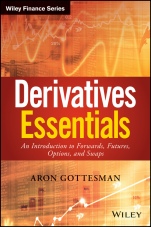
Derivatives Essentials: An Introduction to Forwards, Futures, Options and Swaps
ISBN 9781119163497
Autor: Aron Gottesman
Wydawca: Wiley
Dostępność: 3-6 tygodni
Cena: 354,90 zł
Przed złożeniem zamówienia prosimy o kontakt mailowy celem potwierdzenia ceny.
ISBN13: |
9781119163497 |
ISBN10: |
1119163498 |
Autor: |
Aron Gottesman |
Oprawa: |
Hardback |
Rok Wydania: |
2016-09-02 |
Ilość stron: |
352 |
Wymiary: |
238x163 |
Tematy: |
KFFN |
Praise for Derivatives Essentials
"Derivatives have become critically important hedging and trading vehicles in the Financial Services marketplace, and understanding these complex instruments and markets is thus of paramount importance for industry professionals. Aron′s book provides robust and fulsome coverage of Derivatives. Most importantly, the book provides well balanced viewpoints and insights first, balanced between the academic (′theoretical′) and practitioner (′real–world′) perspectives, and second, balanced between qualitative concepts (the ′why′) and quantitative formulas (the ′numbers′). Possessing such a well–balanced understanding of Derivatives is a critical skill set for industry professionals, and I thus recommend this book."
Robert J. Chersi, retired CFO, Fidelity Investments – Financial Services and UBS Wealth Management
"In the thirty years I′ve worked in risk management on Wall Street, Derivatives Essentials is by far the most comprehensive and understandable book I′ve read about the complex world of derivative products and strategies. Anyone who needs to understand and communicate about topics such as derivative pricing, valuation and risk sensitivities or ′Greeks,′ should have Derivatives Essentials within reach on their book shelf!"
Michael Leibrock, Managing Director – Credit and Systemic Risk, The Depository Trust and Clearing Corporation
"Derivatives Essentials is a comprehensive guide that covers all of the important topics on derivative securities. As an experienced educator, Dr. Gottesman has the ability to simplify many complex concepts for students, but this text also provides experienced practitioners with a deeper understanding of the same concepts as well. This is a must–have text and desk–reference for students and practitioners alike!"
Christopher Lo, Senior Portfolio Manager, Columbia Threadneedle Investments
Preface
Acknowledgements
About the Author
Part One: Introduction to Forwards, Futures, and Options
Chapter 1: Forwards and Futures
Introduction
1.1 Forward contract characteristics
1.2 Long forward payoff
1.3 Long forward P&L
1.4 Short forward payoff
1.6 Short forward P&L
1.7 Long forward P&L diagram
1.8 Short forward P&L diagram
1.9 Forwards are zero–sum games
1.10 Counterparty credit risk
1.11 Futures contracts
Chapter 2: Call Options
Introduction
2.1 Call option characteristics
2.2 Long call payoff
2.3 Long call P&L
2.4 Short call payoff
2.5 Short call P&L
2.6 Long call P&L diagram
2.7 Short call P&L diagram
2.8 Call options are zero–sum games
2.9 Call option moneyness
2.10 Exercising a call option early
2.11 Comparison of call options and forwards/futures
Chapter 3: Put Options
Introduction
3.1 Put option characteristics
3.2 Long put payoff
3.3 Long put P&L
3.4 Short put payoff
3.5 Short put P&L
3.6 Long put P&L diagram
3.7 Short put P&L diagram
3.8 Put options are zero–sum games
3.9 Put option moneyness
3.10 Exercising a put option early
3.11 Comparison of put options, call options and forwards/futures
Part Two: Pricing and Valuation
Chapter 4: Useful Quantitative Concepts
Introduction
4.1 Compounding conventions
4.2 Calculating future value and present value
4.3 Identifying continuously compounded interest rates
4.4 Volatility and historical standard deviation
4.5 Interpretation of standard deviation
4.6 Annualized standard deviation
4.7 The standard normal cumulative distribution function
4.8 The z–score
Chapter 5: Introduction to Pricing and Valuation
Introduction
5.1 The concepts of price and value by a forward contract
5.2 The concepts of price and value by an option
5.3 Comparison of price and value concepts for forwards and options
5.4 Forward value
5.5 Forward price
5.6 Option value: The Black–Scholes model
5.7 Calculating the Black–Scholes model
5.8 Black–Scholes model assumptions
5.9 Implied volatility
Chapter 6: Understanding Pricing and Valuation
Introduction
6.1 Review of payoff, price, and value equations
6.2 Value as the present value of expected payoff
6.3 Risk–neutral valuation
6.4 Probability and expected value concepts
6.5 Understanding the Black–Scholes equation for call value
6.6 Understanding the Black–Scholes equation for put value
6.7 Understanding the equation for forward value
6.8 Understanding the equation for forward price
Chapter 7: The Binomial Option Pricing Model
Introduction
7.1 Modeling discrete points in time
7.2 Introduction to the one–period binomial option pricing model
7.3 Option valuation, one–period binomial option pricing model
7.4 Two–period binomial option pricing model, European–style option
7.5 Two–period binomial model, American–style option
7.6 Multi–period binomial option pricing models
Part Three: The Greeks
Chapter 8: Introduction to the Greeks
Introduction
8.1 Definitions of the Greeks
8.2 Characteristics of the Greeks
8.3 Equations for the Greeks
8.4 Calculating the Greeks
8.5 Interpreting the Greeks
8.6 The accuracy of the Greeks
Chapter 9: Understanding Delta and Gamma
Introduction
9.1 Describing sensitivity using Delta and Gamma
9.2 Understanding Delta
9.3 Delta across the underlying asset price
9.4 Understanding Gamma
9.5 Gamma across the underlying asset price
Chapter 10: Understanding Vega, Rho, and Theta
Introduction
10.1 Describing sensitivity using Vega, Rho, and Theta
10.2 Understanding Vega
10.3 Understanding Rho
10.4 Understanding Theta
Part Four: Trading Strategies
Chapter 11: Price and Volatility Trading Strategies
Introduction
11.1 Price and volatility views
11.2 Relating price and volatility views to Delta and Vega
11.3 Using forwards, calls, and puts to monetize views
11.4 Introduction to straddles
11.5 Delta and Vega characteristics of long and short straddles
11.6 The ATM DNS strike price
11.7 Straddle: numerical example
11.8 P&L diagrams for long and short straddles
11.9 Breakeven points for long and short straddles
11.10 Introduction to strangles
11.11 P&L diagrams for long and short strangles
11.12 Breakeven points for long and short strangles
11.13 Summary of simple price and volatility trading strategies
Chapter 12: Synthetic, Protective, and Yield–Enhancing Trading Strategies
Introduction
12.1 Introduction to put–call parity and synthetic positions
12.2 P&L diagrams of synthetic positions
12.3 Synthetic positions premiums and ATMF
12.4 The Greeks of synthetic positions
12.5 Option arbitrage
12.6 Protective puts
12.7 Covered calls
12.8 Collars
Chapter 13: Spread Trading Strategies
Introduction
13.1 Bull and bear spreads using calls
13.2 Bull and bear spreads using puts
13.3 Risk reversals
13.4 Butterfly spreads
13.5 Condor spreads
Part Five: Swaps
Chapter 14: Interest Rate Swaps
Introduction
14.1 Interest rate swap characteristics
14.2 Interest rate swap cash flows
14.3 Calculating interest rate swap cash flows
14.4 How interest rate swaps can transform cash flows
Chapter 15: Credit Default Swaps, Cross–Currency Swaps, and Other Swaps
Introduction
15.1 Credit default swap characteristics
15.2 Key determinants of the credit default swap spread
15.3 Cross–currency swap characteristics
15.4 Transforming cash flows using a cross–currency swap
15.5 Other swap varieties
Appendix: Solutions to Knowledge Check Questions
Index
ARON GOTTESMAN is professor of finance and the chair of the department of finance and economics at the Lubin School of Business at Pace University. He teaches courses on derivative securities, financial markets, and asset management, and presents corporate workshops on derivative securities to bulge bracket financial institutions.
Koszyk
Książek w koszyku: 0 szt.
Wartość zakupów: 0,00 zł
Informacje


Kontakt
Gambit
Centrum Oprogramowania
i Szkoleń Sp. z o.o.
Al. Pokoju 29b/22-24
31-564 Kraków
Siedziba Księgarni
ul. Kordylewskiego 1
31-542 Kraków
+48 12 410 5991
+48 12 410 5987
+48 12 410 5989
Subskrypcje
Administratorem danych osobowych jest firma Gambit COiS Sp. z o.o. Na podany adres będzie wysyłany wyłącznie biuletyn informacyjny.
Autoryzacja płatności

Informacje na temat autoryzacji płatności poprzez PayU.

© Copyright 2012: GAMBIT COiS Sp. z o.o. Wszelkie prawa zastrzeżone.
Projekt i wykonanie: Alchemia Studio Reklamy