


Wydawcy
Katalog tematyczny
- Archeologia (109)
- Ekonomia, finanse, business (13704)
- Filozofia (1445)
- Historia (3040)
- Języki i językoznawstwo (2356)
- Lifestyle, hobby i rozrywka (475)
- Medycyna (9704)
- Nauki humanistyczne (4)
- Nauki o Ziemi i środowisku (2638)
- Nauki ścisłe (20412)
- Nauki społeczne (8486)
- Nauki techniczne (13450)
- Prawo (1696)
- Publikacje informacyjne i interdyscyplinarne (1288)
- Religia i wierzenia (917)
- Technika komputerowa (4067)
- Zdrowie, relacje międzyludzkie i rozwój osobisty (657)





Informacje szczegółowe o książce
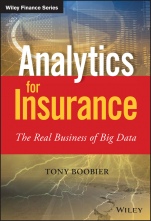
Analytics for Insurance: The Real Business of Big Data
ISBN 9781119141075
Autor: Tony Boobier
Wydawca: Wiley
Dostępność: 3-6 tygodni
Cena: 372,75 zł
Przed złożeniem zamówienia prosimy o kontakt mailowy celem potwierdzenia ceny.
ISBN13: |
9781119141075 |
ISBN10: |
1119141079 |
Autor: |
Tony Boobier |
Oprawa: |
Hardback |
Rok Wydania: |
2016-09-02 |
Ilość stron: |
296 |
Wymiary: |
249x178 |
Tematy: |
KFFK |
Praise for Analytics for Insurance
′Insurance was one of the first industries to use analytics, but now the game has changed. There are new types of analytics, new forms of data, and new business models based on them. Insurers need only read this book if they wish to remain in business.′
Thomas H. Davenport, Distinguished Professor, Babson College; Research Fellow, MIT; Author, Competing on Analytics, Big Data at Work and Only Humans Need Apply
′If you want to understand how analytics is applied in insurance then this is THE book to read. Tony has succeeded in writing not just an authoritative and comprehensive review of the insurance industry and analytics but one that is actually enjoyable to read. He covers a range of topics that extends way beyond the core areas of underwriting, risk modeling and actuarial science, for which the industry is known, but delves into marketing, people and implementation too. This book brings together the author′s extensive knowledge of both insurance and technology and presents it in a form that makes it essential reading for market practitioners and technologists alike.′
Gary Nuttall, Head of Business Intelligence (2012 2016), Chaucer Syndicates
′In this paradigm–shifting book, Tony Boobier provides us with the foundation to explore and rethink the future of the insurance industry. Visions of the future, a review of key processes and implementation concepts all combine to provide the essential guide to help you take your organization into the next decade.′
Robert W Davies, Consultant; Author, The Era of Global Transition; Senior Visiting Fellow, Cass Business School, London
′This book is a valuable read for any professional in the Insurance field who wishes to understand how spatial information and GIS can apply to their field. It introduces the first principals of location theory and goes on to illustrate how they can be applied practically. I would recommend it fully.′
Jack Dangermond, President, Environmental Systems Research Institute (ESRI)
′The number–one ranked finding from all recent buyer and customer research is that sales professionals today must be able to educate their buyers with new ideas and perspectives and have a real in–depth knowledge of their customers′ burning issues. Tony Boobier explains clearly these key issues within insurers today. He goes further by explaining how insurers themselves can take full advantage of the dramatic advances in analytics and the new technologies. For those insurers seeking to optimize their own sales process and sales performance by using the power of analytics to successfully target and capitalize on their customers′ critical issues, this book is required reading. For those sales professionals seeking to successfully sell to the insurance industry, this book really does hit the mark of providing key insights and new perspectives that will enable a deep understanding of the issues affecting the insurance industry today.′
Tom Cairns, Founder and Managing Director, SalesTechnique Limited
′This book is very insightful and shows the author is again thinking ahead of everyone else. Analytics has a major part to play in the supply chain. More information received at FNOL will help provide the right solution to the problem and speed up the process.′
Greg Beech, CEO, Service Solutions Group
′Insurance analytics, the process of sifting the fine grains of probability, is transforming an industry that can no longer thrive on the uneasy marriage between risk and the art of prediction. Anyone navigating this brave new world of known unknowns should read this book. Like insurance itself, it′s a book that should be judged by its cover full and comprehensive.′
Richard Donkin, Author of The History of Work
Preface xi
Acknowledgements xiii
About the Author xv
CHAPTER 1 Introduction The New Real Business 1
1.1 On the Point of Transformation 2
1.1.1 Big Data Defined by Its Characteristics 3
1.1.2 The Hierarchy of Analytics, and how Value is Obtained from Data 6
1.1.3 Next Generation Analytics 7
1.1.4 Between the Data and the Analytics 9
1.2 Big Data and Analytics for All Insurers 10
1.2.1 Three Key Imperatives 10
1.2.2 The Role of Intermediaries 13
1.2.3 Geographical Perspectives 14
1.2.4 Analytics and the Internet of Things 15
1.2.5 Scale Benefit or Size Disadvantage? 15
1.3 How Do Analytics Actually Work? 17
1.3.1 Business Intelligence 18
1.3.2 Predictive Analytics 20
1.3.3 Prescriptive Analytics 22
1.3.4 Cognitive Computing 23
Notes 24
CHAPTER 2 Analytics and the Office of Finance 25
2.1 The Challenges of Finance 26
2.2 Performance Management and Integrated Decision–making 27
2.3 Finance and Insurance 27
2.4 Reporting and Regulatory Disclosure 29
2.5 GAAP and IFRS 29
2.6 Mergers, Acquisitions, and Divestments 30
2.7 Transparency, Misrepresentation, The Securities Act and SOX 31
2.8 Social Media and Financial Analytics 32
2.9 Sales Management and Distribution Channels 33
2.9.1 Agents and Producers 34
2.9.2 Distribution Management 35
Notes 36
CHAPTER 3 Managing Financial Risk across the Insurance Enterprise 37
3.1 Solvency II 37
3.2 Solvency II, Cloud Computing and Shared Services 40
3.3 Sweating the Assets 40
3.4 Solvency II and IFRS 41
3.5 The Changing Role of the CRO 42
3.6 CRO as the Customer Advocate 45
3.7 Analytics and the Challenge of Unpredictability 45
3.8 The Importance of Reinsurance 46
3.9 Risk Adjusted Decision–Making 46
Notes 49
CHAPTER 4 Underwriting 51
4.1 Underwriting and Big Data 52
4.2 Underwriting for Specialist Lines 54
4.3 Telematics and User–Based Insurance as an Underwriting Tool 55
4.4 Underwriting for Fraud Avoidance 56
4.5 Analytics and Building Information Management (BIM) 57
Notes 58
CHAPTER 5 Claims and the Moment of Truth 61
5.1 Indemnity and the Contractual Entitlement 61
5.2 Claims Fraud 62
5.2.1 Opportunistic Fraud 63
5.2.2 Organized Fraud 64
5.3 Property Repairs and Supply Chain Management 66
5.4 Auto Repairs 71
5.5 Transforming the Handling of Complex Domestic Claims 73
5.5.1 The Digital Investigator 73
5.5.2 Potential Changes in the Claims Process 75
5.5.3 Reinvention of the Supplier Ecosystem 76
5.6 Levels of Inspection 77
5.6.1 Reserving 78
5.6.2 Business Interruption 79
5.6.3 Subrogation 80
5.7 Motor Assessing and Loss Adjusting 81
5.7.1 Motor Assessing 82
5.7.2 Loss Adjusting 83
5.7.3 Property Claims Networks 84
5.7.4 Adjustment of Cybersecurity Claims 87
5.7.5 The Demographic Time Bomb in Adjusting 87
Notes 88
CHAPTER 6 Analytics and Marketing 91
6.1 Customer Acquisition and Retention 93
6.2 Social Media Analytics 96
6.3 Demography and How Population Matters 97
6.4 Segmentation 98
6.5 Promotion Strategy 100
6.6 Branding and Pricing 100
6.7 Pricing Optimization 101
6.8 The Impact of Service Delivery on Marketing Success 102
6.9 Agile Development of New Products 103
6.10 The Challenge of Agility 104
6.11 Agile vs Greater Risk? 105
6.12 The Digital Customer, Multi– and Omni–Channel 105
6.13 The Importance of the Claims Service in Marketing 106
Notes 107
CHAPTER 7 Property Insurance 109
7.1 Flood 109
7.1.1 Predicting the Cost and Likelihood of Flood Damage 110
7.1.2 Analytics and the Drying Process 111
7.2 Fire 112
7.2.1 Predicting Fraud in Fire Claims 113
7.3 Subsidence 115
7.3.1 Prediction of Subsidence 116
7.4 Hail 119
7.4.1 Prediction of Hail Storms 120
7.5 Hurricane 121
7.5.1 Prediction of Hurricane Damage 121
7.6 Terrorism 122
7.6.1 Predicting Terrorism Damage 123
7.7 Claims Process and the Digital Customer 124
Notes 125
CHAPTER 8 Liability Insurance and Analytics 127
8.1 Employers Liability and Workers Compensation 127
8.1.1 Fraud in Workers Compensation Claims 128
8.1.2 Employers Liability Cover 130
8.1.3 Effective Triaging of EL Claims 130
8.2 Public Liability 131
8.3 Product Liability 132
8.4 Directors and Officers Liability 133
Notes 134
CHAPTER 9 Life and Pensions 135
9.1 How Life Insurance Differs from General Insurance 136
9.2 Basis of Life Insurance 137
9.3 Issues of Mortality 138
9.4 The Role of Big Data in Mortality Rates 139
9.5 Purchasing Life Insurance in a Volatile Economy 140
9.6 How Life Insurers Can Engage with the Young 141
9.7 Life and Pensions for the Older Demographic 142
9.8 Life and Pension Benefits in the Digital Era 143
9.9 Life Insurance and Bancassurers 145
Notes 147
CHAPTER 10 The Importance of Location 149
10.1 Location Analytics 149
10.1.1 The New Role of the Geo–Location Expert 149
10.1.2 Sharing Location Information 150
10.1.3 Geocoding 150
10.1.4 Location Analytics in Fraud Investigation 151
10.1.5 Location Analytics in Terrorism Risk 152
10.1.6 Location Analytics and Flooding 152
10.1.7 Location Analytics, Cargo and Theft 154
10.2 Telematics and User–Based Insurance ( UBI ) 155
10.2.1 History of Telematics 155
10.2.2 Telematics in Fraud Detection 157
10.2.3 What is the Impact on Motor Insurers? 157
10.2.4 Telematics and Vehicle Dashboard Design 158
10.2.5 Telematics and Regulation 159
10.2.6 Telematics More than Technology 160
10.2.7 User–Based Insurance in Other Areas 161
10.2.8 Telematics in Commercial Insurances 162
Notes 164
CHAPTER 11 Analytics and Insurance People 167
11.1 Talent Management 167
11.1.1 The Need for New Competences 168
11.1.2 Essential Qualities and Capabilities 169
11.2 Talent, Employment and the Future of Insurance 173
11.2.1 Talent Analytics and the Challenge for Human Resources 173
11.3 Learning and Knowledge Transfer 174
11.3.1 Reading Materials 175
11.3.2 Formal Qualifications and Structured Learning 175
11.3.3 Face–to–Face Training 176
11.3.4 Social Media and Technology 177
11.4 Leadership and Insurance Analytics 178
11.4.1 Knowledge and Power 179
11.4.2 Leadership and Influence 179
11.4.3 Analytics and the Impact on Employees 181
11.4.4 Understanding Employee Resistance 182
Notes 184
CHAPTER 12 Implementation 185
12.1 Culture and Organization 188
12.1.1 Communication and Evangelism 192
12.1.2 Stakeholders Vision of the Future 193
12.2 Creating a Strategy 193
12.2.1 Program Sponsorship 194
12.2.2 Building a Project Program 195
12.2.3 Stakeholder Management 197
12.2.4 Recognizing Analytics as a Tool of Empowerment 198
12.2.5 Creation of Open and Trusting Relationships 199
12.2.6 Developing a Roadmap 200
12.2.7 Implementation Flowcharts 202
12.3 Managing the Data 202
12.3.1 Master Data Management 203
12.3.2 Data Governance 203
12.3.3 Data Quality 204
12.3.4 Data Standardization 204
12.3.5 Storing and Managing Data 205
12.3.6 Security 207
12.4 Tooling and Skillsets 207
12.4.1 Certification and Qualifications 208
12.4.2 Competences 208
Notes 209
CHAPTER 13 Visions of the Future? 211
13.1 Auto 2025 211
13.2 The Digital Home in 2025 Property Telematics 214
13.3 Commercial Insurance Analytically Transformed 218
13.4 Specialist Risks and Deeper Insight 220
13.5 2025: Transformation of the Life and Pensions Industry 221
13.6 Outsourcing and the Move Away from Non–Core Activities 223
13.7 The Rise of the Super Supplier 224
Notes 225
CHAPTER 14 Conclusions and Reflections 227
14.1 The Breadth of the Challenge 229
14.2 Final Thoughts 230
Notes 231
APPENDIX A Recommended Reading 233
APPENDIX B Data Summary of Expectancy of Reaching 100 235
APPENDIX C Implementation Flowcharts 239
APPENDIX D Suggested Insurance Websites 265
APPENDIX E Professional Insurance Organizations 267
Index 269
TONY BOOBIER is a worldwide executive at IBM focussing on the insurance industry. With over 30 years of experience, he is a frequent writer and international public speaker. As author of numerous articles on a wide range of topics ranging from claims management to analytical insight, he possesses a deep understanding of the application of business intelligence and analytics in the international insurance industry and holds a successful track record conceiving and introducing changes in the operations and management of national service and delivery organizations.
Koszyk
Książek w koszyku: 0 szt.
Wartość zakupów: 0,00 zł
Informacje


Kontakt
Gambit
Centrum Oprogramowania
i Szkoleń Sp. z o.o.
Al. Pokoju 29b/22-24
31-564 Kraków
Siedziba Księgarni
ul. Kordylewskiego 1
31-542 Kraków
+48 12 410 5991
+48 12 410 5987
+48 12 410 5989
Subskrypcje
Administratorem danych osobowych jest firma Gambit COiS Sp. z o.o. Na podany adres będzie wysyłany wyłącznie biuletyn informacyjny.
Autoryzacja płatności

Informacje na temat autoryzacji płatności poprzez PayU.

© Copyright 2012: GAMBIT COiS Sp. z o.o. Wszelkie prawa zastrzeżone.
Projekt i wykonanie: Alchemia Studio Reklamy