


Wydawcy
Katalog tematyczny
- Archeologia (109)
- Ekonomia, finanse, business (13704)
- Filozofia (1445)
- Historia (3040)
- Języki i językoznawstwo (2356)
- Lifestyle, hobby i rozrywka (475)
- Medycyna (9704)
- Nauki humanistyczne (4)
- Nauki o Ziemi i środowisku (2638)
- Nauki ścisłe (20412)
- Nauki społeczne (8486)
- Nauki techniczne (13450)
- Prawo (1696)
- Publikacje informacyjne i interdyscyplinarne (1288)
- Religia i wierzenia (917)
- Technika komputerowa (4067)
- Zdrowie, relacje międzyludzkie i rozwój osobisty (657)





Informacje szczegółowe o książce
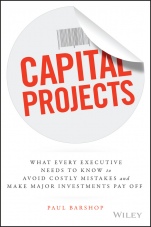
Capital Projects: What Every Executive Needs to Know to Avoid Costly Mistakes and Make Major Investments Pay Off
ISBN 9781119119210
Autor: Paul Barshop
Wydawca: Wiley
Dostępność: 3-6 tygodni
Cena: 211,05 zł
Przed złożeniem zamówienia prosimy o kontakt mailowy celem potwierdzenia ceny.
ISBN13: |
9781119119210 |
ISBN10: |
1119119219 |
Autor: |
Paul Barshop |
Oprawa: |
Hardback |
Rok Wydania: |
2016-10-25 |
Ilość stron: |
224 |
Wymiary: |
233x165 |
Tematy: |
KM |
THE AUTHORITATIVE FRAMEWORK FOR LEADING PROFITABLE CAPITAL PROJECTS
Capital Projects is the A–to–Z guide for directing, supervising, supporting, and ultimately profiting on all types of capital investment projects in any industry.
Senior leadership and project sponsors no longer have to settle for disappointing returns or catastrophic failures. This practical guide from one of the leading minds at Independent Project Analysis, the preeminent consultancy for capital projects excellence, gives you a succinct road map of best practices boiled down from an extensive database of real–world projects. Regardless of the project′s size, objectives, or the industry it operated in, the principles and tools inside this book all produced successfully managed projects that resulted in real bottom–line growth.
If you′ve been burned by poorly operating assets that do not work right, missed market windows due to late projects, or watched as costs ran out of control, this single resource will give you peace of mind by greatly improving the chances of success. It shows you how to take control right away by finding the most value in the capital project, precisely defining the business objectives, and ensuring all potential conflicts between objectives are identified and resolved. Set yourself up for a win by:
Mastering the real–world best practices empirically proven to deliver project success Proactively recruiting and developing the teams who enable you to deliver more value from your projects Avoiding the repeated missteps that cause all types of capital projects to failDecisions are made in the boardroom but action takes place in the field Capital Projects is your go–to guide to taking a project from paper to operational and hitting the best real numbers.
This is IPA′s second Wiley book on capital projects. It follows the widely influential book Industrial Megaprojects: Concepts, Strategies, and Practices for Success by Edward W. Merrow, IPA′s founder, CEO, and President. This book covers all types of capital projects and explains the critical role executives have in making a project a successful business venture and how easily their actions and decisions can lead to a project disaster.
Acknowledgments ix
1 Falling Short of Expectations: How Executives Struggle to Deliver the Value from Their Capital Projects 1
Background and Basis for the Book 5
Capital Projects Create Value 6
Most Projects Create Less Value Than Expected 7
Results Apply to All Types of Projects 7
Sources of Value Erosion Are Not Limited to Cost and Schedule Overruns 8
How to Deliver the Value Promised 10
2 Why the Stage–Gate Process Is the Best Tool Executives Can Use to Get the Most Value from Their Capital Projects 15
A Necessary Process 19
How Does the Process Work? 20
What Is the Role of Executives in the Process? 25
Stage–Gates and Executive Control 29
3 The Project Frame: Understand the Opportunity before Starting a Project 31
Typical Contents of a Project Frame 34
Unlock Value by Finding a Better Option 35
How to Develop a Project Frame 37
Use the Frame for Executive Alignment and Endorsement 45
4 The Critical Project Sponsor Role 51
Who Is the Project Sponsor? 56
Overview of Project Sponsor Role 58
Assign a Project Sponsor as the Initial Business Case Is Developed 59
Requirements for a Strong Project Sponsor 59
Choosing the Right Project Sponsor 69
5 The Single Most Important Thing an Executive Can Do to Make Any Capital Project Succeed: Define Clear Objectives 75
Business Objectives versus Project Objectives 79
Developing Clear Objectives 79
Communicating the Objectives 84
Prioritizing the Objectives 87
6 The Executive s Role in Building and Supporting High–Performing Project Teams 91
Executive Leaders Lead 94
Invest in a Strong Owner Project Team 96
Why You Need a Functionally Integrated Team 97
Help the Project Manager Get the Resources for a Functionally Integrated Team 99
Do Not Outsource the Owner Team Role 100
More Experienced Project Teams Do Better Projects 102
Strategies for Coping with Staffing Shortages 102
Executives Working Together to Support the Project 104
7 Project Definition: The Fundamental Capital Project Concept Every Executive Must Understand 107
Strong Project Definition Preserves Value and Produces Better Assets 112
Executives Control the Quality of Project Definition 115
Understand the Cost of Weak Project Definition 116
Be Careful When Trading Fast Schedule for Strong Project Definition 118
Reduce the Number of Schedule–Driven Projects 122
More Project Definition Is Not Necessarily Better 122
8 It s Going to Cost How Much!?! A Guide to Help Executives Avoid Capital Cost Surprises 125
Key Concepts to Understand about Capital Cost Estimate Accuracy 128
Factor the Cost Estimate Range into Decision Making 129
Improve Project Definition to Narrow the Cost Estimate Range 136
Follow These Rules to Get Contingency Right 140
9 Using a Project Steering Committee to Improve Executive Decision Making 147
How to Build a Strong Steering Committee 150
Who to Include in the Steering Committee 152
Run the Steering Committee Efficiently 154
Make Decisions at the Right Level 155
Do Not Dilute Project Sponsor Accountability 156
10 Risk Management: A Mechanism to Understand Project Risk and Decide What to Do 159
Risk Management: Identify, Analyze, and Manage Individual Risks 164
Practices for Getting the Most from Risk Management 166
Scrutinize Risks to Decide Whether They Are Worth Taking 167
Understand That the Estimate of the Risk Is Probably Too Low 168
Be Careful with Making Late Changes in Response to Business Risk 169
Strong Risk Management Does Not Substitute for Strong Project Definition 171
11 Approve, Recycle, Cancel, or Hold: Making Good Stage–Gate Decisions 173
Capital Investment Decisions Are Made at the Stage–Gates 176
Three Gates Provide Adequate Control 177
The Business Question Asked and Answered at Each Stage–Gate 179
Use Your Early Stage–Gates Better 180
Four Choices for the Stage–Gate Decision 181
Information Used in an Investment Decision 182
Rules for Strong Gates 183
The Slippery Slope of Granting Exceptions to Stage–Gate Deliverables 189
12 Executive Role, Executive Control: 12 Essential Rules 193
Rule 1: Use the Stage–Gate Process 195
Rule 2: Start by Framing the Project 195
Rule 3: Ensure Project Sponsor Involvement 196
Rule 4: Develop Clear Objectives 196
Rule 5: Invest in Owner Teams and Provide the Support They Need 197
Rule 6: Reach a Strong Level of Project Definition 198
Rule 7: Factor the Accuracy of the Capital Cost Estimate into Decision Making 199
Rule 8: Set Contingency in Accordance with Project Risk 199
Rule 9: Build an Effective Steering Committee 200
Rule 10: Use a Robust Risk Management Process 200
Rule 11: Keep the Stage–Gates Strong 200
Rule 12: Be Coachable 201
Glossary 203
Index 207
PAUL BARSHOP, Director, IPA Capital Solutions, provides hands–on support to companies who are seeking to realize more value by enhancing their capital project development and delivery systems. Previously, he served as both IPA′s chief operating officer and director of its Europe, Middle East, and Africa region. He has authored numerous articles for industry trade journals and IPA subscription newsletters.
Koszyk
Książek w koszyku: 0 szt.
Wartość zakupów: 0,00 zł
Informacje


Kontakt
Gambit
Centrum Oprogramowania
i Szkoleń Sp. z o.o.
Al. Pokoju 29b/22-24
31-564 Kraków
Siedziba Księgarni
ul. Kordylewskiego 1
31-542 Kraków
+48 12 410 5991
+48 12 410 5987
+48 12 410 5989
Subskrypcje
Administratorem danych osobowych jest firma Gambit COiS Sp. z o.o. Na podany adres będzie wysyłany wyłącznie biuletyn informacyjny.
Autoryzacja płatności

Informacje na temat autoryzacji płatności poprzez PayU.

© Copyright 2012: GAMBIT COiS Sp. z o.o. Wszelkie prawa zastrzeżone.
Projekt i wykonanie: Alchemia Studio Reklamy