


Wydawcy
Katalog tematyczny
- Archeologia (109)
- Ekonomia, finanse, business (13704)
- Filozofia (1445)
- Historia (3040)
- Języki i językoznawstwo (2356)
- Lifestyle, hobby i rozrywka (475)
- Medycyna (9704)
- Nauki humanistyczne (4)
- Nauki o Ziemi i środowisku (2638)
- Nauki ścisłe (20412)
- Nauki społeczne (8486)
- Nauki techniczne (13450)
- Budownictwo lądowe (1045)
- Chemia przemysłowa (2258)
- Elektronika i telekomunikacja (3287)
- Energetyka (1122)
- Inne nauki stosowane (363)
- Inżynieria biochemiczna (507)
- Inżynieria transportu (232)
- Mechanika i materiały (3316)
- Nauka o środowisku (321)
- Rolnictwo (507)
- Technika, ogólnie (475)
- Prawo (1696)
- Publikacje informacyjne i interdyscyplinarne (1288)
- Religia i wierzenia (917)
- Technika komputerowa (4067)
- Zdrowie, relacje międzyludzkie i rozwój osobisty (657)





Informacje szczegółowe o książce
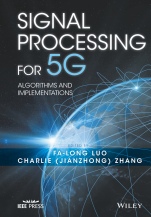
Signal Processing for 5G: Algorithms and Implementations
ISBN 9781119116462
Autor: Fa–Long Luo, Charlie Jianzhong Zhang
Wydawca: Wiley
Dostępność: 3-6 tygodni
Cena: 542,85 zł
Przed złożeniem zamówienia prosimy o kontakt mailowy celem potwierdzenia ceny.
ISBN13: |
9781119116462 |
ISBN10: |
1119116465 |
Autor: |
Fa–Long Luo, Charlie Jianzhong Zhang |
Oprawa: |
Hardback |
Rok Wydania: |
2016-10-14 |
Ilość stron: |
610 |
Wymiary: |
242x182 |
Tematy: |
TJ |
Fa–Long Luo, Ph.D., IEEE Fellow: Element CXI and Anyka, Inc., California, USA
Charlie (Jianzhong) Zhang, Ph.D., IEEE Fellow: Samsung Research America, USA
A comprehensive and invaluable guide to 5G technology, implementation and practice in one single volume. For all things 5G, this book is a must–read.
Signal processing techniques have played the most important role in wireless communications since the second generation of cellular systems. It is anticipated that new techniques employed in 5G wireless networks will not only improve peak service rates significantly, but also enhance capacity, coverage, reliability , low–latency, efficiency, flexibility, compatibility and convergence to meet the increasing demands imposed by applications such as big data, cloud service, machine–to–machine (M2M) and mission–critical communications.
This book is a comprehensive and detailed guide to all signal processing techniques employed in 5G wireless networks. Uniquely organized into four categories, New Modulation and Coding, New Spatial Processing, New Spectrum Opportunities and New System–level Enabling Technologies, it covers everything from network architecture, physical–layer (down–link and up–link), protocols and air interface, to cell acquisition, scheduling and rate adaption, access procedures and relaying to spectrum allocations. All technology aspects and major roadmaps of global 5G standard development and deployments are included in the book.
Key Features:
Preface
Part 1: Modulation, Coding and Waveform for 5G
1. An Introduction to Modulations and Waveforms for 5G Networks
2. Faster than Nyquist Signaling for 5G Communication
3. From OFDM to FBMC: Principles and Comparisons
4. Filter Bank Multicarrier for Massive MIMO
5. Bandwidth Compressed Multicarrier Communication: SEFDM
6. Non–Orthogonal Multi–User Superposition and Shared Access
7. Non–Orthogonal Multiple Access (NOMA): Concept and Design
8. Major 5G Waveform Candidates: Overview and Comparison
Part 2: New Spatial Signal Processing for 5G
9. Massive MIMO for 5G: Theory, Implementation and Prototyping
10. Millimeter–Wave MIMO Transceivers: Theory, Design and Implementation
11. 3D Propagation Channels: Modeling and Measurements
12. 3D–MIMO with Massive Antennas: Theory, Implementation and Testing
13. Orbital Angular Momentum–Based Wireless Communications: Designs and Implementations
Part 3: New Spectrum Opportunities for 5G
14. mmWave for 5G from Theory to Practice
15. 5G Millimeter–Wave Communication Channel and Technology Overview
16. General Principles and Basic Algorithms for Full–Duplex Transmission
17. Design and Implementation of Full–Duplex Transceivers
Part 4: New System–Level Enabling Technologies for 5G
18. Cloud Radio Access Networks: Uplink Channel Estimation and Downlink Precoding
19. Efficient Resource Allocation in 5G with Application to D2D
20. Ultra Dense Network: General Introduction and Design Overview
21. Radio Resources Management and Optimization in 5G Networks
Part 5: Reference Design and 5G Standard Development
22. Full–Duplex Radios in 5G: Fundamental, Design and Prototyping
23. 5G Standard Development: Technology and Roadmap
Koszyk
Książek w koszyku: 0 szt.
Wartość zakupów: 0,00 zł
Informacje


Kontakt
Gambit
Centrum Oprogramowania
i Szkoleń Sp. z o.o.
Al. Pokoju 29b/22-24
31-564 Kraków
Siedziba Księgarni
ul. Kordylewskiego 1
31-542 Kraków
+48 12 410 5991
+48 12 410 5987
+48 12 410 5989
Subskrypcje
Administratorem danych osobowych jest firma Gambit COiS Sp. z o.o. Na podany adres będzie wysyłany wyłącznie biuletyn informacyjny.
Autoryzacja płatności

Informacje na temat autoryzacji płatności poprzez PayU.

© Copyright 2012: GAMBIT COiS Sp. z o.o. Wszelkie prawa zastrzeżone.
Projekt i wykonanie: Alchemia Studio Reklamy