


Wydawcy
Katalog tematyczny
- Archeologia (109)
- Ekonomia, finanse, business (13704)
- Filozofia (1445)
- Historia (3040)
- Języki i językoznawstwo (2356)
- Lifestyle, hobby i rozrywka (475)
- Medycyna (9704)
- Nauki humanistyczne (4)
- Nauki o Ziemi i środowisku (2638)
- Nauki ścisłe (20412)
- Nauki społeczne (8486)
- Nauki techniczne (13450)
- Budownictwo lądowe (1045)
- Chemia przemysłowa (2258)
- Elektronika i telekomunikacja (3287)
- Energetyka (1122)
- Inne nauki stosowane (363)
- Inżynieria biochemiczna (507)
- Inżynieria transportu (232)
- Mechanika i materiały (3316)
- Nauka o środowisku (321)
- Rolnictwo (507)
- Technika, ogólnie (475)
- Prawo (1696)
- Publikacje informacyjne i interdyscyplinarne (1288)
- Religia i wierzenia (917)
- Technika komputerowa (4067)
- Zdrowie, relacje międzyludzkie i rozwój osobisty (657)





Informacje szczegółowe o książce
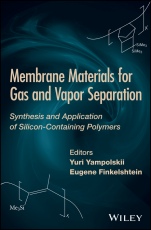
Membrane Materials for Gas and Separation: Synthesis and Application fo Silicon–Containing Polymers
ISBN 9781119112716
Autor: Yuri Yampolskii, E. FInkelshtein
Wydawca: Wiley
Dostępność: 3-6 tygodni
Cena: 757,05 zł
Przed złożeniem zamówienia prosimy o kontakt mailowy celem potwierdzenia ceny.
ISBN13: |
9781119112716 |
ISBN10: |
1119112710 |
Autor: |
Yuri Yampolskii, E. FInkelshtein |
Oprawa: |
Hardback |
Rok Wydania: |
2017-03-03 |
Ilość stron: |
440 |
Wymiary: |
251x177 |
Tematy: |
TDCB |
The key to the successful development of separation membrane materials is finding and elaborating convenient methods for the synthesis of appropriate monomers and the determination of their optimal polymerization conditions, resulting in polymers with good gas transport and film–forming properties. This book discusses the chemistry and synthesis of silicon–containing polymers, and gas permeation and separation properties of the prepared polymers. Topics include
monomer synthesis polymerization processes catalyst selection physicochemical properties parameters of permeability diffusivity sorption thermodynamics computer modeling free volume practical applicationsAimed at researchers and advanced students working in membrane science, organosilicon chemistry, polymer science and physical chemistry as well as those in related areas such as materials science, this volume combines membrane science, organosilicon chemistry, polymer science, materials science and physical chemistry.
1. Permeability of polymers
Yu.Yampolskii
1.1 Introduction
1.2 Detailed mechanism of sorption and transport
1.2.1 Transition state model
1.2.2 Free volume model
1.2.3 Sorption isotherms
1.3 Concentration dependence of coefficients of permeability and diffusion
1.4 Effects of properties of gases and polymers on permeation parameters
References
2. Organosiloxanes (Silicones), Polyorganosiloxane Block Copolymers: Synthesis, Properties, and Gas Permeation Membranes Based On Them
I.Raigorodskii, V.Kopylov, and A.V. Kovyazin
2.1 Introduction
2.2 Synthesis and transformations of organosiloxanes
2.2.1 Polyorganosiloxanes with Aminoalkyl Groups at Silicon
2.2.2 Organosilicon alcohols and phenols
2.3 Synthesis of polyorganosiloxane block copolymers
2.3.1 Polyester(ether)–polyorganosiloxane block copolymers
2.3.2 Synthesis of polyurethane–, polyurea–, polyamide–, polyimide–organosiloxane POBC
2.4 Properties of polyorganosiloxane block copolymers
2.4.1. Phase state of polyblock organosiloxane copolymers
2.5. Morphology of POB and its effects on their diffusion properties
2.6 Some representatives of POBC as membrane materials and their properties
2.6.1 Polycarbonate–polysiloxanes
2.6.2 Polyurethane(urea) polysiloxanes
2.6.3 Polyimide(amide) polysiloxanes
2.7 Conclusions
References
3. Polysilalkylenes
N.V. Ushakov, S.L. Guselnikov, and E.Sh Finkelshtein
4. Polyvinylorganosilanes: the materials for membrane gas separation
N.Ushakov
4.1 Introduction: historical background
4.2 Syntheses and polymerization of vinyltriorganosilanes
4.2.1 Syntheses of vinyltriorganosilanes.
4.2.2. Vinyltriorganosilanes (VTOS) polymerization.
4.2.2.1. VTOS homopolymerizaiton.
4.2.2.2. Statistical copolymerization of VTOS with other monomers
4.2.2.3. Block–copolymerization of VTOS with monomers of other types.
4.3 Properties of polymer materials based on polyvinyltriorganosilanes.
4.4 Concluding remarks
References
5. Substituted Polyacetylenes
T. Sakaguchi, Y. Hu, and T.Masuda
5.1 Introduction
5.2 Poly(1–trimethylsilyl–1–propyne) and related polymers
5.2.1 Synthesis and general properties
5.2.2 Permeation of gases and liquids
5.2.3 Aging effect and cross–linking
5.2.4 Free volume
5.2.5 Nanocomposites and hybrids
5.3 Poly[1–phenyl–2–(p–trimethylsilylphenyl)acetylene] and related polymers
5.3.1 Polymer synthesis
5.3.2 Gas separation
5.4 Desilylated polyacetylenes
5.4.1 Desilylation of poly[1(p–trimethylsilylphenyl)–2–phenylacetylene]
5.4.2 PDPAs from precursor polymers with various silyl groups
5.4.3 Soluble poly(diphenylacetylene)s obtained by desilylation
5.4.4 Poly(diarylacetylene)s
5.5 Polar group–containing polyacetylenes
5.5.1 Hydroxy group
5.5.2 Sulfonated and nitrated poly(diphenylacetylene)s
5.5.3 Other polar groups
5.6 Concluding remarks
References
6. Polynorbornenes
E.Finkelshtein, M.Gringolts, M.Bermeshev, P.Chapala, and Yu. Rogan
6.1. Introduction
6.2. Monomers synthesis
6.3. Metathesis polynorbornenes
6.4. Addition polynorbornenes
6.6. Conclusions
References
7. Polycondensation materials containing bulky side groups: synthesis and transport properties
S.Banerjee and D. Bera,
7.1. Introduction
7.2. Synthesis of the polymers
7.2.1. Polyimides
7.2.1.1. One step polymerization
7.2.1.2. Two step polymerization
7.2.1.2.1. Thermal imidization of poly(amic acid)
7.2.1.2.2. Chemical imidization of poly(amic acid)
7.2.2. Poly(arylene ether)s (PAEs)
7.2.3. Aromatic Polyamides (PAs)
7.2.3.1. Low temperature polymerization
7.2.3.2. High temperature polymerization
7.3.Effect of different bulky groups on polymers gas transport properties
7.3.1. Gas transport properties of the polyimides containing different bulky groups
7.3.2. Gas transport properties of the polyamides containing different bulky groups
7.3.3. Gas transport properties of the poly(arylene ether)s containing different bulky groups
7.3.4. Summary
References
8. Gas and vapor transport properties and free volume of Si–containing and related polymers
Yu.Yampolskii
8.1.Introduction
8.2. Rubbery Si–containing polymers
8.2.1 Polysiloxanes
8.2.2 Siloxane–containing copolymers (block copolymers, random copolymers and graft copolymers)
8.2.3 Polysilmethylenes
8.3. Glassy Si–containing polymers
8.3.1. Polymers with Si–O bonds in side chains
8.3.2 Poly(vinyltrimethyl silane) and related vinylic polymers
8.3.3 Metathesis norbornene polymers
8.3.4 Additive norbornene polymers
8.3.5 Polyacetylenes
8.3.6 Other glassy Si–Containing polymers.
8.4. Free volume in Si–containing polymers
References
9. Modeling of Si–containing polymers
J. R. Fried, T. Dubbs M. Azizi
9.1 Introduction
9.2 Main–Chain Silicon–Containing Polymers
9.2.1 Polysiloxanes
9.2.2 Polysilanes And Silalkylene Polymers
9.3. Side–Chain Silicon–Containing Polymers
9.3.1. Polyvinyltrimethylsilane
9.3.2. Poly[1–(Trimethylsilyl)–1–Propyne]
9.4 Conclusions
Appendices
References
10. Pervaporation and Evapomeation with Si Containing Polymers
T. Uragami
10.1. Introduction
10.2. Structural Design of Si Containing Polymer Membranes
10.2.1 Chemical Design of Si Polymer Membrane Materials
10.2.2 Physical Construction of Si Containing Polymer Membranes
10.3 Pervaporation
10.3.1 Principle of Pervaporation
10.3.2 Fundamentals of Pervaporation
10.3.3 Solution–Diffusion Model in Pervaporation
10.4. Evapomeation
10.4.1 Principle of Evapomeation
10.4.2 Principle of Temperature–Difference Controlled Evapomeation
10.5. Technology of Pervaporation with Si Containing Polymer Membranes
10.5.1 Alcohol Permselective Membranes
10.5.2 Hydrocarbon Permselecive Membranes
10.5.2.1 Aromatic Hydrocarbon Removal
10.5.2.2 Chlorinated Hydrocarbon Removal
10.5.3 Organic Permselecive Membranes
10.5.4 Membranes for Separation of Organic/Organic Mixture
10.5.5 Membranes for Optical Resolution
10.6. Technology of Evapomiation with Si Containing Polymer Membranes
10.6.1 Permeation and Separation by Evapomeation
10.6.2 Concentration of Ethanol by Temperature–Difference Controlled Evapomeation
10.7. Conclusions
References
11. Si–containing polymers in membrane gas separation
Adele Brunetti, Leonardo Melone, Enrico Drioli, and Giuseppe Barbieri
Executive Summary
11.9.1. Introduction
11.9.2. Si–containing polymer membranes used in gas separation
Silicon rubber polymer membranes
Polyacetylene polymer membranes
Polynorbornene polymer membranes
Other polymer membranes
11.9.3. Separations
11.9.4. Membrane Modules
11.9.5. Competing technologies for separation of gases
11.9.6. Applications
Air separation
Hydrogen separation
Hydrocarbons separation
VOCs separation
References
Editors
Yuri Yampolskii
Eugene Finkelshtein
A.V. Topchiev Institute of Petrochemical Synthesis, RAS, Moscow, Russia
Koszyk
Książek w koszyku: 0 szt.
Wartość zakupów: 0,00 zł
Informacje


Kontakt
Gambit
Centrum Oprogramowania
i Szkoleń Sp. z o.o.
Al. Pokoju 29b/22-24
31-564 Kraków
Siedziba Księgarni
ul. Kordylewskiego 1
31-542 Kraków
+48 12 410 5991
+48 12 410 5987
+48 12 410 5989
Subskrypcje
Administratorem danych osobowych jest firma Gambit COiS Sp. z o.o. Na podany adres będzie wysyłany wyłącznie biuletyn informacyjny.
Autoryzacja płatności

Informacje na temat autoryzacji płatności poprzez PayU.

© Copyright 2012: GAMBIT COiS Sp. z o.o. Wszelkie prawa zastrzeżone.
Projekt i wykonanie: Alchemia Studio Reklamy