


Wydawcy
Katalog tematyczny
- Archeologia (109)
- Ekonomia, finanse, business (13704)
- Filozofia (1445)
- Historia (3040)
- Języki i językoznawstwo (2356)
- Lifestyle, hobby i rozrywka (475)
- Medycyna (9704)
- Nauki humanistyczne (4)
- Nauki o Ziemi i środowisku (2638)
- Nauki ścisłe (20412)
- Astronomia (294)
- Biologia (5119)
- Chemia (6540)
- Chemia analityczna (361)
- Chemia fizyczna (346)
- Chemia nieorganiczna (137)
- Chemia organiczna (535)
- Krystalografia (27)
- Minerologia (46)
- Fizyka (3309)
- Matematyka (4574)
- Nauki ścisłe, ogólnie (503)
- Nauki społeczne (8486)
- Nauki techniczne (13450)
- Prawo (1696)
- Publikacje informacyjne i interdyscyplinarne (1288)
- Religia i wierzenia (917)
- Technika komputerowa (4067)
- Zdrowie, relacje międzyludzkie i rozwój osobisty (657)





Informacje szczegółowe o książce
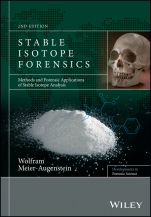
Stable Isotope Forensics: Methods and Forensic Applications of Stable Isotope Analysis
ISBN 9781119080206
Autor: Wolfram Meier–Augenstein
Wydawca: Wiley
Dostępność: 3-6 tygodni
Cena: 718,20 zł
Przed złożeniem zamówienia prosimy o kontakt mailowy celem potwierdzenia ceny.
ISBN13: |
9781119080206 |
ISBN10: |
1119080207 |
Autor: |
Wolfram Meier–Augenstein |
Oprawa: |
Hardback |
Rok Wydania: |
2017-12-01 |
Numer Wydania: |
2nd Edition |
Ilość stron: |
512 |
Wymiary: |
248x172 |
Tematy: |
PN |
The number–one guide, internationally, to all aspects of forensic isotope analysis, thoroughly updated and revised and featuring many new case studies
This edition of the internationally acclaimed guide to forensic stable isotope analysis uses real–world examples to bridge discussions of the basic science, instrumentation and analytical techniques underlying forensic isotope profiling and its various technical applications. Case studies describe an array of applications, many of which were developed by the author himself. They include cases in which isotope profiling was used in murder, and drugs–related crime investigations, as well as for pharmaceutical and food authenticity control studies.
Updated with coverage of exciting advances occurring in the field since the publication of the 1st edition, this 2nd edition explores innovative new techniques and applications in forensic isotope profiling, as well as key findings from original research. More than a simple update, though, this edition has been significantly revised in order to address serious problems that can arise from non–comparable and unfit–for–purpose stable isotope data. To that end, Part II has been virtually rewritten with greater emphasis now being placed on important quality control issues in stable isotope analysis in general and forensic stable isotope analysis in particular.
Written in a highly accessible style that will appeal to practitioners, researchers and students alike Illustrates the many strengths and potential pitfalls of forensic stable isotope analysis Uses recent case examples to bridge underlying principles with technical applications Presents hands–on applications that let experienced researchers and forensic practitioners match problems with success stories Includes new chapters devoted to aspects of quality control and quality assurance, including scale normalisation, the identical treatment principle, hydrogen exchange and accreditationStable Isotope Forensics, 2nd Edition is an important professional resource for forensic scientists, law enforcement officials, public prosecutors, defence attorneys, forensic anthropologists and others for whom isotope profiling has become an indispensable tool of the trade. It is also an excellent introduction to the field for senior undergraduate and graduate forensic science students.
"All students of forensic criminology, and all law enforcement officers responsible for the investigation of serious crime , will want to study this book. Wolfram highlights the value, and future potential, of Stable Isotope Forensics as an emerging powerful tool in the investigation of crime."
Roy McComb, Deputy Director, Specialist Investigations, National Crime Agency (NCA), UK
A single author text in these days is rare and the value of this book lies in the dedication and experience of the author which is evident in the clarity of prose, the honest illustration of evidence and the realistic practical application of the subject – it makes this a text of genuine scientific value.
Prof Dame Sue Black, PhD, DBE, OBE, FRSE, Leverhulme Research Centre for Forensic Science, University of Dundee, UK
Table of Contents
Foreword to 2nd edition by Prof. Dame Sue Black, DBE, OBE, FRSE
Foreword to 2nd edition by Commissioner Mark Harrison, MBE
Foreword to 1st edition by Sean Doyle
Book endorsement
Preface by the author
List of Abbreviations
Introduction: Stable Isotope Profiling or Chemical DNA : A New Dawn for Forensic Chemistry?
Part I: How it works
I.1 What are Stable Isotopes?
I.2 Natural Abundance Variation of Stable Isotopes
I.3 Chemically Identical and Yet Not the Same
I.4 Isotope Effects, Mass Discrimination and Isotopic Fractionation
I.4.1 Physical Chemistry Background
I.4.2 Fractionation Factor Ñ and Enrichment Factor Õ
I.4.3 Isotopic Fractionation in Rayleigh Processes
I.4.4 Isotopic Fractionation Summary
I.5 Stable Isotopic Distribution and Isotopic Fractionation of Light Elements in Nature
I.5.1 Hydrogen
I.5.2 Oxygen
I.5.3 Carbon
I.5.4 Nitrogen
I.5.5 Sulphur
I.5.6 Isoscapes
I.6 Stable Isotope Forensics in Everyday Life
I.6.1 Food Forensics
I.6.1.1 Authenticity and Provenance of Single–Seed Vegetable Oils
I.6.1.2 Authenticity and Provenance of Beverages
I.6.1.3 Caveats
I.6.2 Authenticity and Provenance of other Premium Products
I.6.3 Counterfeit Pharmaceuticals
I.6.4 Environmental Forensics
I.6.5 Wildlife Forensics
I.6.6 Anti–Doping Control
I.7 Summary of Part I
References Part I
Part II: Instrumentation, Analytical Techniques and Data Quality
II.1 Mass Spectrometry versus Isotope Ratio Mass Spectrometry
II.1.1 Stability and Isotopic Linearity
II.2 Instrumentation and Ô Notation
II.2.1 Dual–Inlet Isotope Ratio Mass Spectrometry
II.2.2 Continuous Flow Isotope Ratio Mass Spectrometry
II.2.3 Bulk Material Stable Isotope Analysis
II.2.3.1 13C, 15N and 34S
II.2.3.2 2H and 18O
II.2.4 Compound Specific Stable Isotope Analysis of Volatile Organic Compounds
II.2.4.1 Compound Specific 13C or 15N Analysis by GC/C–IRMS
II.2.4.2 Compound Specific 2H or 18O Analysis by GC/HTC–IRMS
II.2.4.3 Position–Specific Isotope Analysis
II.2.5 Compound Specific 13C Analysis of Polar, Non–Volatile Organic Compounds
II.2.6 Compound Specific Stable Isotope Analysis and Forensic Compound Identification
II.3 Quality Control and Quality Assurance in Continuous Flow Isotope Ratio Mass Spectrometry
II.3.1 Compliance with IUPAC Guidelines is a Prerequisite not a Luxury
II.3.2 The Principle of Identical Treatment
II.3.3 The Importance of Scale Normalisation
II.3.3.1 Scale Normalisation of Measured Ô2H Values to VSMOW
II.3.3.2 Scale Normalisation of Measured Ô13C Values to VPDB
II.3.3.3 Scale Normalisation of Measured Ô18O Values to VSMOW
II.3.3.4 Scale Normalisation of Measured Ô15N Values to AIR
II.3.3.5 Scale Normalisation of Measured Ô34S Values to VCDT
II.4 Points of Note for Stable Isotope Analysis
II.4.1 Preparing for Analysis
II.4.2 Generic Considerations for BSIA
II.4.2.1 Scale Normalisation
II.4.2.2 Keeping Your Powder Dry
II.4.2.3 Isobaric Interference
II.4.2.4 Ionization Quench Effect
II.4.3 Particular Considerations for BSIA
II.4.3.1 Bulk 15N Analysis of Nitrates
II.4.3.2 Bulk 2H Analysis of Nitrogen Rich Compounds
II.4.3.3 Total Ô2H versus True Ô2H Values
II.4.3.4 Compounds with Exchangeable Hydrogen and Implications for 2H Abundance Analysis
II.4.3.4.1 Chemical and Biochemical Considerations – Example: Hair
II.4.3.5 2H Analysis of Human Hair
II.4.3.5.1 Two–point Equilibration with Water
II.4.3.5.2 Two–point End–member Comparative Equilibration
II.4.3.5.3 On–line Two–point End–member Comparative Steam Equilibration
II.4.4 Points of Note for CSIA
II.4.4.1 Scale Normalisation
II.4.4.2 Isotope Effects in GC–IRMS during Sample Injection
II.4.4.3 The Chromatographic Isotope Effect in GC–IRMS
II.4.4.4 Derivatisation of Polar Compounds for GC–IRMS
II.4.4.5 Compound Specific 2H Analysis of N or Cl Rich Compounds
II.5 Statistical Analysis of Stable Isotope Data within a Forensic Context
II.5.1 Chemometric Analysis
II.5.2 Bayesian Analysis
II.6 Quality Control and Quality Assurance in Forensic Stable Isotope Analysis
II.6.1 Accreditation to ISO/IEC 17025:2005
II.6.1.1 Who Assesses the Assessors?
II.6.2 The Forensic Isotope Ratio Mass Spectrometry Network (FIRMS)
II.7 Summary of Part II
Appendix II.A: Guidelines for Setting up a Laboratory for Continuous–Flow IRMS
II.A.1 Pre–Installation Requirements
II.A.2 Laboratory Location
II.A.3 Temperature Control
II.A.4 Power Supply
II.A.5 Gas Supply
II.A.6 Forensic Laboratory Considerations
II.A.7 Finishing Touches
Appendix II.B: Sources of International Reference Materials and Tertiary Standards
Appendix II.C: Sample Preparation Protocols
II.C.1 Derivatisation of Amino Acids for Compound Specific Isotope Analysis by GC–IRMS
II.C.2 Acid Digest of Carbonate from Bio–apatite for 13C and 18O Analysis
II.C.3 Preparing Silver Phosphate from Bio–apatite for 18O Analysis
II.C.4 Two–stage Equilibration Protocol for Determination of non–ex Ô2H Values of Human Hair
Appendix II.D: Internet Sources of Guidance and Policy Documents
References Part II
Part III: Stable Isotope Forensics: Case Studies and Current Research
III.1 Forensic Context
III.1.1 Legal Context
III.2 Distinguishing Drugs
III.2.1 Natural and Semi–synthetic Drugs
III.2.1.1 Marijuana
III.2.1.2 Morphine and Heroin
III.2.1.3 Cocaine
III.2.2 Synthetic Drugs
III.2.2.1 Amphetamine
III.2.2.2 Methamphetamine: Synthesis and Isotopic Signature
III.2.2.2.1 Two Different Synthetic Routes Clandestine Conditions.
III.2.2.3 MDMA: Synthesis and Isotopic Signature
III.2.2.3.1 Three Different Synthetic Routes Controlled Conditions.
III.2.2.3.2 One Synthetic Route Variable Conditions
III.2.3 "Legal Highs" and "Designer Drugs"
III.2.3.1 Mephedrone
III.2.3.2 Piperazines
III.2.4 Excipients
III.2.5 Conclusions
III.3 Elucidating Explosives
III.3.1 Bulk Isotope Analysis of Explosives and Precursors
III.3.1.1 Ammonium Nitrate
III.3.1.2 Hexamine, RDX, C4 and Semtex
III.3.1.3 Isotopic Product/Precursor Relationship
III.3.1.3.1 RDX and HMX
III.3.1.3.2 HMTD and TATP
III.3.1.4 Hydrogen Peroxide
III.3.2 Potential Pitfalls
III.3.3 Conclusions
III.4 Matching Matchsticks
III.4.1 13C–Bulk Isotope Analysis
III.4.2 18O–Bulk Isotope Analysis
III.4.3 2H–Bulk Isotope Analysis
III.4.4 Matching Matches from Fire Scenes
III.4.5 Conclusions
III.5 Provenancing People
III.5.1 Stable Isotope Abundance Variation in Human Tissue
III.5.1.1 Hair and Nails
III.5.1.1.1 Characteristics of Hair
III.5.1.1.2 Characteristics of Nails
III.5.1.1.3 Diagenetic Changes of Keratin
III.5.1.1.4 2H Isotopic Record in Hair and Nails
III.5.1.1.5 18O Isotopic Record in Hair and Nail
III.5.1.1.6 13C Isotopic Record in Hair and Nail
III.5.1.1.7 15N Isotopic Record in Hair and Nail
III.5.1.2 Bone and Teeth
III.5.1.2.1 Chemical Composition of Bone and Teeth
III.5.1.2.2 Static versus Remodelling Tissue Compartments
III.5.1.2.3 Diagenetic Changes of Bone and Teeth Mineral
III.5.1.2.4 Diagenetic Changes of Type I Collagen
III.5.1.2.5 18O Isotopic Record in Carbonate and Phosphate from Bio–apatite
III.5.1.2.6 13C Isotopic Record in Carbonate from Bio–apatite
III.5.1.2.7 Isotopic Record in Type I Collagen
III.5.1.3 Trophic Level Shift Effect on Stable Isotope Abundance Values in Human Tissue
III.5.2 Case Examples
III.5.2.1 The Skull from the Sea
III.5.2.2 A Human Life Recorded in Hair
III.5.2.3 Found in Newfoundland
III.5.2.4 The Case of The Scissor Sisters
III.5.2.5 Too Short a Life
III.5.2.6 "Saltair Sally"
III.5.2.7 A Tale of Two Cultures
III.5.3 Conclusions and Caveats
III.6 Stable Isotope Forensics of other Physical Evidence
III.6.1 Microbial Agents
III.6.2 Toxins and Poisons
III.6.3 Paper, Plastic (Bags) and Parcel Tape
III.6.3.1 Paper
III.6.3.2 Plastic and Plastic Bags
III.6.3.3 Parcel Tape
III.6.4 Conclusions
III.7 Evaluative Interpretation of Forensic Stable Isotope Signatures
III.7.1 Not Scale Referenced Ô–Values
III.7.2 Unresolved Contradictory Data
III.7.2.1 Example: ′Geographic Provenance of a Murder Victim′
III.7.2.2 Example: ′Manslaughter due to Negligence′
III.7.3 Foregone Conclusions
III.7.4 Logical Fallacies
III.7.5 Untested Assumptions
III.7.6 Conclusions
III.8 Summary of Part III
Appendix III: An Abridged List of Forensic Stable Isotope Laboratories world–wide
References Part III
Recommended Reading
Author s Biography
Acknowledgements
Index
Wolfram Meier–Augenstein, PhD is Professor in Stable Isotope Forensics at the Robert Gordon University in Aberdeen, Scotland, UK. He is a registered expert advisor with the National Crime Agency (NCA, UK) and holds a Diplom–Chemiker degree, as well as a Doctorate in Bio–organic Chemistry, both awarded by the University of Heidelberg, Federal Republic of Germany. Dr. Meier–Augenstein has assisted police forces and coroners′ offices around the world in murder enquiries and drug–related related crime investigations.
Koszyk
Książek w koszyku: 0 szt.
Wartość zakupów: 0,00 zł
Informacje


Kontakt
Gambit
Centrum Oprogramowania
i Szkoleń Sp. z o.o.
Al. Pokoju 29b/22-24
31-564 Kraków
Siedziba Księgarni
ul. Kordylewskiego 1
31-542 Kraków
+48 12 410 5991
+48 12 410 5987
+48 12 410 5989
Subskrypcje
Administratorem danych osobowych jest firma Gambit COiS Sp. z o.o. Na podany adres będzie wysyłany wyłącznie biuletyn informacyjny.
Autoryzacja płatności

Informacje na temat autoryzacji płatności poprzez PayU.

© Copyright 2012: GAMBIT COiS Sp. z o.o. Wszelkie prawa zastrzeżone.
Projekt i wykonanie: Alchemia Studio Reklamy