


Wydawcy
Katalog tematyczny
- Archeologia (109)
- Ekonomia, finanse, business (13704)
- Filozofia (1445)
- Historia (3040)
- Języki i językoznawstwo (2356)
- Lifestyle, hobby i rozrywka (475)
- Medycyna (9704)
- Nauki humanistyczne (4)
- Nauki o Ziemi i środowisku (2638)
- Nauki ścisłe (20412)
- Nauki społeczne (8486)
- Edukacja (229)
- Kryminologia, opieka spełeczna (284)
- Obronność (10)
- Polityka (1389)
- Psychologia (777)
- Socjologia (410)
- Społeczeństwo i kultura (187)
- Nauki techniczne (13450)
- Prawo (1696)
- Publikacje informacyjne i interdyscyplinarne (1288)
- Religia i wierzenia (917)
- Technika komputerowa (4067)
- Zdrowie, relacje międzyludzkie i rozwój osobisty (657)





Informacje szczegółowe o książce
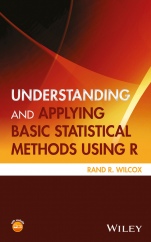
Understanding and Applying Basic Statistical Methods Using R
ISBN 9781119061397
Autor: Rand R. Wilcox
Wydawca: Wiley
Dostępność: 3-6 tygodni
Cena: 394,80 zł
Przed złożeniem zamówienia prosimy o kontakt mailowy celem potwierdzenia ceny.
ISBN13: |
9781119061397 |
ISBN10: |
1119061393 |
Autor: |
Rand R. Wilcox |
Oprawa: |
Hardback |
Rok Wydania: |
2016-07-29 |
Ilość stron: |
504 |
Wymiary: |
234x156 |
Tematy: |
JC |
Features a straightforward and concise resource for introductory statistical concepts, methods, and techniques using R
Understanding and Applying Basic Statistical Methods Using R uniquely bridges the gap between advances in statistical literature and methods routinely used by non–statisticians. Providing a conceptual basis for understanding the relative merits and applications of these methods, the book features modern insights and advances relevant to basic techniques in terms of dealing with non–normality, outliers, heteroscedasticity (unequal variances), and curvature.
Featuring a guide to R, the book uses R programming to explore introductory statistical concepts and standard methods for dealing with known problems associated with classic techniques. Thoroughly class–room tested, the book includes sections that focus on either R programming or computational details to help the reader become acquainted with basic concepts and principles essential in terms of understanding and applying the many methods currently available. Covering relevant material from a wide range of disciplines, Understanding and Applying Basic Statistical Methods Using R also includes:
Numerous illustrations and exercises that use data to demonstrate the practical importance of multiple perspectives Discussions on common mistakes such as eliminating outliers and applying standard methods based on means using the remaining data Detailed coverage on R programming with descriptions on how to apply both classic and more modern methods using R A companion website with the data and solutions to all of the exercisesUnderstanding and Applying Basic Statistical Methods Using R is an ideal textbook for an undergraduate and graduate–level statistics courses in the science and/or social science departments. The book is also relevant reference for professional statisticians and other practitioners looking to better understand modern statistical methods as well as R programming.
Rand R. Wilcox, PhD, is Professor in the Department of Psychology at the University of Southern California, Fellow of the Association for Psychological Science, and an associate editor for four statistics journals. The author of more than 320 articles published in a variety of statistical journals, he is also the author eleven other books on statistics. Dr. Wilcox is creator of WRS (Wilcox Robust Statistics), which is an R package for performing robust statistical methods. His main research interest includes statistical methods, particularly robust methods for comparing groups and studying associations.
List of Symbols xiii
Preface xv
1 Introduction 1
1.1 Samples Versus Populations 3
1.2 Comments on Software 5
1.3 R Basics 7
1.4 R Packages 21
1.5 Access to Data Used in This Book 23
1.6 Accessing More Detailed Answers to the Exercises 23
1.7 Exercises 24
2 Numerical Summaries of Data 27
2.1 Summation Notation 29
2.2 Measures of Location 31
2.3 Quartiles 39
2.4 Measures of Variation 41
2.5 Detecting Outliers 48
2.6 Skipped Measures of Location 52
2.7 Summary 53
2.8 Exercises 54
3 PLOTS PLUS MORE BASICS ON SUMMARIZING DATA 59
3.1 Plotting Relative Frequencies 59
3.2 Histograms and Kernel Density Estimators 63
3.3 Boxplots and Stem–and–Leaf Displays 73
3.4 Summary 76
3.5 Exercises 77
4 PROBABILITY AND RELATED CONCEPTS 81
4.1 The Meaning of Probability 81
4.2 Probability Functions 82
4.3 Expected Values, Population Mean and Variance 84
4.4 Conditional Probability and Independence 87
4.5 The Binomial Probability Function 91
4.6 The Normal Distribution 96
4.7 Non–normality and the Population Variance 108
4.8 Summary 117
4.9 Exercises 118
5 SAMPLING DISTRIBUTIONS 125
5.1 Sampling Distribution of ^p, the Proportion of Successes 126
5.2 Sampling Distribution of the Mean Under Normality 129
5.3 Non–normality and the Sampling Distribution of the Sample Mean 136
5.4 Sampling Distribution of the Median and 20% Trimmed Mean 144
5.5 The Mean Versus the Median and 20% Trimmed Mean 155
5.6 Summary 158
5.7 Exercises 162
6 CONFIDENCE INTERVALS 165
6.1 Confidence Interval for the Mean 166
6.2 Confidence Intervals for the Mean Using s ( Not Known) 172
6.3 A Confidence Interval for the Population Trimmed Mean 176
6.4 Confidence Intervals for the Population Median 178
6.5 The Impact of Non–Normality On Confidence Intervals 182
6.6 Some Basic Bootstrap Methods 192
6.7 Confidence Interval for the Probability of Success 196
6.8 Summary 201
6.9 Exercises 203
7 HYPOTHESIS TESTING 209
7.1 Testing Hypotheses About the Mean, Known 209
7.2 Power and Type II Errors 219
7.3 Testing Hypotheses About the Mean, Not Known 223
7.4 Student′s T and Non–normality 225
7.5 Testing Hypotheses About Medians 229
7.6 Testing Hypotheses Based on a Trimmed Mean 231
8 CORRELATION AND REGRESSION 233
8.1 Regression Basics 233
8.2 Least Squares Regression 238
8.3 Dealing with Outliers 242
8.4 Hypothesis Testing 246
8.5 Correlation 257
8.6 Detecting Outliers When Dealing with Two or More variables 264
8.7 Measures of Association: Dealing with Outliers 266
8.8 Multiple Regression 275
8.9 Dealing with Curvature 280
8.10 Summary 288
8.11 Exercises 290
9 COMPARING TWO INDEPENDENT GROUPS 295
9.1 Comparing Means 296
9.2 Comparing Medians 310
9.3 Comparing Trimmed Means 315
9.4 Tukey′s Three Decision Rule 318
9.5 Comparing Variances 319
9.6 Rank–Based (Nonparametric) Methods 320
9.7 Measuring Effect Size 326
9.8 Plotting Data 331
9.9 Comparing Quantiles 334
9.10 Comparing Two Binomial Distributions 337
9.11 A Method for Discrete or Categorical Data 340
9.12 Comparing Regression Lines 343
9.13 Summary 353
9.14 Exercises 354
10 COMPARING MORE THAN TWO INDEPENDENT GROUPS 359
10.1 The ANOVA F Test 360
10.2 Dealing with Unequal Variances: Welch′s Test 370
10.3 Comparing Groups Based on Medians 372
10.4 Comparing Trimmed Means 374
10.5 Two–Way ANOVA 374
10.6 Rank–Based Methods 384
10.7 R Functions kruskal.test and bdm 387
10.8 Summary 388
10.9 Exercises 389
11 COMPARING DEPENDENT GROUPS 393
11.1 The Paired T Test 394
11.2 Comparing Trimmed Means and Medians 398
11.3 The Sign Test 405
11.4 Wilcoxon Signed Rank Test 407
11.5 Comparing Variances 409
11.6 Dealing With More Than Two Dependent Groups 410
11.7 Between–by–Within Designs 415
11.8 Summary 418
11.9 Exercises 418
12 MULTIPLE COMPARISONS 421
12.1 Classic Methods for Independent Groups 422
12.2 The Tukey{Kramer Method 425
12.3 Scheffé′s Method 428
12.4 Methods that Allow Unequal Population Variances 429
12.5 ANOVA Versus Multiple Comparison Procedures 433
12.6 Comparing Medians 434
12.7 Two–Way ANOVA Designs. 435
12.7.1 R Function mcp2atm 439
12.8 Methods for Dependent Groups 443
12.9 Summary 448
12.10 Exercises 449
13 CATEGORICAL DATA 453
13.1 One–Way Contingency Tables 453
13.2 Two–Way Contingency Tables 459
13.3 Logistic Regression 471
13.4 Summary 478
13.5 Exercises 478
A SOLUTIONS TO SELECTED EXERCISES 481
B TABLES 487
Index 523
Koszyk
Książek w koszyku: 0 szt.
Wartość zakupów: 0,00 zł
Informacje


Kontakt
Gambit
Centrum Oprogramowania
i Szkoleń Sp. z o.o.
Al. Pokoju 29b/22-24
31-564 Kraków
Siedziba Księgarni
ul. Kordylewskiego 1
31-542 Kraków
+48 12 410 5991
+48 12 410 5987
+48 12 410 5989
Subskrypcje
Administratorem danych osobowych jest firma Gambit COiS Sp. z o.o. Na podany adres będzie wysyłany wyłącznie biuletyn informacyjny.
Autoryzacja płatności

Informacje na temat autoryzacji płatności poprzez PayU.

© Copyright 2012: GAMBIT COiS Sp. z o.o. Wszelkie prawa zastrzeżone.
Projekt i wykonanie: Alchemia Studio Reklamy