


Wydawcy
Katalog tematyczny
- Archeologia (109)
- Ekonomia, finanse, business (13704)
- Filozofia (1445)
- Historia (3040)
- Języki i językoznawstwo (2356)
- Lifestyle, hobby i rozrywka (475)
- Medycyna (9704)
- Nauki humanistyczne (4)
- Nauki o Ziemi i środowisku (2638)
- Nauki ścisłe (20412)
- Nauki społeczne (8486)
- Nauki techniczne (13450)
- Budownictwo lądowe (1045)
- Chemia przemysłowa (2258)
- Elektronika i telekomunikacja (3287)
- Energetyka (1122)
- Inne nauki stosowane (363)
- Inżynieria biochemiczna (507)
- Inżynieria transportu (232)
- Mechanika i materiały (3316)
- Nauka o środowisku (321)
- Rolnictwo (507)
- Technika, ogólnie (475)
- Prawo (1696)
- Publikacje informacyjne i interdyscyplinarne (1288)
- Religia i wierzenia (917)
- Technika komputerowa (4067)
- Zdrowie, relacje międzyludzkie i rozwój osobisty (657)





Informacje szczegółowe o książce
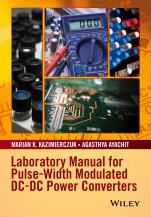
Laboratory Manual for Pulse–Width Modulated DC–DC Power Converters
ISBN 9781119052760
Autor: Marian K. Kazimierczuk, Agasthya Ayachit
Wydawca: Wiley
Dostępność: 3-6 tygodni
Cena: 307,65 zł
Przed złożeniem zamówienia prosimy o kontakt mailowy celem potwierdzenia ceny.
ISBN13: |
9781119052760 |
ISBN10: |
1119052769 |
Autor: |
Marian K. Kazimierczuk, Agasthya Ayachit |
Oprawa: |
Paperback |
Rok Wydania: |
2015-10-16 |
Ilość stron: |
272 |
Wymiary: |
244x170 |
Tematy: |
TJ |
Designed to complement a range of power electronics study resources, this unique lab manual helps students to gain a deep understanding of the operation, modeling, analysis, design, and performance of pulse–width modulated (PWM) DC–DC power converters. Exercises focus on three essential areas of power electronics: open–loop power stages; small–signal modeling, design of feedback loops and PWM DC–DC converter control schemes; and semiconductor devices such as silicon, silicon carbide and gallium nitride. Meeting the standards required by industrial employers, the lab manual combines programming language with a simulation tool designed for proficiency in the theoretical and practical concepts. Students and instructors can choose from an extensive list of topics involving simulations on MATLAB, SABER, or SPICE–based platforms, enabling readers to gain the most out of the prelab, inlab, and postlab activities. The laboratory exercises have been taught and continuously improved for over 25 years by Marian K. Kazimierczuk thanks to constructive student feedback and valuable suggestions on possible workroom improvements. This up–to–date and informative teaching material is now available for the benefit of a wide audience. Key features: Includes complete designs to give students a quick overview of the converters, their characteristics, and fundamental analysis of operation. Compatible with any programming tool (MATLAB, Mathematica, or Maple) and any circuit simulation tool (PSpice, LTSpice, Synopsys SABER, PLECS, etc.). Quick design section enables students and instructors to verify their design methodology for instant simulations. Presents lab exercises based on the most recent advancements in power electronics, including multiple–output power converters, modeling, current– and voltage–mode control schemes, and power semiconductor devices. Provides comprehensive appendices to aid basic understanding of the fundamental circuits, programming and simulation tools. Contains a quick component selection list of power MOSFETs and diodes together with their ratings, important specifications and Spice models.
Preface ix
Acknowledgments xiii
List of Symbols xv
Part I OPEN–LOOP PULSE–WIDTH MODULATED DC DC CONVERTERS STEADY–STATE AND PERFORMANCE ANALYSIS AND SIMULATION OF CONVERTER TOPOLOGIES
1 Boost DC DC Converter in CCM Steady–State Simulation 3
2 Efficiency and DC Voltage Transfer Function of PWM Boost DC DC Converter in CCM 7
3 Boost DC DC Converter in DCM Steady–State Simulation 11
4 Efficiency and DC Voltage Transfer Function of PWM Boost DC DC Converter in DCM 15
5 Open–Loop Boost AC DC Power Factor Corrector Steady–State Simulation 19
6 Buck DC DC Converter in CCM Steady–State Simulation 23
7 Efficiency and DC Voltage Transfer Function of PWM Buck DC DC Converter in CCM 27
8 Buck DC DC Converter in DCM Steady–State Simulation 31
9 Efficiency and DC Voltage Transfer Function of PWM Buck DC DC Converter in DCM 35
10 High–Side Gate–Drive Circuit for Buck DC DC Converter 39
11 Quadratic Buck DC DC Converter in CCM Steady–State Simulation 41
12 Buck Boost DC DC Converter in CCM Steady–State Simulation 45
13 Efficiency and DC Voltage Transfer Function of PWM Buck Boost DC DC Converter in CCM 49
14 Buck Boost DC DC Converter in DCM Steady–State Simulation 53
15 Efficiency and DC Voltage Transfer Function of PWM Buck Boost DC DC Converter in DCM 57
16 Flyback DC DC Converter in CCM Steady–State Simulation 61
17 Efficiency and DC Voltage Transfer Function of PWM Flyback DC DC Converters in CCM 65
18 Multiple–Output Flyback DC DC Converter in CCM 69
19 Flyback DC DC Converter in DCM Steady–State Simulation 73
20 Efficiency and DC Voltage Transfer Function of PWM Flyback DC DC Converter in DCM 77
21 Forward DC DC Converter in CCM Steady–State Simulation 81
22 Efficiency and DC Voltage Transfer Function of PWM Forward DC DC Converter in CCM 85
23 Forward DC DC Converter in DCM Steady–State Simulation 89
24 Efficiency and DC Voltage Transfer Function of PWM Forward DC DC Converter in DCM 93
25 Half–Bridge DC DC Converter in CCM Steady–State Simulation 97
26 Efficiency and DC Voltage Transfer Function of PWM Half–Bridge DC DC Converter in CCM 101
27 Full–Bridge DC DC Converter in CCM Steady–State Simulation 105
28 Efficiency and DC Voltage Transfer Function of PWM Full–Bridge DC DC Converters in CCM 109
Part II CLOSED–LOOP PULSE–WIDTH MODULATED DC DC CONVERTERS TRANSIENT ANALYSIS, SMALL–SIGNAL MODELING, AND CONTROL
29 Design of the Pulse–Width Modulator and the PWM Boost DC DC Converter in CCM 115
30 Dynamic Analysis of the Open–Loop PWM Boost DC DC Converter in CCM for Step Change in the Input Voltage, Load Resistance, and Duty Cycle 119
31 Open–Loop Control–to–Output Voltage Transfer Function of the Boost Converter in CCM 123
32 Root Locus and 3D Plot of the Control–to–Output Voltage Transfer Function 129
33 Open–Loop Input–to–Output Voltage Transfer Function of the Boost Converter in CCM 133
34 Open–Loop Small–Signal Input and Output Impedances of the Boost Converter in CCM 137
35 Feedforward Control of the Boost DC DC Converter in CCM 141
36 P, PI, and PID Controller Design 145
37 P, PI, and PID Controllers: Bode and Transient Analysis 149
38 Transfer Functions of the Pulse–Width Modulator, Boost Converter Power Stage, and Feedback Network 153
39 Closed–Loop Control–to–Output Voltage Transfer Function with Unity–Gain Control 157
40 Simulation of the Closed–Loop Boost Converter with Proportional Control 161
41 Voltage–Mode Control of Boost DC DC Converter with Integral–Double–Lead Controller 165
42 Control–to–Output Voltage Transfer Function of the Open–Loop Buck DC DC Converter 169
43 Voltage–Mode Control of Buck DC DC Converter 173
44 Feedforward Control of the Buck DC DC Converter in CCM 179
Part III SEMICONDUCTOR MATERIALS AND POWER DEVICES
45 Temperature Dependence of Si and SiC Semiconductor Materials 187
46 Dynamic Characteristics of the PN Junction Diode 191
47 Characteristics of the Silicon and Silicon–Carbide PN Junction Diodes 195
48 Analysis of the Output and Switching Characteristics of Power MOSFETs 199
49 Short–Channel Effects in MOSFETs 201
50 Gallium–Nitride Semiconductor: Material Properties 205
APPENDICES 209
A Design Equations for Continuous–Conduction Mode 211
B Design Equations for Discontinuous–Conduction Mode 215
C Simulation Tools 219
D MOSFET Parameters 231
E Diode Parameters 233
F Selected MOSFETs Spice Models 235
G Selected Diodes Spice Models 237
H Physical Constants 239
I Format of Lab Report 241
Index 245
Marian K. Kazimierczuk, Wright State University, Ohio, USA Marian K. Kazimierczuk is a Professor of Electrical Engineering at Wright State University s Department of Electrical Engineering. He has taught graduate courses in high–frequency electronics for 30 years and his research interests include: RF power amplifiers, power electronics, high–frequency magnetics and renewable energy sources. He has published seven books, over 160 journal papers and over 200 conference papers. Marian K. Kazimierczuk also holds seven patents, is an IEEE Fellow and serves as an Associate Editor of the IEEE Transactions on Industrial Electronics, IEEE Transactions on Circuits and Systems and International Journal of Circuit Theory and Applications. Agasthya Ayachit, Wright State University, Ohio, USA Agasthya Ayachit is a Graduate Teaching Assistant in the Department of Electrical Engineering at Wright State University working towards his PhD. In this position he has been teaching the following labs: (1) Power Electronics I (power stages of PWM converters and semiconductor power devices), (2) Power Electronics II (modelling and control of PWM converters), (3) High–Frequency Magnetic Components, and (4) Radio–Frequency Power Amplifiers. He graduated with his Masters degree from Wright State University in 2011 after which he served as a lecturer at Pennsylvania State University for one year where he taught Micro–electronics, power electronics and VLSI courses.
Koszyk
Książek w koszyku: 0 szt.
Wartość zakupów: 0,00 zł
Informacje


Kontakt
Gambit
Centrum Oprogramowania
i Szkoleń Sp. z o.o.
Al. Pokoju 29b/22-24
31-564 Kraków
Siedziba Księgarni
ul. Kordylewskiego 1
31-542 Kraków
+48 12 410 5991
+48 12 410 5987
+48 12 410 5989
Subskrypcje
Administratorem danych osobowych jest firma Gambit COiS Sp. z o.o. Na podany adres będzie wysyłany wyłącznie biuletyn informacyjny.
Autoryzacja płatności

Informacje na temat autoryzacji płatności poprzez PayU.

© Copyright 2012: GAMBIT COiS Sp. z o.o. Wszelkie prawa zastrzeżone.
Projekt i wykonanie: Alchemia Studio Reklamy