


Wydawcy
Katalog tematyczny
- Archeologia (1)
- Ekonomia, finanse, business (698)
- Filozofia (20)
- Historia (57)
- Języki i językoznawstwo (4)
- Lifestyle, hobby i rozrywka (32)
- Medycyna (1025)
- Nauki humanistyczne (2)
- Nauki o Ziemi i środowisku (430)
- Nauki ścisłe (1681)
- Nauki społeczne (1297)
- Nauki techniczne (530)
- Prawo (1437)
- Publikacje informacyjne i interdyscyplinarne (32)
- Religia i wierzenia (15)
- Technika komputerowa (237)
- Zdrowie, relacje międzyludzkie i rozwój osobisty (4)





Informacje szczegółowe o książce
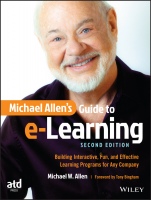
Michael Allens Guide to e–Learning: Building Interactive, Fun, and Effective Learning Programs for Any Company
ISBN 9781119046325
Autor: Michael W. Allen, Tony Bingham
Wydawca: Wiley
Dostępność: 3-6 tygodni
Cena: 211,05 zł
Przed złożeniem zamówienia prosimy o kontakt mailowy celem potwierdzenia ceny.
ISBN13: |
9781119046325 |
ISBN10: |
1119046327 |
Autor: |
Michael W. Allen, Tony Bingham |
Oprawa: |
Paperback |
Rok Wydania: |
2016-11-11 |
Numer Wydania: |
2nd Edition |
Ilość stron: |
432 |
Wymiary: |
232x181 |
Tematy: |
KM |
Explore effective learning programs with the father of e–Learning
The Second Edition of Michael Allen′s Guide to e–Learning is filled with the best practices for trainers and facilitators who want to build interactive, fun, and effective online learning programs. Revised and updated, this edition offers vital information on the recent changes in technology and includes the methods and tools that can help implement winning strategies and techniques. Written in the author′s engaging style, the text reveals what makes great e–learning, with special emphasis given to motivation and interactivity. No matter if you are studying for the ATD e–Learning Instructional Design Certificate Program or simply want to supercharge your e–learning, Michael Allen′s Guide to e–Learning is the essential resource.
"Michael Allen nails it. This rework of classic is itself, an instant classic. If you want a book that will make you a better designer of instruction there is no other book."
Dr. Karl M. Kapp, professor of Instructional Technology, Bloomsburg University; author of The Gamification of Learning and Instruction
"Over a decade after the first edition, Michael Allen does it again with his second edition bringing practical, research–inspired wisdom to e–learning design. I can dive in anywhere in the book and find nugget after nugget of inspired practical insights."
Will Thalheimer, PhD, President of Work–Learning Research, Inc
"His ′Seven Magic Keys to Motivational e–Learning′ are worth the price of the book alone! This book is sure to be your go–to guide for everything ′e.′"
Elaine Biech, author Training and Development for Dummies and 101 Ways to Make Learning Active Beyond the Classroom; editor, ATD Handbook
"Michael′s Guide to e–Learning is a very pragmatic approach that provides a simple way to design instruction that is meaningful, memorable, and motivational, while painlessly implementing the best that research has to say about effective, efficient, and engaging instruction."
M. David Merrill, Emeritus Professor Utah State University; author, First Principles of Instruction
Part 1: The Business Perspective
Chapter 1 What s New?
What s new our field? What s new in this 2nd edition of the Guide?
Nothing!
Everything Has Changed
Can This Book Make Sense of It All?
Chapter 2 P L A I N TALK
Success is getting people to do the right thing at the right time.
The e–Learning Dream
Rationale for Reduced Quality
This Just In: Effective e–Learning Is Practical
Want Proof?
Chapter 3 What You Don t Know Can Kill Your e–Learning
To–Do List Projects
Unplanned On–the–Job Training: A Toxic Elixir for Poor Training
Stop Twisting My Arm. Show Me An Example
The Takeaways
Chapter 4 7 Simple Success Strategies
As Simple as Possible
Chapter 5 Executive s Guide to Good e–Learning
Differentiating the Good and the Bad
Design vs. Technology
Three Priorities for Training Success
Chapter 6 Where Does e–Learning Fit?
The Takeaways
Part 2: Great e–Learning Design
Chapter 7 Seven Simple Success Strategies
As Simple as Possible
The Takeaways
Chapter 8 The Serious e–Learning Manifesto
Quality Obligations
Page Turners
Basic Principles
Design Values
The Principles
A Goal to Strive For
Chapter 9 7 Magic Keys to Learner Motivation (Part 1)
The e–Learning Equation
E–Learning Design Can Heighten as Well as Stifle Motivation
Seven Magic Keys to Motivating e–Learning
Magic Key 1: Build on Anticipated Outcomes
Magic Key 2: Put the Learner at Risk
Magic Key 3: Select the Right Content for Each Learner
Examples
Nav Imperative 1: Let Learners See What s Here
Nav Imperative 2: Let Learners See How the Content Is Organized
Nav Imperative 3: Let Learners See Where They Are
Nav Imperative 4: Let Learners Go Forward
Nav Imperative 5: Let Learners Back Up
Nav Imperative 6: Let Learners Correct Their Errors
Navigational Metaphors
The Takeaways
Chapter 10 Navigation
Victim or Master?
Navigation Services
Reusable Navigation
Navigation Imperatives
Is It Bigger than a Breadbox?
Nav Imperative 2: Let Learners See How the Content Is Organized
Nav Imperative 3: Let Learners See Where They Are
Nav Imperative 4: Let Learners Go Forward
Nav Imperative 5: Let Learners Back Up
Nav Imperative 6: Let Learners Correct Their Errors
The Imperatives
Chapter 11 CCAF and Interactive Instruction
Supernatural Powers
Instructional Interactivity Defined
Analysis of Example 1
Training Challenge
TARGET AUDIENCE
Anatomy of Good Interactions
The Elusive Essence of Good Interactivity
Interactivity s Mistaken Identities
Hybrid Applications: Using an EPSS for Instruction
The Takeaways
Chapter 12 Interactivity Paradigms That Work
Trapdoor Hints
Reusability
The Takeaways
Chapter 13 Successive Approximation and SAM
A Multifaceted Challenge
Successive Approximation Model (SAM)
Simple SAM Goes Commercial
Three–Phase SAM (Big SAM)
The Takeaways
Part 3: Serious Learning Games (SLG)
Chapter 14 Serious Learning Games: Where Rules Rule
Let s play! (And see what we can learn!)
It s Not Rocket Science
My Stance
Making e–Learning Worse
The Essence of Serious Learning Games (SLGs)
The Fundamentals
Making a Serious Learning Game
The Take Aways
Chapter 15 Instructional Content and Integrating Games
Learning in Games of Chance
Learning in Memory Games
Strategic vs. Non–strategic Games
Learning in Strategic Games
CCAF in Games
Maximized Integration of Content
Level–ups
Fun in Learning
Keeping the Fun: Keep Quiet and Reward Strategic Play
Building Serious Learning Games
The Takeaways
Chapter 16 Learning Games, Serious or Not?
Selecting the Best Framework
Intrinsic Learning Games
Gamification
Instructional Thinking
Theoretical Frameworks
Merrill s Classification
Bloom s Taxonomy
The Pure Performance Alternative
Keller s ARCS
Gagne s Taxonomy of Learning Outcomes
Intrigue
The Takeaways
About the Author
References
Endnotes
MICHAEL W. ALLEN is a recognized pioneer and leader in the design of interactive multimedia learning tools and applications. He is the founder and former chairman of Authorware, Inc. He is Chairman and CEO of Allen Interactions Inc., which builds interactive learning systems, develops custom courseware, and provides multimedia consulting and training.
Koszyk
Książek w koszyku: 0 szt.
Wartość zakupów: 0,00 zł
Informacje


Kontakt
Gambit
Centrum Oprogramowania
i Szkoleń Sp. z o.o.
Al. Pokoju 29b/22-24
31-564 Kraków
Siedziba Księgarni
ul. Kordylewskiego 1
31-542 Kraków
+48 12 410 5991
+48 12 410 5987
+48 12 410 5989
Subskrypcje
Administratorem danych osobowych jest firma Gambit COiS Sp. z o.o. Na podany adres będzie wysyłany wyłącznie biuletyn informacyjny.
Autoryzacja płatności

Informacje na temat autoryzacji płatności poprzez PayU.

© Copyright 2012: GAMBIT COiS Sp. z o.o. Wszelkie prawa zastrzeżone.
Projekt i wykonanie: Alchemia Studio Reklamy