


Wydawcy
Katalog tematyczny
- Archeologia (109)
- Ekonomia, finanse, business (13704)
- Filozofia (1445)
- Historia (3040)
- Języki i językoznawstwo (2356)
- Lifestyle, hobby i rozrywka (475)
- Medycyna (9704)
- Chirurgia (272)
- Inne gałęzie medycyny (1871)
- Medycyna kliniczna (4187)
- Choroby wewnętrzne (514)
- Dermatologia (51)
- Diagnostyka medyczna (3)
- Endokrynologia (144)
- Gastroenterologia (27)
- Geriatria (50)
- Ginekologia i położnictwo (134)
- Hematologia (46)
- Hepatologia (10)
- Kardiologia (71)
- Laryngologia (12)
- Nefrologia (10)
- Neurologia (500)
- Oftalmologia (50)
- Pediatria (33)
- Pulmunologia (32)
- Reumatologia (14)
- Terapia genowa (1)
- Układ mięśniowo-szkieletowy (1)
- Urologia (14)
- Medycyna niekonwencjonalna (14)
- Medycyna przedkliniczna (269)
- Medycyna, ogólnie (1740)
- Medyczne służby pomocnicze (745)
- Studia medyczne (16)
- Weterynaria (548)
- Nauki humanistyczne (4)
- Nauki o Ziemi i środowisku (2638)
- Nauki ścisłe (20412)
- Nauki społeczne (8486)
- Nauki techniczne (13450)
- Prawo (1696)
- Publikacje informacyjne i interdyscyplinarne (1288)
- Religia i wierzenia (917)
- Technika komputerowa (4067)
- Zdrowie, relacje międzyludzkie i rozwój osobisty (657)





Informacje szczegółowe o książce
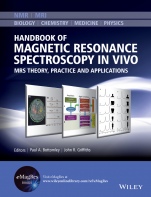
Handbook of Magnetic Resonance Spectroscopy In Vivo: MRS Theory, Practice and Applications
ISBN 9781118997666
Autor: Paul A. Bottomley, John R. Griffiths
Wydawca: Wiley
Dostępność: 3-6 tygodni
Cena: 956,55 zł
Przed złożeniem zamówienia prosimy o kontakt mailowy celem potwierdzenia ceny.
ISBN13: |
9781118997666 |
ISBN10: |
1118997662 |
Autor: |
Paul A. Bottomley, John R. Griffiths |
Oprawa: |
Hardback |
Rok Wydania: |
2016-12-09 |
Ilość stron: |
1232 |
Wymiary: |
252x192 |
Tematy: |
MJ |
HANDBOOK OF MAGNETIC RESONANCE SPECTROSCOPY IN VIVO: MRS THEORY, PRACTICE AND APPLICATIONS
Editors
Paul A. Bottomley, Division of Magnetic Resonance Research, Johns Hopkins University, USA
John R. Griffiths, Cancer Research UK, Cambridge Research Institute, UK
In vivo magnetic resonance spectroscopy (MRS) has generated a vast cloud of scientific papers spanning numerous topics in a large diversity of journals, ranging from the physical sciences to the clinical –ology literature. In addition, there is a vast amount of accumulated but unpublished inside knowledge on what makes a successful in vivo MRS study that is known only to its present and past practitioners. The goal of this comprehensive text, written by an outstanding group of world experts on MRS in vivo, is to steer a pathway through all of the technologies needed to perform MRS in vivo today and tomorrow, showing how to apply in vivo MRS today, what can and might be done with it, why it is useful, and how the results might be interpreted.
The book begins with a first half on methodology that spans the basics of NMR, localization methods and MRS parametric measurements. The reader will find numerous spatial localization and signal processing techniques as well as methods for measuring metabolite diffusion, pH, chemical reaction rates and chemical exchange magnetization transfer, metabolite and fat concentrations, spin coupling, and multiple quantum transitions among non–proton (1H) nuclei. There are how to chapters on performing MRS on non–1H nuclei in vivo, and the latest methods for studying hyperpolarizing nuclei and the sequences needed to realize the enormous sensitivity gains now available therefrom.
The second half of the book is comprised of applications to healthy and diseased tissues, from animal models to humans, which cover the entire body from head to limb. It starts with cells and tissue extracts, then studies of animals and organs for transplantation. This is followed by a series of critical reviews of the state–of–the–art of clinical and research applications of MRS in obesity, diabetes, heart, brain disorders and cancer. There are two reviews on the current state of clinical trials that employ MRS. The book ends with comprehensive appendices that include tabulations of tissue concentrations of NMR nuclei, common metabolites, spectral assignments, frequently–used equations, typical spectra, and common artefacts appearing in MRS in vivo, which should be of practical value.
The audience for this reference book is multi–faceted, ranging from researchers involved in MRS methodology and its applications, to clinicians and biomedical scientists wishing to comprehend the types of clinical information that MRS can deliver, and how MRS can augment our understanding of healthy and disease states. Undergraduate and postgraduate students, clinical radiological technicians and MRI scanner operators who are learning about MRS or training in magnetic resonance in medicine, as well as those just wishing to update their knowledge of current MRS methods, will find the book a useful compendium of the current state of the art of the field.
About eMagRes Handbooks [boxed copy]
eMagRes publishes a wide range of online articles on all aspects of magnetic resonance in physics, chemistry, biology and medicine. The existence of this large number of articles, written by experts in various fields, is enabling the publication of a series of eMagRes Handbooks on specific areas of NMR and MRI. The chapters of each of these handbooks will comprise a carefully chosen selection of eMagRes articles. In consultation with the eMagRes Editorial Board, the eMagRes Handbooks are coherently planned in advance by specially–selected Editors, and new articles are written to give appropriate complete coverage. The handbooks are intended to be of value and interest to research students, postdoctoral fellows and other researchers learning about the scientific area in question and undertaking relevant experiments, whether in academia or industry.
Have the content of this Handbook and the complete content of eMagRes at your fingertips! Visit: www.wileyonlinelibrary.com/ref/eMagRes
[E–book logo] Also available as an e–book
1 Basics of NMR
2 Magnetic Resonance Spectroscopy Instrumentation
3 Detection coils for MRS
4 A Practical Guide to in–vivo MRS
5 Adiabatic Excitation Pulses for MRS
6 Localized MRS employing radiofrequency field (B1) gradients
7 Single Voxel MRS
8 Chemical shift imaging with phase– and sensitivity–encoding
9 Spatial Encoding and Decoding with Prior Knowledge from MRI and Spatio–Spectral Correlation
10 Accurate Localized Spectroscopy from Anatomically Matched Regions with Optimal Spatial Response Function
11 Accelerated Spatially–Encoded MRS of Arbitrarily–Shaped Compartments Using Linear Algebraic Modeling
12 High–Speed Spatial–Spectral Encoding with Echo–Planar and Spiral Spectroscopic Imaging
13 Direct Water––Fat Imaging Methods: Chemical Shift–Selective and Chemical Shift–Encoded MRI
14 Physiological maintenance in animal experiments
15 Physiological maintenance in MRI and MRS of large animals
16 Physiological Monitoring in human MRS
17 Physiologic Motion: Dealing with Cardiac, Respiratory and Other Sporadic Motion in MRS
18 Quantifying Spectra in the Frequency Domain
19 Quantifying Spectra in the Time Domain
20 Advanced spectral quantification: parameter handling, non–parametric pattern modeling and multi–dimensional fitting
21 1H–NMR Chemical Shifts and Coupling Constants for Brain Metabolites
22 Pattern Recognition Analysis of MR Spectra
23 Quantifying Metabolite Ratios and Concentrations by 1H MRS
24 Quantifying Metabolite Ratios and Concentrations by Non–1H MRS
25 Measuring intra– and extra–cellular pH by MRS
26 Temperature Monitoring Using Chemical Shift
27 Diffusion–Weighted MRS
28 Measuring biochemical reaction rates in vivo with magnetization transfer
29 Proton Chemical Exchange Saturation Transfer MRS and MRI
30 Two–Dimensional NMR Spectroscopy Plus Spatial Encoding
31 Spectral editing
32 Multiple quantum MRS
33 Hyperpolarization Methods for MRS
34 Pulse sequences for hyperpolarized MRS
35 MRS of Perfused Cells, Tissues and Organs
36 Metabolism and Metabolomics by MRS
37 In Vivo 19F MRS
38 13C MRS in Human Tissue
39 Hyperpolarized 13C MRI and MRS Studies
40 Integrating 13C Isotopomer Methods with Hyperpolarization for a Comprehensive Picture of Metabolism
41 Muscle studies by 1H MRS
42 Muscle Studies by 31P MRS
43 Measuring Intracellular Oxygenation with Myoglobin 1H MRS
44 Body Fat MRS
45 In Vivo MRS of Lipids in Adipose Tissue, Bone Marrow, and Liver
46 Assessing Fatty Liver with MRS
47 MRS Studies of Muscle and Heart in Obesity and Diabetes
48 Studying Cardiac Lipids in Obese and Diabetic patients by 1H MRS
49 Cardiac MRS Studies in Rodents and Other Animals
50 Assessing Cardiac Transplant Viability with MRS
51 MRS in the Failing Heart: from Mice to Humans
52 MRS studies of Creatine Kinase metabolism in human heart
53 Studying Aging, Dementia, Trauma, Infection, and Developmental Disorders of the Brain with 1H MRS
54 Studying Stroke and Cerebral Ischemia by 1H MRS
55 31P MRS in Psychiatric Disorders
56 The significance of N–Acetyl Aspartate in Human Brain MRS
57 MRS in Brain Cancer
58 MRS in Breast Cancer
59 MRS in Prostate Cancer
60 Clinical Trials of MRS Methods
61 Clinical Trials that Utilize MRS as a Biomarker
62 Properties of NMR–visible isotopes and their biological content in human tissue
63 Concentration ranges of common metabolites detected by MRS in healthy human tissue
64 Peak Assignments for Some Common Metabolites
65 Biochemical reactions and molecular structures of common MRS metabolites
66 Some standard formulae used in MRS
67 Common MRS Artefacts
68 In Vivo Spectra with Peak Assignments
Koszyk
Książek w koszyku: 0 szt.
Wartość zakupów: 0,00 zł
Informacje


Kontakt
Gambit
Centrum Oprogramowania
i Szkoleń Sp. z o.o.
Al. Pokoju 29b/22-24
31-564 Kraków
Siedziba Księgarni
ul. Kordylewskiego 1
31-542 Kraków
+48 12 410 5991
+48 12 410 5987
+48 12 410 5989
Subskrypcje
Administratorem danych osobowych jest firma Gambit COiS Sp. z o.o. Na podany adres będzie wysyłany wyłącznie biuletyn informacyjny.
Autoryzacja płatności

Informacje na temat autoryzacji płatności poprzez PayU.

© Copyright 2012: GAMBIT COiS Sp. z o.o. Wszelkie prawa zastrzeżone.
Projekt i wykonanie: Alchemia Studio Reklamy