


Wydawcy
Katalog tematyczny
- Archeologia (109)
- Ekonomia, finanse, business (13704)
- Filozofia (1445)
- Historia (3040)
- Języki i językoznawstwo (2356)
- Lifestyle, hobby i rozrywka (475)
- Medycyna (9704)
- Nauki humanistyczne (4)
- Nauki o Ziemi i środowisku (2638)
- Nauki ścisłe (20412)
- Nauki społeczne (8486)
- Nauki techniczne (13450)
- Prawo (1696)
- Publikacje informacyjne i interdyscyplinarne (1288)
- Religia i wierzenia (917)
- Technika komputerowa (4067)
- Zdrowie, relacje międzyludzkie i rozwój osobisty (657)





Informacje szczegółowe o książce
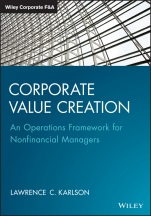
Corporate Value Creation: An Operations Framework for Nonfinancial Managers
ISBN 9781118997529
Autor: Lawrence C. Karlson
Wydawca: Wiley
Dostępność: 3-6 tygodni
Cena: 248,85 zł
Przed złożeniem zamówienia prosimy o kontakt mailowy celem potwierdzenia ceny.
ISBN13: |
9781118997529 |
ISBN10: |
1118997522 |
Autor: |
Lawrence C. Karlson |
Oprawa: |
Hardback |
Rok Wydania: |
2015-07-28 |
Ilość stron: |
656 |
Wymiary: |
260x187 |
Tematy: |
KF |
An Essential and Accessible Guide to Value Creation through Sound Business Management
Corporate Value Creation offers business leaders and managers no matter what their expertise in financial matters a guide and proven framework to help optimize decision making, grow revenue, and increase profitability. Step by step, Lawrence C. Karlson offers a clear understanding of the qualitative and quantitative aspects of managing a business.
This invaluable resource is filled with detailed information on financial statements, valuation, modeling and forecasting, and other aspects of essential business activities. The author includes a discussion of the best practices management needs to adopt if they are to successfully improve bottom–line productivity. Filled with illustrative examples, and comprehensive in scope, the book explores the basics of income statements, balance sheets, and cash flow statements. Then, using critical concepts like Weighted Average Cost of Capital, Karlson outlines the strategies and best practices for managing Return on Capital Employed. He also includes detailed discussions of pricing–driven models and defines the characteristics and attributes of several value–added models.
Corporate Value Creation brings together the concepts associated with understanding financial statements and shows how management′s day–to–day operational approaches (including financial and investment strategies) can influence value creation. Karlson reveals how all of this can be used to build or modify a successful business plan.
To reinforce the information presented, Corporate Value Creation includes a case study at the end of each chapter. A set of exercises with solutions for each chapter is also available to enable the reader to systematically review the material.
Preface xiii
Acknowledgments xvii
Foreword xix
Chapter 1: Basic Concepts 1
Introduction 2
Financial Statements 2
The Income Statement 3
The Balance Sheet 10
The Cash Flow Statement 18
Required Revenue for a Given Level of Net Income 24
Case Study: Advanced Solar Systems Corporation 27
Chapter 2: The Envelope Equations 35
Introduction 36
ROCE and NiROCE 36
Net Investments 39
Investment Rate 42
Incorporating the IR and NiROCE into the Expression for Net Income 43
Incorporating IR into the Expression for Cash Flow after Investing Activities 45
NI and CFaIA A Sequential Year–by–Year Analysis 46
NI and CFaIA The General Model 49
Estimating Growth Rates of Cash Flow after Investing Activities and Net Income 52
Growth Rate of CFaIAg with Constant IR and NiROCE 52
Growth Rate of Net Income (NIg) 54
Net Income Growth Rate (NIg) with Constant IR and NiROCE 54
Envelope Equations Methodology for Estimating Net Income, Cash Flow after Investing Activities, and Growth Rates 56
Required Revenue Revisited 66
Growing the Net Income 71
Case Study: American Technology Corporation 71
Chapter 3: The Weighted Average Cost of Capital 81
Why Is a Company s Weighted Average Cost of Capital Important? 82
Weighted Average Cost of Capital Defined 83
Operating and Capital Leases 84
Weighting of the Components of Capital Structure 84
Market Value of Debt and Equity 85
Impact of Taxes on the Weighted Average Cost of Capital 87
Estimating the Cost of Debt and Equity and the Capital Asset Pricing Model 88
General Equations for Estimating the WACC for a Company with One Class of Debt and Equity 90
Levered and Unlevered Betas 90
Estimating Beta for Non–Public Companies or Business Units 93
Significance and Uses of the WACC 95
Origin of the Coefficients Used in Calculating a WACC 96
Multiple Hurdle Rates 100
Introduction to Present Value 110
Case Study: Omega Corporation 115
Chapter 4: Introduction to Valuation Models 123
Introduction to Estimating Value 126
Valuation Considerations Lessons Learned 166
Most Frequently Used Single–Stage Valuation Models 167
Multi–Stage Valuations 167
Equivalence of the Post–Forecast–Period Models 176
Impact of 1/(k g) on the Perpetual Growth Model 180
Considerations of the Terminal Value Multiplier as Implied by the Equivalency Equations 182
Case Study: NexgenSonics and the Power of Discipline! 183
Chapter 5: ROCE and Cash Flow Analytics 195
Introduction 196
Basic Drivers of ROCE 197
Some Practical Aspects of Managing Return on Capital Employed 209
Case Study: Pharos Corporation The Early Days 210
Chapter 6: Strategies and Best Practices for Managing ROCE and Cash Flow 225
Introduction to Maximizing Return on Capital Employed and Cash Flow 227
Basic Pricing–Driven Models 228
Value–Added Models 230
Introduction to Factors That Impact Corporate Performance 238
Depreciation and Amortization 273
Case Study: Innovative Engineering Corporation 301
Prologue 311
Chapter 7: Productivity and Operating Margin 313
Productivity 314
Incorporating Operating Margin into the Productivity Model 325
Cycle Time 337
Closing Comments on Value Added and Cost 339
Case Study: Laser Technology Inc. Develops Its Productivity Strategy 339
Chapter 8: The Expense Coverage Ratio 353
The Expense Coverage Ratio 354
Expense Coverage Ratio and EBITDA 367
Conclusion 376
Case Study: Safety Solutions Corporation 376
Chapter 9: Debt and Leverage 389
Introduction 391
Debt and Leverage 391
LIBOR and Pricing Loans 391
Debt Financing Alternatives 393
Credit Ratings 395
Relative Cost of Debt Financing 398
Impact of Debt on Return on Capital Employed and Return on Equity 399
Financial Covenants 419
Case Study: Edsson Corporation 424
Chapter 10: Understanding Financial Statements 437
Introduction 439
The Income Statement 440
The Balance Sheet 443
Some Complications 450
The Cash Flow Statement 451
Case Study: Light Technologies Inc. 460
Appendix A: Present Value Models 539
Present Value of Any Stream of Cash Flows 539
Present Value of a Cash Flow E That Takes Place at the End of Year n 540
Present Value of the Terminal Value of a Cash Flow at the End of Year n 541
Present Value of a Stream of Fixed Cash Flows E for n Years 542
Present Value of a Fixed Stream of Cash Flows in Perpetuity (n = Infinity) 544
Single–Stage Growth Models 545
Present Value of a Stream of Cash Flows That Grow at a Fixed Rate for a Finite Period 546
Present Value of a Stream of Cash Flows That Grow at a Fixed Rate in Perpetuity 550
General Equation for Present Value of Single–Stage Cash Flows That Grow at a Fixed Rate 551
Multistage Growth Models 554
Two–Stage Growth Models 555
Three–Stage Growth Models 558
Appendix B: Business Valuation Models 565
Introduction 565
Stream of Distinct Cash Flows 565
Stream of Distinct Cash Flows Followed by a Stream of Perpetual Fixed Cash Flows 566
Stream of Distinct Cash Flows Followed by a Stream of Finite Fixed Cash Flows 567
Stream of Distinct Cash Flows Followed by a Stream of Perpetual Growth Cash Flows 568
Stream of Distinct Cash Flows Followed by a Stream of Finite Growth Cash Flows 569
Stream of Distinct Cash Flows Followed by a Terminal Cash Flow 571
Initial Cash Flow Sequentially Followed by a Finite Period of Cash Flows That Grow at a Fixed Rate gFG and a Terminal Cash Flow 572
Initial Cash Flow Sequentially Followed by a Finite Period of Cash Flows That Grow at a Fixed Rate gFG and a Perpetual Fixed Cash Flow 573
Initial Cash Flow Sequentially Followed by a Finite Period of Cash Flows That Grow at a Fixed Rate gFA for NA Periods and Perpetual Cash Flows That Grow at a Fixed Rate gPB 574
Stream of Cash Flows That Grow at a Fixed Rate gA for NA Periods, Followed by a Stream of Cash Flows That Grow at a Fixed Rate gB
for NB Periods, and a Stream of Perpetual Growth Cash Flows That Grow at a Fixed Rate gC 575
Appendix C: Growth Models 577
Introduction 577
General Compound Annual Growth Rate Model 577
General Expression for CFaIAg, the Growth Rate of CFaIA 579
General Expression for NIg, the Growth Rate of NI 580
Appendix D: General Equations for Estimating NI and CFaIA 583
Introduction 583
ROCE and NiROCE 583
The General Case for the Envelope Equations 585
Special Case: Constant Investment Rate and Net Income Return on Capital Employed 589
Special Case: Focus on Operational Cash Flows 590
Net Income and Cash Flow Growth Equations 592
Appendix E: R&D Growth and Investment Equation 593
Introduction 593
Generational Cost Factor 593
Product Life Cycle 594
Developing an Expression for the Cost of the Next Generation 595
Lifetime Revenue Factor 596
Growth Rates and Product Life Cycles That Satisfy the Requirement ICurrent = INext 599
Appendix F: Inventory Considerations and the EOQ Model 601
Introduction 601
Components of Inventory Costs 601
Economic Order Quantity 606
Shortage Costs 607
Selected References 611
About the Author 613
Index 615
LAWRENCE C. KARLSON currently serves on the board of directors of a number of public corporations. He has broad experience investing in and building the corporate value of companies of all sizes, both public and private, through internal growth and acquisition. Since his retirement, Mr. Karlson has served on numerous boards and led various committees, including audit, finance, corporate governance, and compensation committees in these organizations. He has also provided consulting services to a wide range of companies in Europe and the United States.
Koszyk
Książek w koszyku: 0 szt.
Wartość zakupów: 0,00 zł
Informacje


Kontakt
Gambit
Centrum Oprogramowania
i Szkoleń Sp. z o.o.
Al. Pokoju 29b/22-24
31-564 Kraków
Siedziba Księgarni
ul. Kordylewskiego 1
31-542 Kraków
+48 12 410 5991
+48 12 410 5987
+48 12 410 5989
Subskrypcje
Administratorem danych osobowych jest firma Gambit COiS Sp. z o.o. Na podany adres będzie wysyłany wyłącznie biuletyn informacyjny.
Autoryzacja płatności

Informacje na temat autoryzacji płatności poprzez PayU.

© Copyright 2012: GAMBIT COiS Sp. z o.o. Wszelkie prawa zastrzeżone.
Projekt i wykonanie: Alchemia Studio Reklamy