


Wydawcy
Katalog tematyczny
- Archeologia (109)
- Ekonomia, finanse, business (13704)
- Filozofia (1445)
- Historia (3040)
- Języki i językoznawstwo (2356)
- Lifestyle, hobby i rozrywka (475)
- Medycyna (9704)
- Nauki humanistyczne (4)
- Nauki o Ziemi i środowisku (2638)
- Nauki ścisłe (20412)
- Astronomia (294)
- Biologia (5119)
- Chemia (6540)
- Chemia analityczna (361)
- Chemia fizyczna (346)
- Chemia nieorganiczna (137)
- Chemia organiczna (535)
- Krystalografia (27)
- Minerologia (46)
- Fizyka (3309)
- Matematyka (4574)
- Nauki ścisłe, ogólnie (503)
- Nauki społeczne (8486)
- Nauki techniczne (13450)
- Prawo (1696)
- Publikacje informacyjne i interdyscyplinarne (1288)
- Religia i wierzenia (917)
- Technika komputerowa (4067)
- Zdrowie, relacje międzyludzkie i rozwój osobisty (657)





Informacje szczegółowe o książce
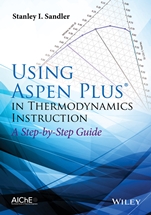
Using Aspen Plus in Thermodynamics Instruction: A Step–by–Step Guide
ISBN 9781118996911
Autor: Stanley I. Sandler
Wydawca: Wiley
Dostępność: 3-6 tygodni
Cena: 370,65 zł
Przed złożeniem zamówienia prosimy o kontakt mailowy celem potwierdzenia ceny.
ISBN13: |
9781118996911 |
ISBN10: |
1118996917 |
Autor: |
Stanley I. Sandler |
Oprawa: |
Paperback |
Rok Wydania: |
2015-05-19 |
Ilość stron: |
368 |
Wymiary: |
254x178 |
Tematy: |
PN |
A step–by–step guide for students (and faculty) on the use of Aspen in teaching thermodynamics
Used for a wide variety of important engineering tasks, Aspen Plus software is a modeling tool used for conceptual design, optimization, and performance monitoring of chemical processes. After more than twenty years, it remains one of the most popular and powerful chemical engineering simulation programs used both industrially and academically.
Using Aspen Plus in Thermodynamics Instruction: A Step by Step Guide introduces the reader to the use of Aspen Plus in courses in thermodynamics. It provides the reader with a self–study, step–by–step guide to doing thermodynamic calculations in Aspen Plus (Version 8.x). This is done by providing actual screen shots of the Aspen Plus interface to solve example problems of specific types, including vapor–liquid, liquid–liquid, vapor–liquid–liquid and chemical reaction equilibria, and simple applications to liquefaction, distillation and liquid–liquid extraction. Using Aspen Plus in Thermodynamics Instruction features:
Easily–accessible modern computational techniques opening up new vistas in teaching thermodynamics
A range of applications of Aspen Plus in the prediction and calculation of thermodynamic properties and phase behavior using the state–of–the art methods
Calculations and application examples in a step–by–step manner designed for out–of–classroom self study
This book serves as a prelude to instruction in the more complex process simulation and provides a coherent approach to introducing the Aspen Plus simulator in undergraduate thermodynamics courses. Because it has been designed for self–study use, it is meant to be assigned to students to use out of class, and not as an in–class textbook. It does not attempt to teach the basics of thermodynamics; it stresses the application of thermodynamics to realistic problems.
Introduction
1. Getting Started with Aspen Plus
2. Two Simple Simulations
3. Properties Analysis Pure Compounds
4. NIST TDE
5. Vapor–Liquid Equilibrium with Activity CoefficientModels
5.1 Mixture Property Analysis
5.2 Simulation
5.3 Regression of vapor–liquid equilibrium data
6. Vapor–Liquid Equilibrium with Equations of State
6.1 Mixture Property Analysis
6.2 Simulation
6.3 Regression of vapor–liquid equilibrium data
7. Liquid–Liquid Equilibrium and Vapor–Liquid–Liquid EquilibriumRegression and Predictions
7.1 Liquid–Liquid Data Regression
7.2 Prediction of Liquid–Liquid and Vapor–Liquid–LiquidEquilibrium
8. Property Method Assistant and Property Estimation
8.1 The Property Method Assistant
8.2 A Concern on Choosing Thermodynamic Models in a ProcessSimulator
8.3 Property Estimation
8.4 Regression Infinite Dilution Activity Coefficient Data
9. Chemical Reaction Equilibrium: RGibbs
10. Short Cut Distillation Calculations: DSTWU
11. A Rigorous Distillation Calculation: RadFrac
12. Liquid–Liquid Extraction
13. Sensitivity Analysis: A Tool for RepetitiveCalculations
14. Electrolyte Solutions
Stanley I. Sandler is the H. B. du Pont Professor of Chemical Engineering, Department of Chemical and Biomolecular Engineering University of Delaware. He is also the founding director of its Center for Molecular and Engineering Thermodynamics. He is the author of approximately 400 refereed papers, mostly on thermodynamics and several on education. He is the sole author of the popular textbook Chemical and Engineering Thermodynamics (first three editions) and now Chemical, Biochemical and Engineering Thermodynamics (4th edition), as well as the author or editor of 7 other books. He is the former editor of the AIChE Journal, a member of the U.S. National Academy of Engineering, and a fellow of the AIChE and the IChemE. In addition, he has received the Professional Progress, Warren K. Lewis, and Founders Awards from the AIChE and a number of international awards.
Preface vii
An Introduction for Students ix
1. Getting Started With Aspen Plus 1
Problems 9
2. Two Simple Simulations 10
Problems 34
3. Pure Component Property Analysis 36
Problems 55
4. The NIST ThermoData Engine (TDE) 56
Problems 64
5. Vapor–Liquid Equilibrium Calculations Using Activity Coefficient Models 66
5.1 Property Analysis Method 69
5.2 The Simulation Method 80
5.3 Regression of Binary VLE Data with Activity Coefficient Models 89
Problems 115
6. Vapor–Liquid Equilibrium Calculations Using an Equation of State 119
6.1 The Property Analysis Method 120
6.2 The Simulation Method 122
6.3 Regression of Binary VLE Data with an Equation of State 129
Problems 142
7. Regression of Liquid–Liquid Equilibrium (LLE) Data and Vapor–Liquid–Liquid Equilibrium (VLLE) and Predictions 144
7.1 Liquid–Liquid Data Regression 144
7.2 The Prediction of Liquid–Liquid and Vapor–Liquid–Liquid Equilibrium 158
7.3 High Pressure Vapor–Liquid–Liquid Equilibrium 167
Problems 173
8. The Property Methods Assistant and Property Estimation 175
8.1 The Property Methods Assistant 175
8.2 Property Estimation 182
8.3 Regressing Infinite Dilution Activity Coefficient Data 188
Problems 201
9. Chemical Reaction Equilibrium in Aspen Plus 203
Problems 229
10. Shortcut Distillation Calculations 233
Problems 250
11. A Rigorous Distillation Calculation: RadFrac 252
Problems 271
12. Liquid–Liquid Extraction 272
Problems 286
13. Sensitivity Analysis: A Tool for Repetitive Calculations 287
Problems 304
14. Electrolyte Solutions 305
Problems 337
Koszyk
Książek w koszyku: 0 szt.
Wartość zakupów: 0,00 zł
Informacje


Kontakt
Gambit
Centrum Oprogramowania
i Szkoleń Sp. z o.o.
Al. Pokoju 29b/22-24
31-564 Kraków
Siedziba Księgarni
ul. Kordylewskiego 1
31-542 Kraków
+48 12 410 5991
+48 12 410 5987
+48 12 410 5989
Subskrypcje
Administratorem danych osobowych jest firma Gambit COiS Sp. z o.o. Na podany adres będzie wysyłany wyłącznie biuletyn informacyjny.
Autoryzacja płatności

Informacje na temat autoryzacji płatności poprzez PayU.

© Copyright 2012: GAMBIT COiS Sp. z o.o. Wszelkie prawa zastrzeżone.
Projekt i wykonanie: Alchemia Studio Reklamy