


Wydawcy
Katalog tematyczny
- Archeologia (109)
- Ekonomia, finanse, business (13704)
- Filozofia (1445)
- Historia (3040)
- Języki i językoznawstwo (2356)
- Lifestyle, hobby i rozrywka (475)
- Medycyna (9704)
- Nauki humanistyczne (4)
- Nauki o Ziemi i środowisku (2638)
- Nauki ścisłe (20412)
- Nauki społeczne (8486)
- Nauki techniczne (13450)
- Prawo (1696)
- Publikacje informacyjne i interdyscyplinarne (1288)
- Religia i wierzenia (917)
- Technika komputerowa (4067)
- Zdrowie, relacje międzyludzkie i rozwój osobisty (657)





Informacje szczegółowe o książce
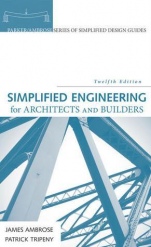
Simplified Engineering for Architects and Builders
ISBN 9781118975046
Autor: James Ambrose, Patrick Tripeny
Wydawca: Wiley
Dostępność: 3-6 tygodni
Cena: 557,55 zł
Przed złożeniem zamówienia prosimy o kontakt mailowy celem potwierdzenia ceny.
ISBN13: |
9781118975046 |
ISBN10: |
1118975049 |
Autor: |
James Ambrose, Patrick Tripeny |
Oprawa: |
Hardback |
Rok Wydania: |
2016-02-16 |
Numer Wydania: |
12th Edition |
Ilość stron: |
720 |
Wymiary: |
219x140 |
Tematy: |
AM |
The classic reference for structural design and construction completely revised and updated
Simplified Engineering for Architects and Builders is the gold standard for the industry and the reference of choice for designers and constructors. The revisions and updates in this new Twelfth Edition reflect the most current practices for designing structures. Plus, this innovative guide goes beyond the covers to provide support for instructors and students on an accompanying website including a complete instructor′s manual and a study guide for students to reinforce complex material.
Architects and builders get the same accessible primer on investigating and designing buildings along with the clear presentation of engineering principles they′ve come to expect from the Parker/Ambrose brand.
Simplified Engineering for Architects and Builders, Twelfth Edition is the total learning solution for structural design.
Preface to the Twelfth Edition xi
Preface to the First Edition xv
Introduction 1
Part I FUNDAMENTAL FUNCTIONS OF STRUCTURES 9
1 Investigation of Forces, Force Systems, Loading, and Reactions 11
1.1 Properties of Forces 11
1.2 Static Equilibrium 15
1.3 Force Components and Combinations 16
1.4 Graphical Analysis of Concurrent Force Systems 21
1.5 Algebraic Analysis of Nonconcurrent Force Systems 25
1.6 Laws of Equilibrium 29
1.7 Loads and Reactive Forces 32
1.8 Load Sources 36
1.9 Load Combinations 48
1.10 Determination of Design Loads 49
1.11 Design Methods 51
2 Investigation of Axial Force Actions 55
2.1 Forces and Stresses 55
2.2 Deformation 59
2.3 Suspension Cables 65
2.4 Funicular Arches 67
2.5 Graphical Analysis of Planar Trusses 70
2.6 Algebraic Analysis of Planar Trusses 77
2.7 Cable–Stayed Structures 85
2.8 Compression Members 87
3 Investigation of Structures for Shear and Bending 92
3.1 Direct Shear Stress 92
3.2 Shear in Beams 93
3.3 Bending Moments in Beams 98
3.4 Sense of Bending in Beams 103
3.5 Tabulated Values for Beam Behavior 111
3.6 Development of Bending Resistance 115
3.7 Shear Stress in Beams 118
3.8 Continuous and Restrained Beams 123
3.9 Members Experiencing Compression Plus Bending 138
3.10 Rigid Frames 148
3.11 Buckling of Beams 157
3.12 Second–Order Analysis
3.13 Computer Software for Structural Analysis
4 Structural Systems and Planning 161
4.1 General Considerations for Structural Systems 162
4.2 Shear Wall and Diaphragm Structural System 165
4.3 Braced Frame Systems 166
4.4 Moment Frame Systems 168
4.5 Wood Construction 170
4.6 Steel Construction 176
4.7 Concrete Construction 182
Part II WOOD CONSTRUCTION 189
5 Wood Spanning Elements 191
5.1 Structural Lumber 192
5.2 Reference Design Values for Allowable Stress Design 193
5.3 Design Controls for Load and Resistance Factor Design 202
5.4 Design for Bending 204
5.5 Beam Shear 207
5.6 Bearing 208
5.7 Deflection 210
5.8 Behavior Considerations for LRFD 214
5.9 Joists and Rafters 222
5.10 Decking for Roofs and Floors 226
5.11 Plywood 227
5.12 Glued–Laminated Products 231
5.13 Wood Fiber Products 232
5.14 Assembled Wood Structural Products 233
6 Wood Columns 236
6.1 Slenderness Ratio for Columns 237
6.2 Compression Capacity of Simple Solid Columns, ASD Method 237
6.3 Column Load Capacity, LRFD Method 245
6.4 Stud Wall Construction 247
6.5 Columns with Bending 249
7 Connections for Wood Structures 258
7.1 Bolted Joints 258
7.2 Nailed Joints 260
7.3 Plywood Gussets 264
7.4 Investigation of Connections, LRFD Method 264
7.5 Formed Steel Framing Elements 265
Part III STEEL CONSTRUCTION 269
8 Steel Structural Products 271
8.1 Design Methods for Steel Structures 271
8.2 Materials for Steel Products 273
8.3 Types of Steel Structural Products 276
9 Steel Beams and Framing Elements 282
9.1 Factors in Beam Design 282
9.2 Inelastic Versus Elastic Behavior 284
9.3 Nominal Moment Capacity of Steel Beams 291
9.4 Design for Bending 299
9.5 Design of Beams for Buckling Failure 304
9.6 Shear in Steel Beams 307
9.7 Deflection of Beams 313
9.8 Safe Load Tables 322
9.9 Steel Trusses 333
9.10 Manufactured Trusses for Flat Spans 335
9.11 Decks with Steel Framing 343
9.12 Concentrated Load Effects on Beams 345
10 Steel Columns and Frames 348
10.1 Column Shapes 348
10.2 Column Slenderness and End Conditions 350
10.3 Safe Axial Loads for Steel Columns 351
10.4 Design of Steel Columns 357
10.5 Columns with Bending 368
10.6 Column Framing and Connections 372
11 Bolted Connections for Steel Structures 375
11.1 Bolted Connections 375
11.2 Design of a Bolted Connection 387
11.3 Bolted Framing Connections 393
11.4 Bolted Truss Connections 395
12 Light–Gage Formed Steel Structures 399
12.1 Light–Gage Steel Products 399
12.2 Light–Gage Steel Decks 400
12.3 Light–Gage Steel Systems 405
Part IV CONCRETE CONSTRUCTION 407
13 Reinforced Concrete Structures 409
13.1 General Considerations 409
13.2 General Application of Strength Methods 417
13.3 Beams: Ultimate Strength Method 417
13.4 Beams in Site–Cast Systems 431
13.5 Spanning Slabs 446
13.6 Shear in Beams 452
13.7 Development Length for Reinforcement 467
13.8 Deflection Control 477
14 Flat–Spanning Concrete Systems 479
14.1 Slab–and–Beam Systems 480
14.2 General Considerations for Beams 488
15 Concrete Columns and Compression Members 492
15.1 Effects of Compression Force 493
15.2 General Considerations for Concrete Columns 496
15.3 Design Methods and Aids for Concrete Columns 506
15.4 Special Considerations for Concrete Columns 515
16 Foundations 522
16.1 Shallow Bearing Foundations 522
16.2 Wall Footings 523
16.3 Column Footings 532
16.4 Pedestals 541
Part V STRUCTURAL SYSTEMS FOR BUILDINGS 545
17 General Considerations for Building Structures 547
17.1 Choice of Building Construction 547
17.2 Structural Design Standards 548
17.3 Structural Design Process 549
17.4 Development of Structural Systems 550
18 Building One 554
18.1 General Considerations 554
18.2 Design of the Wood Structure for Gravity Loads 555
18.3 Design for Lateral Loads 560
18.4 Alternative Steel and Masonry Structure 572
18.5 Alternative Truss Roof 578
18.6 Foundations 580
19 Building Two 583
19.1 Design for Gravity Loads 585
19.2 Design for Lateral Loads 588
19.3 Alternative Steel and Masonry Structure 590
20 Building Three 593
20.1 General Considerations 593
20.2 Structural Alternatives 597
20.3 Design of the Steel Structure 599
20.4 Alternative Floor Construction with Trusses 608
20.5 Design of the Trussed Bent for Wind 612
20.6 Considerations for a Steel Rigid Frame 617
20.7 Considerations for a Masonry Wall Structure 618
20.8 The Concrete Structure 624
20.9 Design of the Foundations 648
Appendix A: Properties of Sections 651
A.1 Centroids 651
A.2 Moment of Inertia 654
A.3 Transferring Moments of Inertia 658
A.4 Miscellaneous Properties 662
A.5 Tables of Properties of Sections 665
Glossary 686
References 697
Index 699
JAMES AMBROSE is Editor of the Parker/Ambrose Series of Simplified Design Guides. He practiced as an architect in California and Illinois, and as a structural engineer in Illinois. He was a professor of architecture at the University of Southern California. PATRICK TRIPENY is the Director of the Center for Teaching and Learning Excellence and is a Professor of Architecture at the University of Utah. He teaches the architectural structures sequence in the School of Architecture and the graduate design studio. He is the recipient of several teaching awards including the ACSA/AIAS New Faculty Teaching Award in 2001 and the University of Utah′s Early Career Teaching Award in 2000–2001.
Koszyk
Książek w koszyku: 0 szt.
Wartość zakupów: 0,00 zł
Informacje


Kontakt
Gambit
Centrum Oprogramowania
i Szkoleń Sp. z o.o.
Al. Pokoju 29b/22-24
31-564 Kraków
Siedziba Księgarni
ul. Kordylewskiego 1
31-542 Kraków
+48 12 410 5991
+48 12 410 5987
+48 12 410 5989
Subskrypcje
Administratorem danych osobowych jest firma Gambit COiS Sp. z o.o. Na podany adres będzie wysyłany wyłącznie biuletyn informacyjny.
Autoryzacja płatności

Informacje na temat autoryzacji płatności poprzez PayU.

© Copyright 2012: GAMBIT COiS Sp. z o.o. Wszelkie prawa zastrzeżone.
Projekt i wykonanie: Alchemia Studio Reklamy