


Wydawcy
Katalog tematyczny
- Archeologia (109)
- Ekonomia, finanse, business (13704)
- Filozofia (1445)
- Historia (3040)
- Języki i językoznawstwo (2356)
- Lifestyle, hobby i rozrywka (475)
- Medycyna (9704)
- Nauki humanistyczne (4)
- Nauki o Ziemi i środowisku (2638)
- Nauki ścisłe (20412)
- Nauki społeczne (8486)
- Nauki techniczne (13450)
- Prawo (1696)
- Publikacje informacyjne i interdyscyplinarne (1288)
- Religia i wierzenia (917)
- Technika komputerowa (4067)
- Zdrowie, relacje międzyludzkie i rozwój osobisty (657)





Informacje szczegółowe o książce
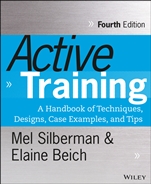
Active Training: A Handbook of Techniques, Designs, Case Examples, and Tips
ISBN 9781118972014
Autor: Melvin L. Silberman, Elaine Biech, Carol Auerbach
Wydawca: Wiley
Dostępność: 3-6 tygodni
Cena: 222,60 zł
Przed złożeniem zamówienia prosimy o kontakt mailowy celem potwierdzenia ceny.
ISBN13: |
9781118972014 |
ISBN10: |
1118972015 |
Autor: |
Melvin L. Silberman, Elaine Biech, Carol Auerbach |
Oprawa: |
Hardback |
Rok Wydania: |
2015-06-05 |
Numer Wydania: |
4th Edition |
Ilość stron: |
448 |
Wymiary: |
254x177 |
Tematy: |
KM |
The Trusted Active Training Methodology, Fully Updated for Today′s Business Challenges
Active Training is the runaway bestselling handbook for beginning and experienced trainers alike. This Fourth Edition updates the proven Active Training approach which turns the spotlight away from the instructor and puts the emphasis on the learner to reflect today′s business realities, emerging technologies, and the ever–evolving role of the adult educator.
The field of training has changed dramatically in the past decade, and this thoroughly revised edition provides a wealth of practical information for implementing training practices across a newly expanded range of settings. New topics include:
Emerging learning technologies, such as social media, mobile learning, and online virtual classes Tips for implementing the active learning method in onboarding, change management, coaching, consulting, and team building Advice for working under budgetary constraints, training a multi–generational workforce, and participating in globalizationIn addition to covering these crucial issues, Active Training now contains expanded guidelines on assessing training return on expectations, training management, and extending the value of training programs. Updated examples, templates, and theory round out this comprehensive update, making Active Training the only choice for practitioners in this ever–important field.
From assessing training needs and developing objectives through to preparing well–rounded training programs that appeal to learners of all types, Active Training is a bounty of practical tips and techniques guaranteed to improve any training program.
Acknowledgments / xi
Preface / xiii
The Goals of This Book / xiv
How This Book Is Organized / xv
PART ONE INTRODUCING ACTIVE TRAINING / 1
The Nature of Adult Learning / 2
The Social Side of Learning / 6
Concerns About Active Training / 7
The Delivery of Active Training / 10
PART TWO DESIGNING AN ACTIVE TRAINING PROGRAM / 13
Steps for Designing Active Training / 15
What s in the Part Two Chapters? / 17
Chapter One Assessing Training Needs / 19
Why Do Assessment? / 20
What Information Should Be Collected? / 23
How Can Information Be Collected? / 29
What If There Is No Time to Do a Proper Assessment? / 38
Chapter Two Developing Active Training Objectives / 41
Setting Learning Goals / 42
Selecting Objectives / 44
Specifying Objectives / 47
Expressing Objectives / 48
Communicating Training Objectives to Others / 49
Chapter Three Creating Opening Exercises / 53
What Opening Exercises Accomplish / 53
What to Keep in Mind When Creating Opening Exercises / 67
Ten Ways to Open an Active Online Virtual Training Session / 68
Ten Ways to Obtain Participation / 69
Chapter Four Preparing Brain–Friendly Presentations / 75
Five Ways to Gain Your Audience s Interest / 75
Five Ways to Maximize Understanding and Retention / 82
Five Ways to Involve Participants During a Presentation / 88
Five Ways to Reinforce Presentations / 94
An Example of a Well–Designed Presentation / 99
Chapter Five Finding Alternative Methods to Presenting / 103
Demonstration / 103
Case Study / 105
Guided Teaching / 109
Group Inquiry / 110
Information Search / 113
Study Group / 115
Jigsaw Learning / 118
Learning Tournament / 121
Applying the Alternatives to a Common Topic / 123
Chapter Six Using Experiential Learning Approaches / 129
Role Playing / 130
Games and Simulations / 139
Observation / 144
Mental Imagery / 148
Writing Tasks / 152
Action Learning / 155
Chapter Seven Designing Active Training Activities / 165
The Three Major Ingredients of Any Design / 165
Basic Questions About Any Design / 169
The Remaining Details / 170
Three Tips for Creative Designs / 172
Chapter Eight Sequencing Active Training Activities / 177
Basic Sequencing Guidelines / 178
Applying Sequencing Guidelines / 181
The Finer Side of Sequencing / 188
Experiential Learning Sequences / 193
Chapter Nine Planning Active Training Programs / 199
The Macrodesign of an Active Training Program / 199
Chapter Ten Incorporating Active Learning in All Training / 207
Asynchronous E–Learning / 208
Group–Based E–Learning / 212
Virtual Classrooms / 216
Blended Learning / 218
Social Media Expands Active Training and Development / 220
M–Learning Offers Instant Options / 223
PART THREE CONDUCTING AN ACTIVE TRAINING PROGRAM / 229
Chapter Eleven Beginning an Active Training Program / 233
Preparing Yourself Mentally / 233
Arranging the Physical Environment / 236
Greeting Participants and Establishing Rapport / 242
Getting the Best from the First Thirty Minutes of Training / 245
Reviewing the Agenda / 246
Inviting Feedback to the Agenda / 248
Chapter Twelve Gaining Leadership of the Group / 253
Setting Group Norms / 253
Controlling Timing and Pacing / 255
Increasing Receptivity to Your Leadership / 257
Handling Problem Situations / 258
Chapter Thirteen Giving Presentations and Leading Discussions / 267
Knowing Your Group / 267
Organizing Your Presentation / 271
Watching Your Body Language / 273
Adding Visuals / 275
Making Smooth Transitions / 277
Facilitating a Lively Discussion / 279
Chapter Fourteen Facilitating Structured Activities and Promoting Team Learning / 287
Structured Activities / 287
Team Learning / 298
Chapter Fifteen Concluding an Active Training Program / 307
Reviewing Program Content / 307
Obtaining Final Questions and Concerns / 309
Promoting Self–Assessment / 312
Focusing on Back–on–the–Job Application / 315
Expressing Final Sentiments / 316
PART FOUR EXTENDING THE VALUE OF AN ACTIVE TRAINING PROGRAM / 319
Chapter Sixteen Providing for Back–on–the–Job Application / 321
Prior to the Training Program / 321
During the Training Program / 323
At the End of the Training Program / 324
Obstacle Assessment / 328
Peer Consultation / 329
Self–Monitoring / 330
Follow–Up Coaching and Support / 340
Chapter Seventeen Evaluating an Active Training Program / 343
Expanding the Four Evaluation Levels / 344
Designing Evaluations / 354
Obtain Feedback Along the Way / 355
PART FIVE THE EVOLVING ROLE OF TRAINERS / 359
Chapter Eighteen Expanded Roles for Trainers / 361
Onboarding / 362
Leading Change / 364
Coaching Managers / 367
Mentoring Programs / 368
Internal Consulting / 371
Building Teams / 373
Chapter Nineteen New Business Realities for Trainers / 379
Doing More with Less / 380
Globalization / 382
Working with Multigenerational Workforces / 384
Working with the C–Suite / 386
Vendor Management / 388
Working with Subject Matter Experts / 390
We ve Reached the End Or Is It the Beginning? / 391
References / 395
About the Authors / 399
Index / 401
MEL SILBERMAN was Professor Emeritus of Adult and Organizational Development at Temple University for 41 years. Mel rose to international prominence for his contributions to the field of training. Mel passed away in 2010.
ELAINE BIECH is President of ebb associates inc, where she specializes in helping leaders maximize their effectiveness. She is the author or editor of over 60 books.
CAROL AUERBACH has over 25 years′ experience designing and delivering corporate training programs for such companies as CIGNA Insurance, Kellogg′s, and IBM.
Koszyk
Książek w koszyku: 0 szt.
Wartość zakupów: 0,00 zł
Informacje


Kontakt
Gambit
Centrum Oprogramowania
i Szkoleń Sp. z o.o.
Al. Pokoju 29b/22-24
31-564 Kraków
Siedziba Księgarni
ul. Kordylewskiego 1
31-542 Kraków
+48 12 410 5991
+48 12 410 5987
+48 12 410 5989
Subskrypcje
Administratorem danych osobowych jest firma Gambit COiS Sp. z o.o. Na podany adres będzie wysyłany wyłącznie biuletyn informacyjny.
Autoryzacja płatności

Informacje na temat autoryzacji płatności poprzez PayU.

© Copyright 2012: GAMBIT COiS Sp. z o.o. Wszelkie prawa zastrzeżone.
Projekt i wykonanie: Alchemia Studio Reklamy