


Wydawcy
Katalog tematyczny
- Archeologia (109)
- Ekonomia, finanse, business (13704)
- Filozofia (1445)
- Historia (3040)
- Języki i językoznawstwo (2356)
- Lifestyle, hobby i rozrywka (475)
- Medycyna (9704)
- Chirurgia (272)
- Inne gałęzie medycyny (1871)
- Medycyna kliniczna (4187)
- Medycyna niekonwencjonalna (14)
- Medycyna przedkliniczna (269)
- Medycyna, ogólnie (1740)
- Historia medycyny (3)
- Lekarze, sprawy zawodowe (8)
- Medycyna, aspekty prawne (10)
- Służba zdrowia (36)
- Wyposażenie medyczne (157)
- Zdrowie publiczne (460)
- Medyczne służby pomocnicze (745)
- Studia medyczne (16)
- Weterynaria (548)
- Nauki humanistyczne (4)
- Nauki o Ziemi i środowisku (2638)
- Nauki ścisłe (20412)
- Nauki społeczne (8486)
- Nauki techniczne (13450)
- Prawo (1696)
- Publikacje informacyjne i interdyscyplinarne (1288)
- Religia i wierzenia (917)
- Technika komputerowa (4067)
- Zdrowie, relacje międzyludzkie i rozwój osobisty (657)





Informacje szczegółowe o książce
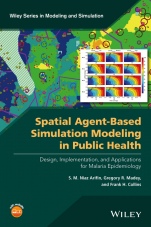
Spatial Agent–Based Simulation Modeling in Public Health: Design, Implementation, and Applications for Malaria Epidemiology
ISBN 9781118964354
Autor: S. M. Niaz Arifin, Gregory R. Madey, Frank H. Collins
Wydawca: Wiley
Dostępność: 3-6 tygodni
Cena: 583,80 zł
Przed złożeniem zamówienia prosimy o kontakt mailowy celem potwierdzenia ceny.
ISBN13: |
9781118964354 |
ISBN10: |
1118964357 |
Autor: |
S. M. Niaz Arifin, Gregory R. Madey, Frank H. Collins |
Oprawa: |
Hardback |
Rok Wydania: |
2016-05-27 |
Ilość stron: |
320 |
Wymiary: |
236x160 |
Tematy: |
MBN |
Presents an overview of the complex biological systems used within a global public health setting and features a focus on malaria analysis
Bridging the gap between agent–based modeling and simulation (ABMS) and geographic information systems (GIS), Spatial Agent–Based Simulation Modeling in Public Health: Design, Implementation, and Applications for Malaria Epidemiology provides a useful introduction to the development of agent–based models (ABMs) by following a conceptual and biological core model of Anopheles gambiae for malaria epidemiology. Using spatial ABMs, the book includes mosquito (vector) control interventions and GIS as two example applications of ABMs, as well as a brief description of epidemiology modeling. In addition, the authors discuss how to most effectively integrate spatial ABMs with a GIS. The book concludes with a combination of knowledge from entomological, epidemiological, simulation–based, and geo–spatial domains in order to identify and analyze relationships between various transmission variables of the disease.
Spatial Agent–Based Simulation Modeling in Public Health: Design, Implementation, and Applications for Malaria Epidemiology also features:
Location–specific mosquito abundance maps that play an important role in malaria control activities by guiding future resource allocation for malaria control and identifying hotspots for further investigation Discussions on the best modeling practices in an effort to achieve improved efficacy, cost–effectiveness, ecological soundness, and sustainability of vector control for malaria An overview of the various ABMs, GIS, and spatial statistical methods used in entomological and epidemiological studies, as well as the model malaria study A companion website with computer source code and flowcharts of the spatial ABM and a landscape generator tool that can simulate landscapes with varying spatial heterogeneity of different types of resources including aquatic habitats and housesSpatial Agent–Based Simulation Modeling in Public Health: Design, Implementation, and Applications for Malaria Epidemiology is an excellent reference for professionals such as modeling and simulation experts, GIS experts, spatial analysts, mathematicians, statisticians, epidemiologists, health policy makers, as well as researchers and scientists who use, manage, or analyze infectious disease data and/or infectious disease–related projects. The book is also ideal for graduate–level courses in modeling and simulation, bioinformatics, biostatistics, public health and policy, and epidemiology.
S. M. Niaz Arifin, PhD, is Research Assistant Professor in the Department of Computer Science and Engineering at the University of Notre Dame. A member of The Society for Computer Simulation, and American Society of Tropical Medicine and Hygiene, and the recipient of The American Society of Tropical Medicine and Hygiene Travel Award in 2011, his research interests include agent–based modeling and simulation, public health, data warehousing, and geographic information systems.
Gregory R. Madey, PhD, is Research Professor in the Department of Computer Science and Engineering at the University of Notre Dame. A member of The Society for Computer Simulation, Institute of Electrical and Electronics Engineers Computer Society, and American Society of Tropical Medicine and Hygiene, his research interests include agent–based modeling and simulation, cyberinfrastructure, bioinformatics, biocomplexity, e–Technologies, open source software, disaster management, and health informatics.
Frank H. Collins, PhD, is Professor in the Department of Biological Sciences at the University of Notre Dame. His research interests include genome level studies of arthropod vectors of human pathogens, the biology of malaria vectors with a focus on the development of molecular tools that will permit better resolution of questions about vector population ecology, ecological genetics, and the epidemiology of malaria transmission.
Preface
Acknowledgements
Abbreviations
1: Introduction
1.1 Overview
1.2 Malaria
1.3 Agent–Based Modeling of Malaria
1.4 Contributions
1.5 Organization
2: Malaria: A Brief History
2.1 Overview
2.2 Malaria in Human History
2.2.1 The Malarial Path: Ancient Origins
2.2.2 Naming and Key Discoveries
2.2.3 Antimalarial Drugs
2.2.4 Prevention Measures
2.3 Malaria Epidemiology: A Global View
2.3.1 The Malaria Parasite
2.3.2 Geographic Distribution
2.3.3 Types of Transmission
2.3.4 Risk Mapping and Forecasting
2.4 Malaria Control
3. Agent–Based Modeling and Malaria
3.1 Overview
3.2 Agent–Based Models (ABMs)
3.2.1 Agents
3.2.2 Environment
3.2.3 Rules
3.2.4 Software for ABMs
3.3 History and Applications
3.3.1 M&S Organizations
3.4 Advantages of ABMs
3.4.1 Emergence, Aggregation, and Complexity
3.4.2 Heterogeneity
3.4.3 Learning and Adaptation
3.4.4 Flexibility in System Description
3.4.5 Inclusion of Multiple Spaces
3.4.6 Limitations of ABMs
3.4.7 ABMs vs. Mathematical Models
3.4.8 Applicability of ABMs for Malaria Modeling
3.5 Malaria Models: A Review
3.5.1 Mathematical Models of Malaria
3.5.2 Agent–Based Models (ABMs) of Malaria
3.5.3 The Spatial Dimension of Malaria Models
3.6 Summary
4. The Biological Core Model
4.1 Overview
4.1.1 Relevant Terms of Interest
4.2 The Aquatic Phase
4.2.1 Egg (E)
4.2.2 Larva (L)
4.2.3 Pupa (P)
4.3 The Adult Phase
4.3.1 Immature Adult (IA)
4.3.2 Mate Seeking (MS)
4.3.3 Blood Meal Seeking (BMS)
4.3.4 Blood Meal Digesting (BMD)
4.3.5 Gravid (G)
4.4 Aquatic Habitats and Oviposition
4.4.1 Aquatic Habitats
4.4.2 Oviposition
4.5 Senescence and Mortality Rates
4.5.1 Senescence
4.5.2 Mortality Models: Basic Mathematical Formulation
4.6 Mortality in the Core Model
4.6.1 Aquatic (Immature) Mortality Rates
4.6.2 Adult Mortality Rates
4.7 Discussion
4.7.1 An Extendible Framework for Other Anopheline Species
4.7.2 Weather, Seasonality, and Other Factors
4.7.3 Mortality Rates
4.8 Summary
5. The Agent–Based Model (ABM)
5.1 Overview
5.2 Model Architecture
5.2.1 Object–Oriented Programming (OOP) Terminology
5.2.2 Agents
5.2.3 Environments
5.2.4 Event–Action–List Diagram
5.3 Mosquito Population Dynamics
5.4 Model Features
5.4.1 Processing Steps Ordering
5.4.2 Model Assumptions
5.4.3 Simulations
5.5 Summary
6. The Spatial ABM
6.1 Overview
6.2 The Spatial ABM
6.2.1 De—nition of Terms
6.2.2 Landscapes
6.2.3 Landscape Generator Tools
6.3 Resource Clustering
6.4 Flight Heuristics for Mosquito Agents
6.5 Simulation Results
6.5.1 Model Veri—cation
6.5.2 Landscape Patterns
6.5.3 Relative Sizes of Resources
6.5.4 Resource Density
6.5.5 Combined Habitat Capacity
6.6 Spatial Heterogeneity
6.7 Summary
7. Verification, Validation, Replication, and Reproducibility
7.1 Overview
7.2 Verification and Validation (V&V)
7.2.1 Quality Assurance (QA) .
7.2.2 Verification and Validation (V&V)
7.3 Replication and Reproducibility (R&R)
7.4 Summary
8. Verification and Validation (V&V) of ABMs
8.1 Overview
8.2 Verification and Validation (V&V) of ABMs
8.3 Phase–wise Docking
8.3.1 Assumptions for the ABMs
8.3.2 Phase–wise Docking Results
8.4 Compartmental Docking
8.4.1 Implementations of the ABMs
8.4.2 Assumptions for the ABMs
8.4.3 Compartmental Docking Results
8.5 Summary
9. Replication and Reproducibility (R&R) of ABMs
9.1 Overview
9.1.1 Simulation Stochasticity
9.1.2 Boundary Types
9.2 Vector Control Interventions
9.2.1 Larval Source Management (LSM)
9.2.2 Insecticide–Treated Nets (ITNs)
9.2.3 Population Profiles for ITNs
9.2.4 Coverage Schemes for ITNs
9.2.5 Applying LSM in Isolation
9.2.6 Applying ITNs in Isolation
9.2.7 Applying LSM and ITNs in Combination
9.3 Simulation Results
9.3.1 Simulation Stochasticity
9.3.2 LSM in Isolation
9.3.3 Impact of Boundary Types
9.3.4 ITNs in Isolation
9.3.5 LSM and ITNs in Combination
9.4 Replication and Reproducibility (R&R) Guidelines
9.5 Discussion
9.6 Summary
10. A Landscape Epidemiology Modeling Framework
10.1 Overview
10.2 GIS in Public Health
10.3 The Study Area and the ABM
10.3.1 Features of the Spatial ABM
10.3.2 Vector Control Intervention Scenarios
10.4 The Geographic Information System (GIS)
10.4.1 The GIS–ABM Workflow
10.4.2 GIS Processing of Data Layers
10.4.3 Feature Counts
10.5 Simulations and Spatial Analyses
10.5.1 Output Indices
10.5.2 Hot Spot Analysis
10.5.3 Kriging Analysis
10.6 Results
10.6.1 Mosquito Abundance
10.6.2 Oviposition Count per Aquatic Habitat
10.6.3 Blood Meal Count per House
10.7 Discussion
10.7.1 Stochasticity and Initial Conditions
10.7.2 Model Calibration and Parameterization
10.7.3 Emergence
10.7.4 Complexity
10.7.5 Data Resolution (Granularity)
10.7.6 Spatial Analyses
10.7.7 Habitat–based Interventions
10.7.8 Miscellaneous Issues
10.8 Conclusions
11. The EMOD Individual–Based Model
11.1 Overview
11.1.1 Motivation: Modeling of Malaria Eradication
11.1.2 Questions that Arise in the Context of Malaria Eradication
11.1.3 Spatial Heterogeneity and Metapopulation Effects
11.1.4 Implications for Model Structure
11.1.4.1 Modeling Individuals and Infections
11.1.4.2 Modeling Mosquitoes
11.1.4.3 Modeling Campaign Elements
11.2 Model Structure
11.2.1 Human Demographics and Synthetic Population
11.2.2 Vector Ecology
11.2.3 Vector Transmission
11.2.4 Within–Host Disease Dynamics
11.2.5 Human Migration and Spatial Effects
11.2.6 Stochastic Ensembles
11.3 Results
11.3.1 Single–Village Simulations
11.3.2 Spatial Simulations: Garki District
11.3.3 Madagascar
11.4 Discussion
APPENDIX A: Enzyme Kinetics Model
A.1 Overview
A.2 Stochastic Thermodynamic Models
A.3 Poikilothermic Development Models
A.3.1 Log–linear Models
A.3.2 The Arrhenius Model
A.3.3 The Eyring Equation
A.3.4 The Gibbs Free Energy, Entropy and Enthalpy
A.3.5 Incorporating Entropy and Enthalpy into Eyring Equation
A.4 The Sharpe and DeMichele Model
A.4.1 Energy States
A.4.2 Exponential Distribution of Transition Times
A.4.3 Probability Calculations
A.5 The Schoolfield et al. Model
A.6 The Depinay et al. Model
A.6.1 Cumulative Development
A.6.2 Results
A.7 Summary
APPENDIX B: Source Code for the Agent–Based Model (ABM)
B.1 Overview
B.2 Source Code for the Spatial ABM
B.2.1 Instructions to Run
B.3 Sample Input File for the ABM
B.4 The Landscape Generator Tool
B.4.1 Instructions to Run
APPENDIX C: ABM Flowchart
C.1 Flowchart for the Agent–Based Model (ABM)
APPENDIX D: Additional Files for Chapter 10
APPENDIX E: A Post–Simulation Analysis Module
E.1 Overview
E.2 Simulation Output Analysis: A Review
E.2.1 Statistical Analysis
E.2.2 Visualization and Analysis Tools
E.3 The LiNK Model
E.3.1 Agents, Interface and Pathogens
E.3.2 Space and Time
E.3.3 Verification and Validation
E.4 P–SAM Architecture
E.4.1 The Writer
E.4.2 The Reader
E.4.3 Advantages of Using Perl
E.5 Post–Simulation Analysis and Visualization
E.5.1 Infection Statistics
E.5.2 Roaming Infection Statistics
E.5.3 Birth and Death Statistics
E.5.4 Pathogen Transmission Graphs
E.5.5 Summary Statistics
E.6 P–SAM Performance
E.6.1 Profiling
E.6.2 Code Optimization
E.7 Conclusion
Bibliography
Index
Koszyk
Książek w koszyku: 0 szt.
Wartość zakupów: 0,00 zł
Informacje


Kontakt
Gambit
Centrum Oprogramowania
i Szkoleń Sp. z o.o.
Al. Pokoju 29b/22-24
31-564 Kraków
Siedziba Księgarni
ul. Kordylewskiego 1
31-542 Kraków
+48 12 410 5991
+48 12 410 5987
+48 12 410 5989
Subskrypcje
Administratorem danych osobowych jest firma Gambit COiS Sp. z o.o. Na podany adres będzie wysyłany wyłącznie biuletyn informacyjny.
Autoryzacja płatności

Informacje na temat autoryzacji płatności poprzez PayU.

© Copyright 2012: GAMBIT COiS Sp. z o.o. Wszelkie prawa zastrzeżone.
Projekt i wykonanie: Alchemia Studio Reklamy