


Wydawcy
Katalog tematyczny
- Archeologia (109)
- Ekonomia, finanse, business (13704)
- Filozofia (1445)
- Historia (3040)
- Języki i językoznawstwo (2356)
- Lifestyle, hobby i rozrywka (475)
- Medycyna (9704)
- Nauki humanistyczne (4)
- Nauki o Ziemi i środowisku (2638)
- Nauki ścisłe (20412)
- Nauki społeczne (8486)
- Edukacja (229)
- Kryminologia, opieka spełeczna (284)
- Obronność (10)
- Polityka (1389)
- Psychologia (777)
- Socjologia (410)
- Społeczeństwo i kultura (187)
- Nauki techniczne (13450)
- Prawo (1696)
- Publikacje informacyjne i interdyscyplinarne (1288)
- Religia i wierzenia (917)
- Technika komputerowa (4067)
- Zdrowie, relacje międzyludzkie i rozwój osobisty (657)





Informacje szczegółowe o książce
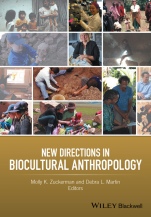
New Directions in Biocultural Anthropology
ISBN 9781118962961
Autor: Molly K. Zuckerman, Debra L. Martin
Wydawca: Wiley
Dostępność: 3-6 tygodni
Cena: 609,00 zł
Przed złożeniem zamówienia prosimy o kontakt mailowy celem potwierdzenia ceny.
ISBN13: |
9781118962961 |
ISBN10: |
1118962966 |
Autor: |
Molly K. Zuckerman, Debra L. Martin |
Oprawa: |
Hardback |
Rok Wydania: |
2016-10-18 |
Ilość stron: |
544 |
Wymiary: |
244x178 |
Tematy: |
JHBK |
Biocultural or biosocial anthropology is a research approach that views biology and culture as dialectically and inextricably intertwined, explicitly emphasizing the dynamic interaction between humans and their larger social, cultural, and physical environments. The biocultural approach emerged in anthropology in the 1960s, matured in the 1980s, and is now one of the dominant paradigms in anthropology, particularly within biological anthropology. This volume gathers contributions from the top scholars in biocultural anthropology focusing on six of the most influential, productive, and important areas of research within biocultural anthropology. These are: critical and synthetic approaches within biocultural anthropology; biocultural approaches to identity, including race and racism; health, diet, and nutrition; infectious disease from antiquity to the modern era; epidemiologic transitions and population dynamics; and inequality and violence studies. Focusing on these six major areas of burgeoning research within biocultural anthropology makes the proposed volume timely, widely applicable and useful to scholars engaging in biocultural research and students interested in the biocultural approach, and synthetic in its coverage of contemporary scholarship in biocultural anthropology. Students will be able to grasp the history of the biocultural approach, and how that history continues to impact scholarship, as well as the scope of current research within the approach, and the foci of biocultural research into the future. Importantly, contributions in the text follow a consistent format of a discussion of method and theory relative to a particular aspect of the above six topics, followed by a case study applying the surveyed method and theory. This structure will engage students by providing real world examples of anthropological issues, and demonstrating how biocultural method and theory can be used to elucidate and resolve them.
Key features include:
Contributions which span the breadth of approaches and topics within biological anthropology from the insights granted through work with ancient human remains to those granted through collaborative research with contemporary peoples.
Comprehensive treatment of diverse topics within biocultural anthropology, from human variation and adaptability to recent disease pandemics, the embodied effects of race and racism, industrialization and the rise of allergy and autoimmune diseases, and the sociopolitics of slavery and torture.
Contributions and sections united by thematically cohesive threads.
Clear, jargon–free language in a text that is designed to be pedagogically flexible: contributions are written to be both understandable and engaging to both undergraduate and graduate students.
Provision of synthetic theory, method and data in each contribution.
The use of richly contextualized case studies driven by empirical data.
Through case–study driven contributions, each chapter demonstrates how biocultural approaches can be used to better understand and resolve real–world problems and anthropological issues.
Molly K. Zuckerman is an Assistant Professor in the Department of Anthropology and Middle Eastern Cultures at Mississippi State University. The author of numerous peer–reviewed publications employing the biocultural approach, Dr Zuckerman also teaches graduate and undergraduate introductory courses in anthropology and biological anthropology, osteology, diet and nutrition, and human behavior and disease.
Debra L. Martin is the UNLV Barrick Distinguished Professor of Anthropology at the University of Nevada, Las Vegas. Her expertise is in the biocultural approach as it can be applied to understanding poor health, inequality and violence. She has published four co–edited volumes, three co–authored volumes, and over 100 chapters and peer–reviewed articles on biocultural approaches in anthropology.
Chapters in the proposed text fall into five major categories, all within the biocultural perspective: (1) race and racism, (2) diet, nutrition and agriculture, (3) bioarchaeology and ancient disease, (4) social identity and gender, and (5) epidemiologic transitions. These categories reflect primary, highly productive foci of contemporary research within biocultural biological anthropology. They also represent five of the areas of research within biological anthropology where George Armelagos s scholarly contributions have had the greatest impact.
1. Introduction
Introduction to the Volume.
Molly K. Zuckerman and Debra L. Martin.
(Tentative title) The Biocultural Approach and Four–Field Anthropology: A Force Against Future
Fission.
Peter Brown.
2. Race and Racism
(Tentative title) Race is Real: It′s Just that It Isn′t What We Were Taught.
Alan Goodman, Michael Blakey, and Joseph Jones.
(Tentative title) Achieving Synthesis: New York s African Burial Ground and the Influences of Biocultural Anthropology.
Michael Blakey and Leslie Rankin–Hill.
(Tentative title) Race, Health, Biology: Biocultural Approaches.
Christopher Kuzawa, Alan Goodman, George Armelagos.
A History of Indigenous Caribbean Populations: Insights from Archeological, Ethnographic, Genetic and Historical Studies.
Theodore G. Schurr, Jada Benn Torres, Miguel G. Vilar, and Jill B. Gaieski.
3. Diet, Nutrition and Agriculture
The Myth of Protein Deficient Diets in Prehispanic Mexico.
Rebecca Storey and Randolph J. Widmer, Unversity of Houston.
Explorations in Paleodemography: An Overview of the Artificial Long House Valley Agent–Based Modeling Project, with New Observations on Demographic Estimation and Possible Disease Impacts.
Alan C. Swedlund, Lisa Sattenspiel, Richard S. Meindl, Amy Warren, and George J. Gumerman.
(Tentative title) Evolution, Ecology and Political Economy: Biocultural Perspectives on Nutrition and Disease.
Thomas Leatherman, Alan Goodman, and R. Brooke Thomas.
(Tentative title) Stable Isotopes and the Three Evolutionary Forces in Biomedical Anthropology.
Christine D. White and Fred J. Longstaffe.
4. Bioarchaeology and Ancient Disease
Broken Bodies and Broken Bones: A Biocultural Approached to the Origin and Evolution of Violence.
Debra L. Martin
Life and Death in 19th Century Peoria, Illinois: Taking a Biocultural Approach Towards Understanding the Past.
Anne L. Grauer.
Beyond the Differential Diagnosis: New Approaches to the Bioarchaeology of the Hittite Plague.
Nicole E. Smith, Jerome C. Rose, Kathleen Kuckens.
(Tentative title) Reconstructing Health and Disease in Ancient Egypt
Brenda Baker
(Tentative title) Wadi Halfa and Kulubnarti: 50 years in ancient Nubia.
Dennis Van Gerven, Paul Sandberg, and George J. Armelagos.
Paleoepidemiological approaches to ancient disease.
Kristin N. Harper and Molly K. Zuckerman.
5. Social Identity and Gender
(Tentative title) Searching for the Invisible People in the African Diaspora: Biocultural Perspectives.
Leslie Rankin–Hill.
(Tentative title) Violence, Politics, Identity: Biocultural Approaches.
Ventura Perez.
(Tentative title) Taking a closer look at the institutionalized: The late 19th century Colorado Insane Asylum.
Ann Magennis.
(Tentative title) Mobility, Violence, and the Formation of Identity in Ancient Peru.
Bethany L. Turner and Haagen Klaus.
(Tentative title) Age of Lead Exposure and Geographic Origins for Enslaved Individuals in 18th–Century New York: Quantitative Enamel–Lead Determination by Laser Ablation–Inductively Coupled Plasma–Mass Spectrometry (LA ICP–MS).
Joseph Jones, Alan Goodman, Dula Amarasiriwardena, Michael Blakey, and Mark Mack.
6. Epidemiologic Transitions.
From the Neolithic to the Nineties: The Human Determinants of Emerging Diseases.
Ronald Barrett and George J. Armelagos.
Population and Disease Transitions in the Åland Islands, Finland.
Jacob T. Boyd and James H. Mielke
The Second Epidemiologic Transition and the Hygiene Hypothesis: Using Evidence of
Ancient Health to Inform Practice in Clinical Medicine and Public Health.
Molly K. Zuckerman and George J. Armelagos.
Koszyk
Książek w koszyku: 0 szt.
Wartość zakupów: 0,00 zł
Informacje


Kontakt
Gambit
Centrum Oprogramowania
i Szkoleń Sp. z o.o.
Al. Pokoju 29b/22-24
31-564 Kraków
Siedziba Księgarni
ul. Kordylewskiego 1
31-542 Kraków
+48 12 410 5991
+48 12 410 5987
+48 12 410 5989
Subskrypcje
Administratorem danych osobowych jest firma Gambit COiS Sp. z o.o. Na podany adres będzie wysyłany wyłącznie biuletyn informacyjny.
Autoryzacja płatności

Informacje na temat autoryzacji płatności poprzez PayU.

© Copyright 2012: GAMBIT COiS Sp. z o.o. Wszelkie prawa zastrzeżone.
Projekt i wykonanie: Alchemia Studio Reklamy