


Wydawcy
Katalog tematyczny
- Archeologia (109)
- Ekonomia, finanse, business (13704)
- Filozofia (1445)
- Historia (3040)
- Języki i językoznawstwo (2356)
- Lifestyle, hobby i rozrywka (475)
- Medycyna (9704)
- Nauki humanistyczne (4)
- Nauki o Ziemi i środowisku (2638)
- Nauki ścisłe (20412)
- Nauki społeczne (8486)
- Edukacja (229)
- Kryminologia, opieka spełeczna (284)
- Obronność (10)
- Polityka (1389)
- Psychologia (777)
- Socjologia (410)
- Społeczeństwo i kultura (187)
- Nauki techniczne (13450)
- Prawo (1696)
- Publikacje informacyjne i interdyscyplinarne (1288)
- Religia i wierzenia (917)
- Technika komputerowa (4067)
- Zdrowie, relacje międzyludzkie i rozwój osobisty (657)





Informacje szczegółowe o książce
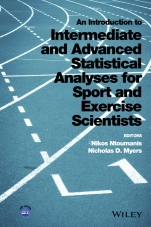
An Introduction to Intermediate and Advanced Statistical Analyses for Sport and Exercise Scientists
ISBN 9781118962053
Autor: Nikos Ntoumanis, Nicholas D. Myers
Wydawca: Wiley
Dostępność: 3-6 tygodni
Cena: 353,85 zł
Przed złożeniem zamówienia prosimy o kontakt mailowy celem potwierdzenia ceny.
ISBN13: |
9781118962053 |
ISBN10: |
1118962052 |
Autor: |
Nikos Ntoumanis, Nicholas D. Myers |
Oprawa: |
Hardback |
Rok Wydania: |
2016-01-22 |
Ilość stron: |
312 |
Wymiary: |
234x155 |
Tematy: |
JN |
An Introduction to Intermediate and Advanced Statistical Analyses for Sport and Exercise Scientists
Nikos Ntoumanis, School of Psychology and Speech Pathology, Curtin University, Perth, Australia
Nicholas D. Myers, School of Education and Human Development, University of Miami, Florida, USA
An essential guide to modern statistical methods for sport and exercise scientists
This book introduces the reader to a wide variety of intermediate and advanced statistical tests that are utilised within the sport and exercise science/ kinesiology field. The first part of this book explores widely employed statistical tests including ANOVA, MANOVA and mediation and moderation via regressions. The later chapters examine more advanced and less frequently used tests and procedures such as sample size and power determination, exploratory structural equation modeling and mixture modeling.
Key features:
Provides a wide variety of intermediate to advanced statistical tests with all examples being specific to sport and exercise sciences Each chapter has step–by–step explanations of the required procedures and a non–technical interpretation of the findings Written by a diverse international group of experts in quantitative methodology A supporting website featuring a variety of detailed programme code; primarily SPSS and MPlus, screenshots and datasets to enable readers to replicate the examples presented throughout the bookThis book provides an excellent resource for researchers and postgraduate students who need to use complex and statistical techniques. Postgraduate students and researchers in health, psychology and education will also find this book beneficial.
About the editors xiii
List of contributors xv
Foreword xix
Preface xxi
1 Factorial ANOVA and MANOVA 1
General Introduction 1
Hypothesis Testing 2
Alpha Level 2
Assumptions 3
Further Considerations 4
Utility in Sport and Exercise Sciences 6
Treatment Conditions 6
Existing Conditions 6
Individual Characteristics 7
Recent Usage 7
The Substantive Example 7
Univariate: Factorial ANOVA 8
Univariate Assumptions 8
The Synergy 10
Factorial ANOVA Analysis Plan 10
Example of a Write ]Up Compatible with the APA Publication Manual 11
Factorial MANOVA Analysis Plan 13
Example of a Write ]Up Compatible with the APA Publication Manual 13
Summary 16
Acknowledgment 18
References 18
2 Repeated measures ANOVA and MANOVA 19
General Introduction 19
Between ] versus Within ]Subjects Variables 19
Hypothesis Testing 20
Assumptions 20
Further Considerations 21
Utility in Sport and Exercise Sciences 22
Multiple Treatment Conditions 23
Multiple Assessments 23
Longitudinal Studies 23
Recent Usage 24
The Substantive Example 24
Univariate: Repeated Measures ANOVA 24
Univariate Assumptions 25
Multivariate: Repeated Measures MANOVA 26
Multivariate Assumptions 26
The Synergy 27
Repeated Measures ANOVA Analysis Plan 27
Example of a Write ]Up Compatible with the APA Publication Manual 29
Repeated Measures MANOVA Analysis Plan 29
Example of a Write ]Up Compatible with the APA Publication Manual 31
Summary 32
Acknowledgment 34
References 34
3 Mediation and moderation via regression analysis 35
General Introduction 35
Utility of the Methods in Sport and Exercise Science 36
The Substantive Example 38
Mediation 38
The Synergy 38
Mediation 38
The Substantive Example 44
Moderation 44
The Synergy 45
Moderation 45
Summary 53
References 55
4 Item response theory and its applications in Kinesiology 57
General Introduction 57
What Is IRT? 59
Other Commonly Used IRT Models 60
Assumptions Related to IRT 62
Unidimensionality 62
Local Independence 62
Addressing Model ]Data Fit 62
Inspecting Model Assumptions 63
Inspecting Expected Model Features 63
Inspecting Overall Model ]Data Fit 64
Computer Simulation for Model ]Data Fit Testing 64
Unique Features and Advantages of IRT 65
Estimation Invariance 65
Common Metric Scale 65
Item and Test Information 66
Test Relative Efficiency 68
Global Reliability Is no Longer a Concern 69
Item Bank and IRT ]Based Test Construction 69
Parameter Estimation and Software 71
Utility of the Methodology in Kinesiology 71
IRT Limitations and Future Direction 72
Conclusion 73
References 74
5 Introduction to factor analysis and structural equation modeling 79
General Introduction 79
Utility of the Method in Sport and Exercise Science 80
Terminology and Methodology 83
Evaluating Model Fit 86
Interpreting Parameter Estimates 88
The Substantive Example 89
The Synergy 91
EFA: Establishing the Factor Structure 91
CFA: Testing the Measurement Models 93
Structural Equation Modeling: Adding the Regression Paths 96
Summary 98
References 99
6 Invariance testing across samples and time: Cohort ]sequence analysis of perceived body composition 101
General Introduction to the Importance of Measurement Invariance 102
Cohort ]Sequential Designs: Longitudinal Invariance across Samples and Time 106
Substantive Application: Physical Self ]Concept 107
Methodology 111
The PSDQ Instrument 111
Statistical Analyses 111
Goodness of Fit 112
Results 113
Basic Cohort ]Sequence Model: Four Cohort Groups and Four Waves 113
Cohort ]Sequence Design of Multiple Indicators, Multiple Causes Models 115
Use of Model Constraint with Orthogonal Polynomial Contrasts to Evaluate Cohort Sequence and MIMIC Latent Means 116
Use of Latent Growth Curve Models to Evaluate Stability/Change over Time 119
LGC Results 123
Summary, Implications, and Further Directions 123
Methodological Implications, Limitations, and Further Directions 123
References 125
7 Cross ]lagged structural equation modeling and latent growth modeling 131
General Introduction 131
A Theoretical Framework for the Study of Change 132
Utility of the Method in Sport and Exercise Science 132
Analysis of Change 132
The Substantive Example 134
Theoretical Background 134
The Data: Participants and Measurement 134
The Synergy 135
CLPM 135
CLPM Example 137
Latent Growth Modeling 140
LGM Example 141
Model 2a: Unconditional LGM 143
Model 2b: Conditional LGM 145
Model 2c: Unconditional LGM with TVCs 145
Model 3: Parallel Process LGM 146
Model 4: Second ]Order LGM 148
Summary 150
References 151
8 Exploratory structural equation modeling and Bayesian estimation 155
General Introduction 155
Utility of the Methods in Sport and Exercise Science 156
The Substantive Example(s) 159
The Motivational Correlates of Mentally Tough Behavior 159
Developing Synergies through Statistical Modeling 161
ESEM 161
Bayesian Estimation 168
Summary 179
References 180
9 A gentle introduction to mixture modeling using physical fitness performance data 183
General Introduction 183
Utility of the Method in Sport and Exercise Science 186
The Substantive Example(s) 187
Class Enumeration in Mixture Models 188
The Estimation of Mixture Models 190
The Synergy 190
LPA of Grade 5 Students and Tests of Invariance across Gender Groups 190
Inclusion of Covariates in LPA Solutions 195
LTA 196
Mixture Regression Analyses of Grade 5 Students 198
Latent Basis Growth Mixture Analyses: Cardiovascular Fitness 202
Piecewise Growth Mixture Analyses: Physical Strength 203
Summary 204
Acknowledgments 205
References 206
10 Multilevel (structural equation) modeling 211
General Introduction 211
Multilevel Structural Equation Modeling 212
Utility of the Methodology in Sport and Exercise Science 214
The Substantive Examples 215
Coaching Competency Collective Efficacy Team Performance: 1 1 2 216
Action Planning Intervention Physical Activity Action Plans Physical Activity: 2 1 1 217
The Synergy 218
Coaching Competency Collective Efficacy Team Performance: 1 1 2 219
Action Planning Intervention Physical Activity Action Plans Physical Activity: 2 1 1 222
Summary 229
References 230
11 Application of meta ]analysis in sport and exercise science 233
General Introduction 233
Stages of Meta ]Analysis 233
Key Elements of Meta ]Analysis 234
Goals of Meta ]Analysis 236
Utility of the Methodology in Sport and Exercise Science 238
The Substantive Example 238
The Synergy 241
Univariate Meta ]Analysis 241
Multivariate Meta ]Analysis 245
Summary 249
Acknowledgment 251
References 251
12 Reliability and stability of variables/instruments used in sport science and sport medicine 255
Introduction 255
A. Assessment of Test Retest Agreement Using Interval/Ratio Data 256
A Worked Example Using the Test Retest Differences of the Biceps Skinfold Measurements 257
B. Utility of the Assessment of Test Retest Stability Using Categorical/Likert ]Type Data 260
The Substantive Example 261
Utility of the Test Retest Stability Using Nonparametric Data 261
The Synergy 262
Utility of the Item by Item Approach to Test Retest Stability 263
The Synergy 263
Summary 265
References 266
13 Sample size determination and power estimation in structural equation modeling 267
General Introduction 267
Power 268
Power Analysis in SEM 268
Utility of the Methodology in Sport and Exercise Science 269
Power Analysis Regarding Model ]Data Fit: An Introduction 269
Power Analysis Regarding Focal Parameters: An Introduction 270
The Substantive Example 272
Bifactor Model in Sport and Exercise Science 272
Bifactor Model and the PETES 273
The Synergy 275
Power Analysis Regarding Model ]Data Fit: A Demonstration 276
Power Analysis Regarding Focal Parameters: A Demonstration 278
Summary 281
References 282
Index 285
Koszyk
Książek w koszyku: 0 szt.
Wartość zakupów: 0,00 zł
Informacje


Kontakt
Gambit
Centrum Oprogramowania
i Szkoleń Sp. z o.o.
Al. Pokoju 29b/22-24
31-564 Kraków
Siedziba Księgarni
ul. Kordylewskiego 1
31-542 Kraków
+48 12 410 5991
+48 12 410 5987
+48 12 410 5989
Subskrypcje
Administratorem danych osobowych jest firma Gambit COiS Sp. z o.o. Na podany adres będzie wysyłany wyłącznie biuletyn informacyjny.
Autoryzacja płatności

Informacje na temat autoryzacji płatności poprzez PayU.

© Copyright 2012: GAMBIT COiS Sp. z o.o. Wszelkie prawa zastrzeżone.
Projekt i wykonanie: Alchemia Studio Reklamy