


Wydawcy
Katalog tematyczny
- Archeologia (109)
- Ekonomia, finanse, business (13704)
- Filozofia (1445)
- Historia (3040)
- Języki i językoznawstwo (2356)
- Lifestyle, hobby i rozrywka (475)
- Medycyna (9704)
- Nauki humanistyczne (4)
- Nauki o Ziemi i środowisku (2638)
- Nauki ścisłe (20412)
- Nauki społeczne (8486)
- Nauki techniczne (13450)
- Prawo (1696)
- Publikacje informacyjne i interdyscyplinarne (1288)
- Religia i wierzenia (917)
- Technika komputerowa (4067)
- Zdrowie, relacje międzyludzkie i rozwój osobisty (657)





Informacje szczegółowe o książce
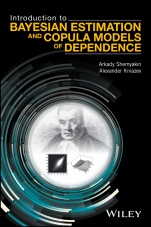
Introduction to Bayesian Estimation and Copula Models of Dependence
ISBN 9781118959015
Autor: Arkady Shemyakin, Alexander Kniazev
Wydawca: Wiley
Dostępność: 3-6 tygodni
Cena: 542,85 zł
Przed złożeniem zamówienia prosimy o kontakt mailowy celem potwierdzenia ceny.
ISBN13: |
9781118959015 |
ISBN10: |
1118959019 |
Autor: |
Arkady Shemyakin, Alexander Kniazev |
Oprawa: |
Hardback |
Rok Wydania: |
2017-05-12 |
Ilość stron: |
352 |
Wymiary: |
237x163 |
Tematy: |
KFFN |
Presents an introduction to Bayesian statistics, presents an emphasis on Bayesian methods (prior and posterior), Bayes estimation, prediction, MCMC, Bayesian regression, and Bayesian analysis of statistical models of dependence, and features a focus on copulas for risk management
Introduction to Bayesian Estimation and Copula Models of Dependence emphasizes the applications of Bayesian analysis to copula modeling and equips readers with the tools needed to implement the procedures of Bayesian estimation in copula models of dependence. This book is structured in two parts: the first four chapters serve as a general introduction to Bayesian statistics with a clear emphasis on parametric estimation; and the following four chapters stress statistical models of dependence with a focus of copulas.
A review of the main concepts are discussed along with the basics of Bayesian statistics including prior information and experimental data, prior and posterior distributions, with an emphasis on Bayesian parametric estimation. The basic mathematical background of both Markov chains and Monte Carlo integration and simulation is also provided. The author discusses statistical models of dependence with a focus on copulas and presents a brief survey of pre–copula dependence models. The main definitions and notations of copula models are summarized followed by discussions of real world cases that address particular risk management problems.
In addition, this book includes:
Practical examples of copulas in use including within the Basel Accord II documents that regulate the world banking system as well as examples of Bayesian methods within current FDA recommendations Step–by–step procedures of multivariate data analysis and copula modeling, allowing readers to gain insight for their own applied research and studies Separate reference lists within each chapter and end–of–the–chapter exercises within Chapters 2 through 8 A companion website containing appendices: data files and demo files in Microsoft® Office Excel®, basic code in R, and selected exercise solutionsIntroduction to Bayesian Estimation and Copula Models of Dependence is a reference and resource for statisticians who need to learn formal Bayesian analysis as well as professionals within analytical and risk management departments of banks and insurance companies who are involved in quantitative analysis and forecasting. This book can also be used as a textbook for upper–undergraduate and graduate level courses in Bayesian statistics and analysis.
Arkady Shemyakin, PhD, is Professor in the Department of Mathematics and Director of the Statistics Program at the University of St. Thomas. A member of the American Statistical Association and the International Society for Bayesian Analysis, Dr. Shemyakin′s research interests include information theory, Bayesian methods of parametric estimation, and copula models in actuarial mathematics, finance, and engineering.
Alexander G. Kniazev, PhD, is Associate Professor and Head of the Department of Mathematics at Astrakhan State University in Russia. Dr. Kniazev′s research interests include representation theory of Lie algebras and finite groups, mathematical statistics, econometrics, and financial mathematics.
List of Figures xv
List of Tables xxi
Foreword xxiii
Acknowledgments xxv
Acronyms xxvii
Glossary xxix
Introduction xxxi
PART I BAYESAIN ESTIMATION
1 Random Variables and Distributions 3
1.1 Conditional Probability 4
1.2 Discrete Random Variables 5
1.3 Continuous Distributions on the Real Line 8
1.4 Continuous Distributions with Nonnegative Values 12
1.5 Continuous Distributions on a Bounded Interval 17
1.6 Joint Distributions 18
1.7 Time Dependent Random Variables 24
References 29
2 Foundations of Bayesian Analysis 31
2.1 Education and Wages 31
2.2 Two Envelopes 34
2.3 Hypothesis Testing 37
2.3.1 The Likelihood Principle. 37
2.3.2 Review of Classical Procedures 37
2.3.3 Bayesian Hypotheses Testing 39
2.4 Parametric Estimation 41
2.4.1 Review of Classical Procedures 41
2.4.2 Maximum Likelihood Estimation (MLE) 41
2.4.3 Bayesian Approach to Parametric Estimation 44
2.5 Bayesian and Classical Approaches to Statistics 45
2.5.1 Classical (Frequentist) Approach 47
2.5.2 Lady Tasting Tea 47
2.5.3 Bayes Theorem 50
2.5.4 Main Principles of the Bayesian Approach 51
2.6 The Choice of the Prior 54
2.6.1 Subjective Priors 54
2.6.2 Objective Priors 57
2.6.3 Empirical Bayes 60
2.7 Conjugate Distributions 62
2.7.1 Exponential Family 63
2.7.2 Poisson Likelihood 63
2.7.3 Table of Conjugate Distributions 64
References 64
Problems 66
3 Background for Markov Chain Monte Carlo 69
3.1 Randomization 69
3.1.1 Rolling Dice 69
3.1.2 Two Envelopes Revisited 70
3.2 Random Number Generation 72
3.2.1 Pseudorandom Numbers 72
3.2.2 Inverse Transform Method 73
3.2.3 General Transformation Methods 75
3.2.4 AcceptReject Methods 78
3.3 Monte Carlo Integration 81
3.3.1 Numerical Integration 82
3.3.2 Estimating Moments 83
3.3.3 Estimating Probabilities 84
3.3.4 Simulating Multiple Futures 85
3.4 Precision of Monte Carlo Method 87
3.4.1 Monitoring Mean and Variance 87
3.4.2 Importance Sampling 89
3.4.3 Correlated Samples 91
3.4.4 Variance Reduction Methods 93
3.5 Markov Chains 96
3.5.1 Markov Processes 96
3.5.2 Discrete Time, Discrete State Space 98
3.5.3 Transition Probability 98
3.5.4 "Sun City" 99
3.5.5 Utility Bills 99
3.5.6 Classification of States 100
3.5.7 Stationary Distribution 101
3.5.8 Reversibility Condition 102
3.5.9 Markov Chains with Continuous State Spaces 103
3.6 Simulation of a Markov Chain 104
3.7 Applications 105
3.7.1 Bank Sizes 105
3.7.2 Related Failures of Car Parts 107
References 110
Problems 111
4 Markov Chain Monte Carlo Methods (MCMC) 113
4.1 Markov Chain Simulations for Sun City and Ten Coins 113
4.2 MetropolisHastings Algorithm (MHA) 120
4.3 Random Walk MHA 123
4.4 Gibbs Sampling 126
4.5 Diagnostics of MCMC 129
4.5.1 Monitoring Bias and Variance of MCMC 130
4.5.2 Burnin and Skip Intervals 133
4.5.3 Diagnostics of MCMC 134
4.6 Suppressing Bias and Variance 135
4.6.1 Perfect Sampling 135
4.6.2 Adaptive MHA 136
4.6.3 ABC and Other Methods 137
4.7 Timetodefault Analysis of Mortgage Portfolios 137
4.7.1 Mortgage Defaults 137
4.7.2 Customer Retention and Infinite Mixture Models 138
4.7.3 Latent Classes and Finite Mixture Models 140
4.7.4 Maximum Likelihood Estimation 142
4.7.5 A Bayesian Model 143
References 146
Problems 148
PART II MODELING DEPENDENCE
5 Statistical Dependence Structures 153
5.1 Introduction 153
5.2 Correlation 156
5.2.1 Pearson s Linear Correlation 157
5.2.2 Spearman s Rank Correlation 158
5.2.3 Kendall s Concordance 159
5.3 Regression Models 161
5.3.1 Heteroskedasticity 162
5.3.2 Nonlinear Regression 163
5.3.3 Prediction 166
5.4 Bayesian Regression 167
5.5 Survival Analysis 170
5.5.1 Proportional Hazards 171
5.5.2 Shared Frailty 171
5.5.3 Multistage Models of Dependence 173
5.6 Modeling Joint Distributions 173
5.6.1 Bivariate Survival Functions 174
5.6.2 Bivariate Normal 176
5.7 Statistical Dependence and Financial Risks 177
5.7.1 A Story of Three Loans 177
5.7.2 Independent Defaults 179
5.7.3 Correlated Defaults 180
References 183
Problems 184
6 Copula Models of Dependence 187
6.1 Introduction 187
6.2 Definitions 189
6.2.1 Quasimonotonicity 189
6.2.2 Definition of Copula 190
6.2.3 Sklar s Theorem 191
6.2.4 Survival Copulas 191
6.3 Simplest Pair Copulas 192
6.3.1 Maximum Copula 192
6.3.2 Minimum Copula 195
6.3.3 FGM Copulas 196
6.4 Elliptical Copulas 197
6.4.1 Elliptical Distributions 197
6.4.2 Method of Inverses 198
6.4.3 Gaussian Copula 198
6.4.4 The tcopula 200
6.5 Archimedean Copulas 202
6.5.1 Definitions 202
6.5.2 Oneparameter Copulas 204
6.5.3 Clayton Copula 205
6.5.4 Frank Copula 206
6.5.5 GumbelHougaard Copula 207
6.5.6 Twoparameter Copulas 209
6.6 Simulation of Joint Distributions 211
6.6.1 Bivariate Elliptical Distributions 211
6.6.2 Bivariate Archimedean Copulas 213
6.7 Multidimensional Copulas 215
References 222
Problems 224
7 Statistics of Copulas 227
7.1 The Formula that Killed Wall Street 227
7.2 Criteria of Model Comparison 231
7.2.1 Goodnessoffit Tests 232
7.2.2 Posterior Predictive pvalues 233
7.2.3 Information Criteria 236
7.2.4 Concordance Measures 237
7.2.5 Tail Dependence 238
7.3 Parametric Estimation 239
7.3.1 Parametric, Semiparametric, or Nonparametric? 241
7.3.2 Method of Moments 242
7.3.3 Minimum Distance 242
7.3.4 MLE and MPLE 243
7.3.5 Bayesian Estimation 244
7.4 Model Selection 246
7.4.1 Hybrid Approach 246
7.4.2 Information Criteria 247
7.4.3 Bayesian Model Selection 249
7.5 Copula Models of Joint Survival 250
7.6 Related Failures of Vehicle Components 253
7.6.1 Estimation of Association Parameters 255
7.6.2 Comparison of Copula Classes 256
7.6.3 Bayesian Model Selection 258
7.6.4 Conclusions 260
References 262
Problems 264
8 International Markets 265
8.1 Introduction 265
8.2 Selection of univariate distribution models. 268
8.3 Prior Elicitation for Pair Copula Parameter 272
8.4 Bayesian Estimation of Pair Copula Parameters 277
8.5 Selection of Pair Copula Model 281
8.6 GoodnessofFit Testing 285
8.7 Simulation and Forecasting 289
References 294
Problems 296
Index 299
Koszyk
Książek w koszyku: 0 szt.
Wartość zakupów: 0,00 zł
Informacje


Kontakt
Gambit
Centrum Oprogramowania
i Szkoleń Sp. z o.o.
Al. Pokoju 29b/22-24
31-564 Kraków
Siedziba Księgarni
ul. Kordylewskiego 1
31-542 Kraków
+48 12 410 5991
+48 12 410 5987
+48 12 410 5989
Subskrypcje
Administratorem danych osobowych jest firma Gambit COiS Sp. z o.o. Na podany adres będzie wysyłany wyłącznie biuletyn informacyjny.
Autoryzacja płatności

Informacje na temat autoryzacji płatności poprzez PayU.

© Copyright 2012: GAMBIT COiS Sp. z o.o. Wszelkie prawa zastrzeżone.
Projekt i wykonanie: Alchemia Studio Reklamy