


Wydawcy
Katalog tematyczny
- Archeologia (109)
- Ekonomia, finanse, business (13704)
- Filozofia (1445)
- Historia (3040)
- Języki i językoznawstwo (2356)
- Lifestyle, hobby i rozrywka (475)
- Medycyna (9704)
- Nauki humanistyczne (4)
- Nauki o Ziemi i środowisku (2638)
- Nauki ścisłe (20412)
- Nauki społeczne (8486)
- Edukacja (229)
- Kryminologia, opieka spełeczna (284)
- Obronność (10)
- Polityka (1389)
- Psychologia (777)
- Socjologia (410)
- Społeczeństwo i kultura (187)
- Nauki techniczne (13450)
- Prawo (1696)
- Publikacje informacyjne i interdyscyplinarne (1288)
- Religia i wierzenia (917)
- Technika komputerowa (4067)
- Zdrowie, relacje międzyludzkie i rozwój osobisty (657)





Informacje szczegółowe o książce
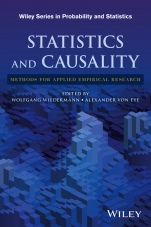
Statistics and Causality: Methods for Applied Empirical Research
ISBN 9781118947043
Autor: Wolfgang Wiedermann, Alexander von Eye
Wydawca: Wiley
Dostępność: 3-6 tygodni
Cena: 535,50 zł
Przed złożeniem zamówienia prosimy o kontakt mailowy celem potwierdzenia ceny.
ISBN13: |
9781118947043 |
ISBN10: |
1118947045 |
Autor: |
Wolfgang Wiedermann, Alexander von Eye |
Oprawa: |
Hardback |
Rok Wydania: |
2016-07-22 |
Ilość stron: |
480 |
Wymiary: |
242x159 |
Tematy: |
JC |
A one–of–a–kind guide to identifying and dealing with modern statistical developments in causality
Written by a group of well–known experts, Statistics and Causality: Methods for Applied Empirical Research focuses on the most up–to–date developments in statistical methods in respect to causality. Illustrating the properties of statistical methods to theories of causality, the book features a summary of the latest developments in methods for statistical analysis of causality hypotheses.
The book is divided into five accessible and independent parts. The first part introduces the foundations of causal structures and discusses issues associated with standard mechanistic and difference–making theories of causality. The second part features novel generalizations of methods designed to make statements concerning the direction of effects. The third part illustrates advances in Granger–causality testing and related issues. The fourth section focuses on counterfactual approaches and propensity score analysis. Finally, the fifth part presents designs for causal inference with an overview of the research designs commonly used in epidemiology. Statistics and Causality: Methods for Applied Empirical Research also includes:
New statistical methodologies and approaches to causal analysis in the context of the continuing development of philosophical theories End–of–chapter bibliographies that provide references for further discussions and additional research topics Discussions on the use and applicability of software when appropriateStatistics and Causality: Methods for Applied Empirical Research is an ideal reference for practicing statisticians, applied mathematicians, psychologists, sociologists, logicians, medical professionals, epidemiologists, and educators who want to learn more about new methodologies in causal analysis. The book is also an excellent textbook for graduate–level courses in causality and qualitative logic.
Wolfgang Wiedermann, PhD, is Assistant Professor in the Department of Educational, School, and Counseling Psychology at the University of Missouri, Columbia. His research interests include the development of methods to evaluate directionality of regression models, the development and evaluation of methods for person–oriented research, and methods for intensive longitudinal data.
Alexander von Eye, PhD, is Professor Emeritus of Psychology at Michigan State University. His research interests include statistical methods, categorical data analysis, and human development. Dr. von Eye is Section Editor for the Encyclopedia of Statistics in Behavioral Science and is the coauthor of Log–Linear Modeling: Concepts, Interpretation, and Application, both published by Wiley.
List of Contributors ix
Preface xiii
Part I Base of Causality 1
1 Causation and the Aims of Inquiry 3
Edward J. Hall
1.1 Introduction 3
1.2 The aim of an account of causation 4
1.2.1 The possible utility of a false account 5
1.2.2 Inquiry s Aim 5
1.2.3 The role of intuitions 6
1.3 The good news 7
1.3.1 The core idea 7
1.3.2 Taxonomizing conditions 9
1.3.3 Unpacking dependence 10
1.3.4 The good news, amplified 12
1.4 The challenging news 17
1.4.1 Multiple realizability 17
1.4.2 Protracted causes 19
1.4.3 Higher–level taxonomies and normal conditions 25
1.5 The perplexing news 27
1.5.1 The centrality of causal process 27
1.5.2 A speculative proposal 29
2 Evidence and Epistemic Causality 33
Michael Wilde and Jon Williamson
2.1 Causality and evidence 33
2.2 The epistemic theory of causality 37
2.3 The nature of evidence 40
2.4 Conclusion 42
Part II Directionality of Effects 45
3 Statistical Inference for Direction of Dependence in Linear Models 47
Yadolah Dodge and Valentin Rousson
3.1 Introduction 47
3.2 Choosing the direction of a regression line 48
3.3 Significance testing for the direction of a regression line 50
3.4 Lurking variables and causality 57
3.4.1 Two independent predictors 57
3.4.2 Confounding variable 58
3.4.3 Selection of a subpopulation 59
3.5 Brain and body data revisited 59
3.6 Conclusions 62
4 Directionality of Effects in Causal Mediation Analysis 65
Wolfgang Wiedermann and Alexander von Eye
4.1 Introduction 65
4.2 Elements of causal mediation analysis 68
4.3 Directionality of effects in mediation models 71
4.4 Testing directionality using independence properties of competing mediation models 74
4.4.1 Independence properties of bivariate relations 74
4.4.2 Independence properties of the multiple variable model 76
4.4.3 Measuring and testing independence 77
4.5 Simulating the performance of directionality tests 85
4.5.1 Results 86
4.6 Empirical data example: Development of numerical cognition 90
4.7 Discussion 93
5 Direction of Effects in Categorical Variables: A Structural Perspective 107
Alexander von Eye and Wolfgang Wiedermann
5.1 Introduction 107
5.2 Concepts of independence in categorical data analysis 108
5.3 Direction dependence in bivariate settings: Metric and categorical variables 110
5.3.1 Simulating the performance of non–hierarchical log–linear models 114
5.4 Explaining the structure of cross–classifications 116
5.5 Data example 123
5.6 Discussion 126
6 Directional Dependence Analysis Using Skew–Normal Copula–Based Regression 131
Seongyong Kim and Daeyoung Kim
6.1 Introduction 131
6.2 Copula–based regression 132
6.2.1 Copula 133
6.2.2 Copula–based regression 134
6.3 Directional dependence in the copula–based regression 136
6.4 Skew–normal copula 137
6.5 Inference of directional dependence using skew–normal copula–based regression 140
6.5.1 Estimation of copula–based regression 140
6.5.2 Detection of directional dependence and computation of the directional dependence measures 145
6.6 Application 146
6.7 Conclusion 149
7 Non–Gaussian Structural Equation Models for Causal Discovery 153
Shohei Shimizu
7.1 Introduction 153
7.2 Independent component analysis 157
7.2.1 Model 157
7.2.2 Identifiability 157
7.2.3 Estimation 158
7.3 Basic linear non–gaussian acyclic model 158
7.3.1 Model 159
7.3.2 Identifiability 160
7.3.3 Estimation 162
7.4 LiNGAM for time series 167
7.4.1 Model 167
7.4.2 Identifiability 167
7.4.3 Estimation 168
7.5 LiNGAM with latent common causes 169
7.5.1 Model 169
7.5.2 Identifiability 171
7.5.3 Estimation 173
7.6 Conclusions and future directions 177
8 Nonlinear Functional Causal Models for Distinguishing Cause from Effect 185
Kun Zhang and Aapo Hyvärinen
8.1 Introduction 185
8.2 Nonlinear additive noise model 187
8.2.1 Definition of model 187
8.2.2 Likelihood ratio for nonlinear additive models 189
8.2.3 Information–theoretic interpretation 190
8.2.4 Likelihood ratio and independence–based methods 191
8.3 Post–nonlinear causal model 192
8.3.1 The model 192
8.3.2 Identifiability of causal direction 193
8.3.3 Determination of causal direction based on the PNL causal model 194
8.4 On the relationships between different principles for model estimation 195
8.5 Remark on general nonlinear causal models 197
8.6 Some empirical results 198
8.7 Conclusion and discussions 198
Part III Granger Causality and Longitudinal Data Modeling 203
9 Alternative Forms of Granger Causality, Heterogeneity and Non–Stationarity 205
Peter C.M. Molenaar and Lawrence L.Lo
9.1 Introduction 205
9.2 Some initial remarks on the logic of Granger causality testing 206
9.3 Preliminary introduction to time series analysis 207
9.4 Overview of Granger causality testing in the time domain 210
9.5 Granger causality testing in the frequency domain 212
9.5.1 Two equivalent representations of a VAR(a) 212
9.5.2 Partial directed coherence (PDC) as a frequency domain index of Granger causality 213
9.5.3 Some preliminary comments 214
9.5.4 Application to simulated data 215
9.6 A new data–driven solution to Granger causality testing 216
9.6.1 Fitting a uSEM 217
9.6.2 Extending the fit of a uSEM 217
9.6.3 Application of the hybrid VAR fit to simulated data 218
9.7 Extensions to non–stationary series and heterogeneous replications 220
9.7.1 Heterogeneous replications 220
9.7.2 Non–stationary series 222
9.8 Discussion and conclusion 224
10 Granger meets Rasch: Investigating Granger Causation with Multidimensional Longitudinal Item Response Models 231
Ingrid Koller, Claus H. Carstensen, Wolfgang Wiedermann, and Alexander von Eye
10.1 Introduction 231
10.2 Granger Causation 232
10.3 The Rasch Model 234
10.4 Longitudinal item response theory models 235
10.5 Data example: Scientific literacy in preschool children 240
10.6 Discussion 242
11 Granger Causality for Ill–Posed Problems: Ideas, Methods, and Application in Life Sciences 249
Kate ina Hlavá ková–Schindler, Valeriya Naumova, and Sergiy Pereverzyev Jr.
11.1 Introduction 249
11.1.1 Causality problems in life sciences 249
11.1.2 Outline of the chapter 250
11.1.3 Notation 251
11.2 Granger causality and multivariate Granger causality 251
11.2.1 Granger causality 252
11.2.2 Multivariate Granger causality 253
11.3 Gene regulatory networks 254
11.4 Regularization of ill–posed inverse problems 255
11.5 Multivariate Granger causality approaches using 1 and 2 penalties 256
11.6 Applied quality measures 261
11.7 Novel regularization techniques with a case study of gene regulatory networks reconstruction 263
11.7.1 Optimal graphical lasso Granger estimator 263
11.7.2 Thresholding strategy 264
11.7.3 An automatic realization of the GLG–method 265
11.7.4 Granger causality with multi–penalty regularization 266
11.7.5 Case study of gene regulatory network reconstruction 268
11.8 Conclusion 272
12 Unmeasured Reciprocal Interactions: Specification and Fit Using Structural Equation Models 277
Phillip K. Wood
12.1 Introduction 278
12.2 Types of reciprocal relationship models 278
12.2.1 Cross–lagged panel approaches 279
12.2.2 Granger causality 280
12.2.3 Epistemic causality 281
12.2.4 Reciprocal causality 282
12.3 Unmeasured reciprocal and auto–causal effects 286
12.3.1 Bias in standardized regression weight 288
12.3.2 Auto–causal effects 289
12.3.3 Instrumental variables 291
12.4 Longitudinal data settings 293
12.4.1 Monte Carlo simulation 293
12.4.2 Real world data examples 300
12.5 Discussion 304
Part IV Counterfactual Approaches and Propensity Score Analysis 309
13 Loglinear Causal Analysis of Cross–Classified Categorical Data 311
Kazuo Yamaguchi
13.1 Introduction 311
13.2 Propensity score methods and the collapsibility problem for the logit model 313
13.3 On standardization and the lack of collapsibility of the logit model 316
13.4 The problem of zero–sample estimates of conditional probabilities and the use of semiparametric models to solve the problem 318
13.4.1 The problem of zero–sample estimates of conditional probabilities 318
13.4.2 Method for obtaining adjusted two–way frequency data for the analysis of association between X and Y 319
13.4.3 Method for obtaining an adjusted three–way frequency table for the analysis of conditional association 320
13.5 The estimation of standard errors in the analysis of association with adjusted contingency table data 321
13.6 Illustrative application 323
13.6.1 Data 323
13.6.2 Software 323
13.6.3 Analysis 324
13.7 Conclusion 326
14 Design–Based and Model–Based Analysis of Propensity Score Designs 333
Peter M. Steiner
14.1 Introduction 333
14.2 Causal models and causal estimands 334
14.3 Design–based and model–based inference with randomized experiments 336
14.3.1 Design–based formulation 337
14.3.2 Model–based formulation 338
14.4 Design–based and model–based inferences with PS designs 339
14.4.1 Propensity score designs 340
14.4.2 Design– vs. model–based formulations of PS designs 345
14.4.3 Other propensity score techniques 346
14.5 Statistical issues with PS designs in practice 347
14.5.1 Choice of a specific PS design 348
14.5.2 Estimation of propensity scores 350
14.5.3 Estimating and testing the treatment effect 354
14.6 Discussion 355
15 Adjustment when Covariates are Fallible 363
Steffi Pohl, Marie–Ann Sengewald, and Rolf Steyer
15.1 Introduction 363
15.2 Theoretical framework 364
15.2.1 Definition of causal effects 365
15.2.2 Identification of causal effects 366
15.2.3 Adjusting for latent or fallible covariates 367
15.3 The impact of measurement error in covariates on causal effect estimation 369
15.3.1 Theoretical impact of one fallible covariate 369
15.3.2 Investigation of the impact of fallible covariates in simulation studies 370
15.3.3 Investigation of the impact of fallible covariates in an empirical study 370
15.4 Approaches accounting for latent covariates 372
15.4.1 Latent covariates in propensity score methods 373
15.4.2 Latent covariates in ANCOVA models 374
15.4.3 Performance of the approaches in an empirical study 375
15.5 The impact of additional covariates on the biasing effect of a fallible covariate 375
15.5.1 Investigation of the impact of additional covariates in an empirical study 377
15.5.2 Investigation of the impact of additional covariates in simulation studies 379
15.6 Discussion 379
16 Latent Class Analysis with Causal Inference: The Effect of Adolescent Depression on Young Adult Substance Use Profile 385
Stephanie T. Lanza, Megan S. Schuler, and Bethany C. Bray
16.1 Introduction 385
16.2 Latent class analysis 386
16.2.1 LCA with covariates 387
16.3 Propensity score analysis 389
16.3.1 Inverse propensity weights (IPWs) 390
16.4 Empirical demonstration 390
16.4.1 The causal question: A moderated average causal effect 390
16.4.2 Participants 391
16.4.3 Measures 391
16.4.4 Analytic strategy for LCA with causal inference 394
16.4.5 Results from empirical demonstration 394
16.5 Discussion 397
16.5.1 Limitations 399
Part V Designs for Causal Inference 407
17 Can we Establish Causality with Statistical Analyses? The Example of Epidemiology 409
Ulrich Frick and Jürgen Rehm
17.1 Why a chapter on design? 409
17.2 The epidemiological theory of causality 410
17.3 Cohort and case–control studies 413
17.4 Improving control in epidemiological research 416
17.4.1 Measurement 416
17.4.2 Mendelian randomization 418
17.4.3 Surrogate endpoints (experimental) 421
17.4.4 Other design measures to increase control 422
17.4.5 Methods of analysis 423
17.5 Conclusions: Control in epidemiological research can be improved. 426
Koszyk
Książek w koszyku: 0 szt.
Wartość zakupów: 0,00 zł
Informacje


Kontakt
Gambit
Centrum Oprogramowania
i Szkoleń Sp. z o.o.
Al. Pokoju 29b/22-24
31-564 Kraków
Siedziba Księgarni
ul. Kordylewskiego 1
31-542 Kraków
+48 12 410 5991
+48 12 410 5987
+48 12 410 5989
Subskrypcje
Administratorem danych osobowych jest firma Gambit COiS Sp. z o.o. Na podany adres będzie wysyłany wyłącznie biuletyn informacyjny.
Autoryzacja płatności

Informacje na temat autoryzacji płatności poprzez PayU.

© Copyright 2012: GAMBIT COiS Sp. z o.o. Wszelkie prawa zastrzeżone.
Projekt i wykonanie: Alchemia Studio Reklamy