


Wydawcy
Katalog tematyczny
- Archeologia (109)
- Ekonomia, finanse, business (13704)
- Filozofia (1445)
- Historia (3040)
- Języki i językoznawstwo (2356)
- Lifestyle, hobby i rozrywka (475)
- Medycyna (9704)
- Nauki humanistyczne (4)
- Nauki o Ziemi i środowisku (2638)
- Nauki ścisłe (20412)
- Nauki społeczne (8486)
- Nauki techniczne (13450)
- Prawo (1696)
- Publikacje informacyjne i interdyscyplinarne (1288)
- Religia i wierzenia (917)
- Technika komputerowa (4067)
- Zdrowie, relacje międzyludzkie i rozwój osobisty (657)





Informacje szczegółowe o książce
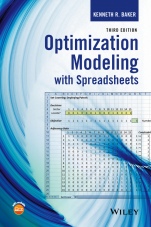
Optimization Modeling with Spreadsheets
ISBN 9781118937693
Autor: Kenneth R. Baker
Wydawca: Wiley
Dostępność: 3-6 tygodni
Cena: 535,50 zł
Przed złożeniem zamówienia prosimy o kontakt mailowy celem potwierdzenia ceny.
ISBN13: |
9781118937693 |
ISBN10: |
1118937694 |
Autor: |
Kenneth R. Baker |
Oprawa: |
Hardback |
Rok Wydania: |
2015-08-11 |
Numer Wydania: |
3rd Edition |
Ilość stron: |
400 |
Wymiary: |
242x156 |
Tematy: |
KM |
An accessible introduction to optimization analysis using spreadsheets
Updated and revised, Optimization Modeling with Spreadsheets, Third Edition emphasizes model–building skills in optimization analysis. By emphasizing both spreadsheet modeling and optimization tools in the freely available Microsoft® Office Excel® Solver, the book illustrates how to find solutions to real–world optimization problems without needing additional specialized software.
The Third Edition includes many practical applications of optimization models as well as a systematic framework that illuminates the common structures found in many successful models. With focused coverage on linear programming, nonlinear programming, integer programming, and heuristic programming, Optimization Modeling with Spreadsheets, Third Edition features:
Optimization Modeling with Spreadsheets, Third Edition is an excellent textbook for upper–undergraduate and graduate–level courses that include deterministic models, optimization, spreadsheet modeling, quantitative methods, engineering management, engineering modeling, operations research, and management science. The book is an ideal reference for readers wishing to advance their knowledge of Excel and modeling and is also a useful guide for MBA students and modeling practitioners in business and non–profit sectors interested in spreadsheet optimization.
Kenneth R. Baker, PhD, is Nathaniel Leverone Professor of Management at the Tuck School of Business and Adjunct Professor of Engineering at Dartmouth College. A Fellow of the Institute for Operations Research and the Management Sciences (INFORMS), Dr. Baker has published extensively in his areas of research interest, which include mathematical modeling, spreadsheet engineering, and scheduling. He is also coauthor of Principles of Sequencing and Scheduling and Management Science: The Art of Modeling with Spreadsheets, Fourth Edition, both published by Wiley.
Preface ix
1 Introduction to Spreadsheet Models for Optimization 1
1.1 Elements of a Model 2
1.2 Spreadsheet Models 4
1.3 A Hierarchy for Analysis 7
1.4 Optimization Software 8
1.5 Using Solver 10
Summary 16
Exercises 17
2 Linear Programming: Allocation, Covering, and Blending Models 21
2.1 Linear Models 22
2.1.1 Linear Constraints 24
2.1.2 Formulation 25
2.1.3 Layout 27
2.1.4 Results 28
2.2 Allocation Models 29
2.2.1 The Product Mix Problem 36
2.3 Covering Models 38
2.3.1 The Staff–Scheduling Problem 43
2.4 Blending Models 47
2.5 Modeling Errors in Linear Programming 52
2.5.1 Exceptions 53
2.5.2 Debugging 54
2.5.3 Logic 56
Summary 56
Exercises 57
3 Linear Programming: Network Models 65
3.1 The Transportation Model 66
3.2 The Assignment Model 71
3.3 The Transshipment Model 75
3.4 Features of Special Network Models 78
3.5 Building Network Models with Balance Equations 79
3.6 General Network Models with Yields 84
3.6.1 Models with Yield Losses 84
3.6.2 Models with Yield Gains 86
3.7 General Network Models with Transformed Flows 91
Summary 96
Exercises 96
4 Sensitivity Analysis in Linear Programs 108
4.1 Parameter Analysis in the Transportation Example 109
4.2 Parameter Analysis in the Allocation Example 116
4.3 The Sensitivity Report and the Transportation Example 123
4.4 The Sensitivity Report and the Allocation Example 127
4.5 Degeneracy and Alternative Optima 129
4.6 Patterns in Linear Programming Solutions 133
4.6.1 The Transportation Model 134
4.6.2 The Product Portfolio Model 138
4.6.3 The Investment Model 142
4.6.4 The Allocation Model 144
4.6.5 The Refinery Model 145
Summary 149
Exercises 151
5 Linear Programming: Data Envelopment Analysis 160
5.1 A Graphical Perspective on DEA 162
5.2 An Algebraic Perspective on DEA 166
5.3 A Spreadsheet Model for DEA 168
5.4 Indexing 173
5.5 Reference Sets and HCUs 174
5.6 Assumptions and Limitations of DEA 178
Summary 181
Exercises 181
6 Integer Programming: Binary ]Choice Models 191
6.1 Using Solver with Integer Requirements 193
6.2 The Capital Budgeting Problem 198
6.3 Set Covering 202
6.4 Set Packing 205
6.5 Set Partitioning 208
6.6 Playoff Scheduling 211
6.7 The Algorithm for Solving Integer Programs 215
Summary 220
Exercises 220
7 Integer Programming: Logical Constraints 227
7.1 Simple Logical Constraints: Exclusivity 229
7.2 Linking Constraints: The Fixed Cost Problem 231
7.3 Linking Constraints: The Threshold Level Problem 237
7.4 Linking Constraints: The Facility Location Model 238
7.4.1 Capacitated Version 239
7.4.2 Uncapacitated Version 243
7.5 Disjunctive Constraints: The Machine ]Sequencing Problem 246
7.6 Tour Constraints: The Traveling Salesperson Problem 251
Summary 259
Exercises 260
8 Nonlinear Programming 270
8.1 One ]Variable Models 271
8.1.1 An Inventory Example 273
8.1.2 A Quantity Discount Example 275
8.2 Local Optima and the Search for an Optimum 277
8.3 Two ]Variable Models 280
8.3.1 Curve Fitting 280
8.3.2 Two ]Dimensional Location 283
8.4 Nonlinear Models with Constraints 285
8.4.1 A Pricing Example 286
8.4.2 Sensitivity Analysis for Nonlinear Programs 288
8.4.3 The Portfolio Optimization Model 290
8.5 Linearizations 293
8.5.1 Linearizing the Maximum 294
8.5.2 Linearizing the Absolute Value 296
Summary 299
Exercises 301
9 Heuristic Solutions with the Evolutionary Solver 307
9.1 Features of the Evolutionary Solver 308
9.2 An Illustrative Example: Nonlinear Regression 309
9.3 The Machine ]Sequencing Problem Revisited 317
9.4 The Traveling Salesperson Problem Revisited 319
9.5 Budget Allocation 322
9.6 Two ]Dimensional Location 324
9.7 Line Balancing 327
9.8 Group Assignment 331
Summary 334
Exercises 336
Appendices
1 Supplemental Files and Software 348
A1.1 Supplemental MicrosoftR Office ExcelR Files 348
A1.2 Analytic Solver Platform for Education Software 348
A1.3 Opensolver Software 349
2 Graphical Methods for Linear Programming 350
A2.1 An Example 350
A2.2 Generalities 355
3 The Simplex Method 357
A3.1 An Example 357
A3.2 Variations of the Algorithm 362
Index 366
Kenneth R. Baker, PhD, is Nathaniel Leverone Professor of Management at the Tuck School of Business and Adjunct Professor of Engineering at Dartmouth College. A Fellow of the Institute for Operations Research and the Management Sciences (INFORMS), Dr. Baker has published extensively in his areas of research interest, which include mathematical modeling, spreadsheet engineering, and scheduling. He is also coauthor of Principles of Sequencing and Scheduling and Management Science: The Art of Modeling with Spreadsheets, Fourth Edition, both published by Wiley.
Koszyk
Książek w koszyku: 0 szt.
Wartość zakupów: 0,00 zł
Informacje


Kontakt
Gambit
Centrum Oprogramowania
i Szkoleń Sp. z o.o.
Al. Pokoju 29b/22-24
31-564 Kraków
Siedziba Księgarni
ul. Kordylewskiego 1
31-542 Kraków
+48 12 410 5991
+48 12 410 5987
+48 12 410 5989
Subskrypcje
Administratorem danych osobowych jest firma Gambit COiS Sp. z o.o. Na podany adres będzie wysyłany wyłącznie biuletyn informacyjny.
Autoryzacja płatności

Informacje na temat autoryzacji płatności poprzez PayU.

© Copyright 2012: GAMBIT COiS Sp. z o.o. Wszelkie prawa zastrzeżone.
Projekt i wykonanie: Alchemia Studio Reklamy