


Wydawcy
Katalog tematyczny
- Archeologia (109)
- Ekonomia, finanse, business (13704)
- Filozofia (1445)
- Historia (3040)
- Języki i językoznawstwo (2356)
- Lifestyle, hobby i rozrywka (475)
- Medycyna (9704)
- Nauki humanistyczne (4)
- Nauki o Ziemi i środowisku (2638)
- Nauki ścisłe (20412)
- Astronomia (294)
- Biologia (5119)
- Biochemia (575)
- Biologia człowieka (14)
- Biologia komórkowa (377)
- Biologia molekularna (398)
- Biologia rozwoju (130)
- Biologia, ogólnie (1277)
- Botanika (280)
- Hydrobiologia (92)
- Mikrobiologia (363)
- Mykologia (22)
- Zoologia (303)
- Chemia (6540)
- Fizyka (3309)
- Matematyka (4574)
- Nauki ścisłe, ogólnie (503)
- Nauki społeczne (8486)
- Nauki techniczne (13450)
- Prawo (1696)
- Publikacje informacyjne i interdyscyplinarne (1288)
- Religia i wierzenia (917)
- Technika komputerowa (4067)
- Zdrowie, relacje międzyludzkie i rozwój osobisty (657)





Informacje szczegółowe o książce
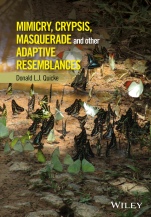
Mimicry, Crypsis, Masquerade and other Adaptive Resemblances
ISBN 9781118931530
Autor: Donald L. J. Quicke
Wydawca: Wiley
Dostępność: 3-6 tygodni
Cena: 471,45 zł
Przed złożeniem zamówienia prosimy o kontakt mailowy celem potwierdzenia ceny.
ISBN13: |
9781118931530 |
ISBN10: |
111893153X |
Autor: |
Donald L. J. Quicke |
Oprawa: |
Hardback |
Rok Wydania: |
2017-10-06 |
Ilość stron: |
576 |
Wymiary: |
260x204 |
Tematy: |
PS |
Mimicry, Crypsis, Masquerade and other Adaptive Resemblances synthesises the huge range of adaptations of living organisms that are the result of natural selection favouring an appearance that resembles some other organism (or aspect thereof), inanimate object or general background. It covers a wide range of examples, mostly from animals and plants, but fungi, protists, bacteria and even viruses are also discussed, and even some human aspects such as padded bras, striped dresses and military camouflage. Collectively, the examples illustrate the enormous scope of the topic. Many different modalities of resemblance are involved, such as colouration, countershading, texture, bioluminescence, behaviour, structure, chemistry and sound.
The author explores the results of a large number of experimental tests that have been conducted in the field, especially over recent years, explaining key models and experimental systems.
The book is beautifully illustrated in full colour throughout with over 500 images to aid understanding. These show many examples of adaptive resemblance between animals and plants as well as many graphs which are presented to illustrate research findings. Whilst it includes some mathematical equations and descriptions of models that explore and explain the depths of evolution′s complexities these are all presented in a fully explained, accessible manner so that non–academic readers will also be able to appreciate their significance. Mimicry, Crypsis, Masquerade and other Adaptive Resemblances:
covers everything from classic examples of animal and plant camouflage, the evolution of warning signals, Batesian, Müllerian, aggressive, sexual, social and dispersal mimicries explores many other topics, such as fruit colouration, and shows how some aspects of human behaviour and microbial molecular actions can easily be seen as products of the same types of natural selection that led to classic types of mimicry, albeit in more complicated ways highlights areas where additional work or specific experimentation could be fruitful cites and references over 2600 worksFar more than a course text, for which it is also ideal for levels ranging through undergraduate to graduate, this book is the most comprehensive resource on this diverse subject area for many years, and certainly the one of broadest scope. It is written in a way that can be understood easily by all readers including amateur natural history enthusiasts. The author shows how observational and experimental data can be interpreted, and how modelling has greatly increased our understanding of the processes involved in the evolution of all sorts of mimetic and other resemblances.
Preface
Acknowledgements
1 INTRODUCTION AND CLASSIFICATION OF MIMICRY SYSTEMS
2 CAMOUFLAGE: CRYPSIS AND DISRUPTIVE COLOURATION IN ANIMALS
3 CAMOUFLAGE: MASQUERADE
4 APOSEMATISM AND ITS EVOLUTION
5 ANTI–PREDATOR MIMICRY. I. MATHEMATICAL MODELS
6 ANTI–PREDATOR MIMICRY. II. EXPERIMENTAL TESTS
7 ANTI–PREDATOR MIMICRY. III. BATESIAN AND MULLERIAN EXAMPLES
8 ANTI–PREDATOR MIMICRY. ATTACK DEFLECTION, SCHOOLING, ETC.
9 ANTI–HERBIVORY DECEPTIONS
10 AGGRESSIVE DECEPTIONS
11 SEXUAL MIMICRIES IN ANIMALS (INCLUDING HUMANS)
12 REPRODUCTIVE MIMICRIES IN PLANTS
13 INTRA– AND INTERSPECIFIC COOPERATION, COMPETITION AND HIERARCHIES
14 ADAPTIVE RESEMBLANCES AND DISPERSAL: SEEDS, SPORES AND EGGS
15 MOLECULAR MIMICRY: PARASITES, PATHOGENS AND PLANTS
Extended glossary
References
Author index
General index
Taxonomic index
Donald L.J. Quicke retired in 2013 to live in Thailand where he is a Visiting Professor at Chulalongkorn University. He studied zoology at Oxford University where he became especially interested in mimicry. After graduating in 1976 he travelled to Kenya to explore tropical biodiversity and there his work on insect systematics and colouration fertilised his interests including on parasitoid wasps which were to become one of his lifelong passions and major research interest. From then on he kept abreast of the increasingly experimental and theoretical developments in the field even though his academic research took him in diverse other directions. Having now retired he has been able devote his time, in addition to bird watching and butterfly photography, to synthesising and extending his interest in this topic. Mimicry, Crypsis, Masquerade and other Adaptive Resemblances is the result of this work.
Koszyk
Książek w koszyku: 0 szt.
Wartość zakupów: 0,00 zł
Informacje


Kontakt
Gambit
Centrum Oprogramowania
i Szkoleń Sp. z o.o.
Al. Pokoju 29b/22-24
31-564 Kraków
Siedziba Księgarni
ul. Kordylewskiego 1
31-542 Kraków
+48 12 410 5991
+48 12 410 5987
+48 12 410 5989
Subskrypcje
Administratorem danych osobowych jest firma Gambit COiS Sp. z o.o. Na podany adres będzie wysyłany wyłącznie biuletyn informacyjny.
Autoryzacja płatności

Informacje na temat autoryzacji płatności poprzez PayU.

© Copyright 2012: GAMBIT COiS Sp. z o.o. Wszelkie prawa zastrzeżone.
Projekt i wykonanie: Alchemia Studio Reklamy