


Wydawcy
Katalog tematyczny
- Archeologia (109)
- Ekonomia, finanse, business (13704)
- Filozofia (1445)
- Historia (3040)
- Języki i językoznawstwo (2356)
- Lifestyle, hobby i rozrywka (475)
- Medycyna (9704)
- Nauki humanistyczne (4)
- Nauki o Ziemi i środowisku (2638)
- Nauki ścisłe (20412)
- Nauki społeczne (8486)
- Edukacja (229)
- Kryminologia, opieka spełeczna (284)
- Obronność (10)
- Polityka (1389)
- Psychologia (777)
- Socjologia (410)
- Społeczeństwo i kultura (187)
- Nauki techniczne (13450)
- Prawo (1696)
- Publikacje informacyjne i interdyscyplinarne (1288)
- Religia i wierzenia (917)
- Technika komputerowa (4067)
- Zdrowie, relacje międzyludzkie i rozwój osobisty (657)





Informacje szczegółowe o książce
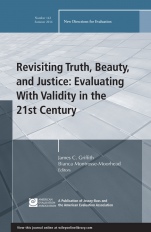
Revisiting Truth, Beauty,and Justice: Evaluating With Validity in the 21st Century: New Directions for Evaluation, Number 142
ISBN 9781118930342
Autor: James C. Griffith, Bianca Montrosse–Moorhead
Wydawca: Wiley
Dostępność: 3-6 tygodni
Cena: 162,75 zł
Przed złożeniem zamówienia prosimy o kontakt mailowy celem potwierdzenia ceny.
ISBN13: |
9781118930342 |
ISBN10: |
1118930347 |
Autor: |
James C. Griffith, Bianca Montrosse–Moorhead |
Oprawa: |
Paperback |
Rok Wydania: |
2014-06-24 |
Ilość stron: |
128 |
Wymiary: |
248x159 |
Tematy: |
JN |
When Ernest House published Evaluating with Validity in 1980, he wasn’t just attempting to expand the way the field thought of validity in evaluation. He was also proposing a new way of thinking about evaluation itself. The sense of validity House applied to evaluation was the more general sense of argumentative validity. He contended, “one must take seriously the opinions of other people and engage them in serious discourse. This is the realm of argumentation and the proper sphere of evaluation” (House, 1980, p. 94). In doing so, he proposed that we see evaluation as argumentation. This sense of validity does not displace predictive validity or existing validity typologies. Instead, viewing evaluation as argumentation puts the role of predictive validity in proper perspective—as one component of the complex arguments that evaluative investigations produce. The chapters in this issue discuss ways of constructing, organizing, and managing arguments for evaluation. This is not a collection of writings about the logic of evaluation, nor is it a collection of writings narrowly focused on predictive validity. Instead, the chapters here deal with the various elements needed to construct evaluation arguments that are compelling and influential by virtue of the truth, beauty, and justice they express. Through exposition, original research, critical reflection, and application to case examples, the authors present tools, perspectives, and guides to help evaluators navigate the complex contexts of evaluation in the 21st century.
EDITORS’ NOTES 1 James C. Griffith, Bianca Montrosse–Moorhead 1. Origins of the Ideas in Evaluating with Validity 9 Ernest R. House This chapter traces the origins of the ideas in the book Evaluating with Validity (House, 1980), the social context from which it emerged, and contends that the criteria of truth, beauty, and justice still apply, though the contents of the criteria have changed somewhat and the context has changed substantially. 2. The Value in Validity 17 James C. Griffith, Bianca Montrosse–Moorhead Using two case examples, this chapter analyzes the inherent values and prioritization between truth, justice, and beauty and aims to help the evaluator confront the kinds of dilemmas faced when her commitment to values, evaluation theories, or methodology comes up against conflicting realities for a particular evaluation. 3. How “Beauty” Can Bring Truth and Justice to Life 31 E. Jane Davidson This chapter flips House’s idea on its head and argues that the process of creating a clear, compelling, and coherent (beautiful) evaluative story is the key to unlocking validity (truth) and fairness (justice). 4. Credible Judgment: Combining Truth, Beauty, and Justice 45 Marthe Hurteau, David D. Williams Employing grounded theory methodology, this chapter summarizes research conducted on the production of credible judgments, presents a descriptive model of a process to produce credible evaluation judgments, and argues that the results provide evidence to support House’s vision of validity. 5. Negotiating Truth, Beauty, and Justice: A Politically Responsive Approach 57 Tarek Azzam, Bret Levine This chapter focuses on the nontechnical factors that affect the evaluation design and implementation process, discusses cases and studies to illustrate their influence, and concludes by introducing the concept of politically responsive evaluation as an organizing frame to help evaluators consider some of the nontechnical issues that influence evaluations. 6. Truth, Beauty, and Justice: Conceptualizing House’s Framework for Evaluation in Community–Based Settings 71 Katrina L. Bledsoe Grounded in examples from the author’s own evaluation practice, the goal of this chapter is to discuss House’s theoretical framework of truth, beauty, and justice and its relationship to community–based evaluation and programming, as well as pose questions related to evaluation practice, validity, and social justice. 7. Justice Signposts in Evaluation Theory, Practice, and Policy 83 Rodney K. Hopson Influenced by House’s conceptions of justice from Evaluating with Validity (House, 1980), this chapter offers two justice signposts in contemporary evaluation theory, practice, and policy: (a) continue to expand the social justice or values branch of the evaluation theory tree and (b) promote evaluation as liberating and decolonizing for the marginalized and underrepresented. 8. House With a View: Validity and Evaluative Argument 95 Bianca Montrosse–Moorhead, James C. Griffith, Pamela Pokorny Drawing upon a series of conversations between the issue editors and Ernest R. House, this chapter provides a summary and analysis of the contribution of each chapter in the issue and presents a vision for the future concerning the validity of evaluative arguments in practice and theory. INDEX 107
Koszyk
Książek w koszyku: 0 szt.
Wartość zakupów: 0,00 zł
Informacje


Kontakt
Gambit
Centrum Oprogramowania
i Szkoleń Sp. z o.o.
Al. Pokoju 29b/22-24
31-564 Kraków
Siedziba Księgarni
ul. Kordylewskiego 1
31-542 Kraków
+48 12 410 5991
+48 12 410 5987
+48 12 410 5989
Subskrypcje
Administratorem danych osobowych jest firma Gambit COiS Sp. z o.o. Na podany adres będzie wysyłany wyłącznie biuletyn informacyjny.
Autoryzacja płatności

Informacje na temat autoryzacji płatności poprzez PayU.

© Copyright 2012: GAMBIT COiS Sp. z o.o. Wszelkie prawa zastrzeżone.
Projekt i wykonanie: Alchemia Studio Reklamy