


Wydawcy
Katalog tematyczny
- Archeologia (109)
- Ekonomia, finanse, business (13704)
- Filozofia (1445)
- Historia (3040)
- Języki i językoznawstwo (2356)
- Lifestyle, hobby i rozrywka (475)
- Medycyna (9704)
- Nauki humanistyczne (4)
- Nauki o Ziemi i środowisku (2638)
- Geografia (299)
- Nauki o Ziemi (1661)
- Geologia (414)
- Hydrologia (237)
- Meteorologia i klimatologia (114)
- Paleontologia (33)
- Wulkanologia i sejsmologia (44)
- Planowanie przestrzenne (53)
- Środowisko (607)
- Nauki ścisłe (20412)
- Nauki społeczne (8486)
- Nauki techniczne (13450)
- Prawo (1696)
- Publikacje informacyjne i interdyscyplinarne (1288)
- Religia i wierzenia (917)
- Technika komputerowa (4067)
- Zdrowie, relacje międzyludzkie i rozwój osobisty (657)





Informacje szczegółowe o książce
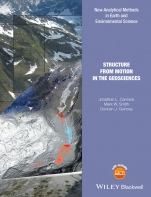
Structure from Motion in the Geosciences
ISBN 9781118895849
Autor: Jonathan L. Carrivick, Mark W. Smith, Duncan J. Quincey
Wydawca: Wiley
Dostępność: 3-6 tygodni
Cena: 471,45 zł
Przed złożeniem zamówienia prosimy o kontakt mailowy celem potwierdzenia ceny.
ISBN13: |
9781118895849 |
ISBN10: |
1118895843 |
Autor: |
Jonathan L. Carrivick, Mark W. Smith, Duncan J. Quincey |
Oprawa: |
Hardback |
Rok Wydania: |
2016-08-26 |
Ilość stron: |
208 |
Wymiary: |
254x178 |
Tematy: |
RB |
Structure from Motion with Multi View Stereo provides hyperscale landform models using images acquired from standard compact cameras and a network of ground control points. The technique is not limited in temporal frequency and can provide point cloud data comparable in density and accuracy to those generated by terrestrial and airborne laser scanning at a fraction of the cost. It therefore offers exciting opportunities to characterise surface topography in unprecedented detail and, with multi–temporal data, to detect elevation, position and volumetric changes that are symptomatic of earth surface processes. This book firstly places Structure from Motion in the context of other digital surveying methods and details the Structure from Motion workflow including available software packages and assessments of uncertainty and accuracy. It then critically reviews current usage of Structure from Motion in the geosciences, provides a synthesis of recent validation studies and looks to the future by highlighting opportunities arising from developments in allied disciplines. This book will appeal to academics, students and industry professionals because it balances technical knowledge of the Structure from Motion workflow with practical guidelines for image acquisition, image processing and data quality assessment and includes case studies that have been contributed by experts from around the world.
Abbreviations
About the companion website
Chapter 1: Introduction to Structure from Motion for the geosciences
1.1. The geosciences and related disciplines
1.2. Aim and scope of this book
1.3. The time and the place
1.4. What is Structure from Motion?
1.5. Structure of this book
References
Chapter 2: The place of Structure from Motion: a new paradigm in topographic surveying?
2.1. Introduction
2.2. Direct topographic surveying
2.3. Remote digital surveying
2.4. Chapter summary
References
Further Reading/Resources
Chapter 3: Background to Structure from Motion
3.1. Introduction
3.2. Feature Detection
3.3. Keypoint Correspondence
3.4. Identifying Geometrically Consistent Matches
3.5. Structure from Motion
3.6. Scale and Georeferencing
3.7. Optimization of Image Alignment
3.8. Clustering for Multi View Stereo
3.9. Multi View Stereo Image Matching Algorithms
3.10. Summary
References
Further Reading/Resources
Chapter 4: Structure from Motion in practice
4.1. Introduction
4.2. Platforms
4.3. Sensors
4.4. Acquiring images and control data
4.5. Software
4.6. Point cloud viewers
4.7. Filtering
4.8. Generating digital elevation models (DEMs) from point clouds
4.9. Key issues
4.10. Chapter summary
References
Further reading
Chapter 5: Quality assessment: quantifying error in Structure from Motion–derived topographic data
5.1. Introduction
5.2. Validation Data Sets
5.3. Validation Methods
5.4. Survey Platform
5.5. Error Metrics
5.6. Distribution of Ground Control Points
5.7. Terrain
5.8. Software
5.9. Camera
5.10. Summary
References
Further Reading/Resources
Chapter 6: Current applications of Structure from Motion in the geosciences
6.1. Introduction
6.2. Use of SfM–MVS–derived orthophotograph mosaics
6.3. Use of SfM–MVS for 3D point clouds
6.4. Use of SfM–MVS for gridded topography
6.5. Combined orthophotograph and point cloud analysis
6.6. Crossing temporal scales: Examples of change detection to suggest process dynamics
6.7. Practitioner–based SfM–MVS
6.8. Chapter summary
References
Further Reading/Resources
Chapter 7: Developing Structure from Motion for the geosciences: future directions
7.1. Introduction
7.2. Developments in hardware
7.3. Progressive automation of acquisition
7.4. Efficient management and manipulation of photographs
7.5. Point cloud generation and decimation
7.6. Real–time SfM–MVS and instant maps: Simultaneous Localization And Mapping (SLAM)
7.7. Augmented reality
7.8. Detection of object or surface motion: non–rigid SfM (NRSfM)
7.9. Chapter summary
References
Further Reading/Resources
Chapter 8: Concluding recommendations
8.1. Key Recommendation 1: get under the bonnet of SfM–MVS to become more critical end–users
8.2. Key Recommendation 2: get coordinated to understand the sources and magnitudes of error
8.3. Key Recommendation 3: focus on the research question
8.4. Key Recommendation 4: focus your efforts on data processing
8.5. Key Recommendation 5: learn from other disciplines
8.6. Key Recommendation 6: harness the democratising power of SfM–MVS
Index
Jonathan Carrivick is a Senior Lecturer in Geomorphology in the School of Geography, University of Leeds, UK. His primary research interests lie within polar, arctic and alpine ice–marginal systems, and especially focus on glacier outburst floods and proglacial lakes. He specialises in digital topographic surveying, especially for construction of terrain models for input to morphodynamic computer simulations, and for detecting rapid geomorphological changes and geomorphological coupling in glaciers, alpine hillslopes, moraines and gravel bed and bedrock rivers.
Dr Mark Smith is a Lecturer in Water Research in the School of Geography, University of Leeds, UK. His research focuses on the interactions of rough surfaces with air and water flows and methods of quantifying that roughness, with particular application to fluvial hydraulics, sediment transport and surface energy balances. He is a specialist in high resolution survey methods having worked with Terrestrial Laser Scanners for over a decade and more recently using Structure–from–Motion datasets in a range of environments, from gravel bed rivers, to eroding badlands to melting glacier ice.
Dr Duncan Quincey is an Associate Professor in Geomorphology in the School of Geography, University of Leeds, UK. His research focuses on the evolution of glacial and alpine environments, with particular interests in the processes controlling lake development and outburst flooding. He is a remote sensing specialist with skills in developing optical– and SAR–based methods for retrieving surface velocity data from satellite imagery and in employing novel remote sensing methods, such as Structure–from–Motion, to data model geophysical processes.
Koszyk
Książek w koszyku: 0 szt.
Wartość zakupów: 0,00 zł
Informacje


Kontakt
Gambit
Centrum Oprogramowania
i Szkoleń Sp. z o.o.
Al. Pokoju 29b/22-24
31-564 Kraków
Siedziba Księgarni
ul. Kordylewskiego 1
31-542 Kraków
+48 12 410 5991
+48 12 410 5987
+48 12 410 5989
Subskrypcje
Administratorem danych osobowych jest firma Gambit COiS Sp. z o.o. Na podany adres będzie wysyłany wyłącznie biuletyn informacyjny.
Autoryzacja płatności

Informacje na temat autoryzacji płatności poprzez PayU.

© Copyright 2012: GAMBIT COiS Sp. z o.o. Wszelkie prawa zastrzeżone.
Projekt i wykonanie: Alchemia Studio Reklamy