


Wydawcy
Katalog tematyczny
- Archeologia (109)
- Ekonomia, finanse, business (13704)
- Filozofia (1445)
- Historia (3040)
- Języki i językoznawstwo (2356)
- Lifestyle, hobby i rozrywka (475)
- Medycyna (9704)
- Nauki humanistyczne (4)
- Nauki o Ziemi i środowisku (2638)
- Nauki ścisłe (20412)
- Astronomia (294)
- Biologia (5119)
- Chemia (6540)
- Chemia analityczna (361)
- Chemia fizyczna (346)
- Chemia nieorganiczna (137)
- Chemia organiczna (535)
- Krystalografia (27)
- Minerologia (46)
- Fizyka (3309)
- Matematyka (4574)
- Nauki ścisłe, ogólnie (503)
- Nauki społeczne (8486)
- Nauki techniczne (13450)
- Prawo (1696)
- Publikacje informacyjne i interdyscyplinarne (1288)
- Religia i wierzenia (917)
- Technika komputerowa (4067)
- Zdrowie, relacje międzyludzkie i rozwój osobisty (657)





Informacje szczegółowe o książce
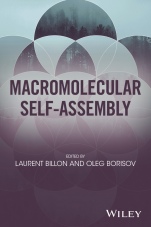
Macromolecular Self–Assembly
ISBN 9781118887127
Autor: Laurent Billon, Oleg Borisov
Wydawca: Wiley
Dostępność: 3-6 tygodni
Cena: 687,75 zł
Przed złożeniem zamówienia prosimy o kontakt mailowy celem potwierdzenia ceny.
ISBN13: |
9781118887127 |
ISBN10: |
1118887123 |
Autor: |
Laurent Billon, Oleg Borisov |
Oprawa: |
Hardback |
Rok Wydania: |
2016-10-18 |
Ilość stron: |
272 |
Wymiary: |
239x161 |
Tematy: |
PN |
Molecular self–assembly, the process by which molecules adopt a defined arrangement without guidance or management, is crucial to the function of cells. It is exhibited in lipids forming membranes, the formation of double helical DNA, and the assembly of proteins to form quaternary structures. Because they occur in nature, it is believed that self–assembled molecules are more compatible in biosystems than other systems thus self–assembly continues to be a hot technique in synthetic chemistry.
This book describes self–assembly techniques in the synthesis of biomolecules for developing new compounds and improving functionality of existing ones. Because self–assembly emulates how nature creates molecules, they likely have the best chance at succeeding in real–world biomedical applications.
A valuable and comprehensive resource for researchers and graduate students, Macromolecular Self–Assembly offers readers benefits that include:
Use of synthetic chemistry, physical chemistry, and materials science principles and techniques
Emphasis on self–assembly in solutions (particularly, aqueous solutions) and at solid–liquid interfaces
Description of polymer assembly driven by multitude interactions, including solvophobic, electrostatic, and obligatory co–assembly
Review of principles of cross–scale hierarchical assembly
Illustration of the assembly of bio–hybrid macromolecules and applications in biomedical engineeringChapter 1: A Supramolecular Approach to Macromolecular Self–Assembly: Cyclodextrin Host/Guest Complexes
Bernhard V. K. J. Schmidt and Christopher Barner–Kowollik
1.1 Introduction
1.2 Synthetic Approaches to Host/Guest Functionalized Building Blocks
1.2.1 CD functionalization
1.2.2 Suitable guest groups
1.3 Supramolecular CD Self–Assemblies
1.3.1 Linear polymers
1.3.2 Branched polymers
1.3.3 Cyclic polymer architectures
1.4 Higher Order Assemblies of CD based Polymer Architectures towards Nanostructures
1.4.1 Micelles/Core–Shell Particles
1.4.2 Vesicles
1.4.3 Nanotubes and Fibers
1.4.4 Nanoparticles and hybrid materials
1.4.5 Planar surface modification
1.5 Applications
1.6 Conclusion and Outlook
References
Chapter 2: Polymerization–Induced Self–Assembly: the Contribution of Controlled Radical Polymerization to the Formation of Self–Stabilized Polymer Particles of Various Morphologies
Muriel Lansalot, Jutta Rieger, Franck D Agosto
2.1 Introduction
2.2 Preliminary Comments Underlying Controlled Radical Polymerization
2.2.1 Introduction
2.2.2 Major methods based on a reversible termination mechanism
2.2.3 Major methods based on a reversible transfer mechanism
2.3 PISA via CRP Based on Reversible Termination
2.3.1 PISA Using NMP
2.3.2 Using a TRP
2.4 PISA via CRP Based on Reversible Transfer
2.4.1 Using RAFT in Emulsion Polymerization
2.4.2 Using RAFT in Dispersion Polymerization
2.4.3 Using TERP
2.5 Concluding Remarks
Acknowldgements
Abbreviations
References
Chapter 3: Amphiphilic Gradient copolymers : synthesis and self–assemblyin aqueous solution
Elise Deniau–Lejeune, Olga Borisova, Petr Stepanek, Laurent Billon, Oleg Borisov
Nomenclature
3.1 Introduction
3.2 Synthetic strategies for the preparation of gradient copolymers
3.2.1 Preparation of gradient copolymers by Controlled Radical Copolymerization
3.2.2 Preparation of block–gradient copolymers using controlled radical polymerization
3.3 Self–Assembly
3.3.1 Gradient copolymers
3.3.2 Diblock–gradient copolymers
3.3.3 Triblock–gradient copolymers
3.4 Conclusion and Outlook
References
Chapter 4: Electrostatically Assembled Complex Macromolecular Architectures Based on Star–Like Polyionic Species
Dmitry V. Pergushov and Felix A. Plamper
4.1 Introduction
4.2 Core–Corona Co–Assemblies of Homopolyelectrolyte Stars Complexed with Linear Polyions
4.3 Core–Shell–Corona Co–Assemblies of Star–Like Micelles of Ionic Amphiphilic Diblock Copolymers Complexed with Linear Polyions
4.4 Vesicular Co–Assemblies of Bis–Hydrophilic Miktoarm Stars Complexed with Linear Polyions
4.5 Conclusions
Acknowledgements
References
Chapter 5: Solution properties of associating polymers
Olga Philippova
5.1 Introduction
5.2 Structures of associating polyelectrolytes
5.3 Associating polyelectrolytes in dilute solutions
5.3.1 Intramolecular association
5.3.2 Intermolecular association
5.4 Associating polyelectrolytes in semidilute solutions
5.5 Conclusions
References
Chapter 6: Macromolecular decoration of nanoparticles for guiding self–assembly in 2D and 3D
Christian Kuttner, Munish Chanana, Matthias Karg, Andreas Fery
6.1 Introduction
6.2 Guiding assembly bydecoration with artificialmacromolecules
6.2.1 Decoration of nanoparticles
6.2.2 Distance control in 2D and 3D
6.2.3 Breaking the symmetry
6.3 Biomacromolecules
6.4 DNA
6.5 Proteins
6.6 Application of assemblies
6.7 Conclusion and outlook
References
Chapter 7: Self–Assembly of Biohybrid Polymers
Dawid Kedracki, Jancy Nixon Abraham, Enora Prado, Corinne Nardin
7.1 Introduction to the Mechanism of Self–Assembly
7.1.1 Amphiphiles
7.1.2 Packing Parameter and Interfacial Tension
7.1.3 Interaction Forces in Self–Assembly
7.2 Self–Assembly of Biohybrid Polymers
7.2.1 Polymer–DNA Hybrids
7.2.2 Polypeptide Block Copolymers
7.2.3 Block Copolypeptides
7.3 Self–Assembly Driven Nucleation Polymerization
7.3.1 Polymer–DNA Hybrids
7.3.2 Polymer–Peptide Hybrids
7.3.3 DNA–Peptide Hybrids
7.4 Self–Assembly Driven by Electrostatic Interactions
7.4.1 DNA/polymer bio–IPECs
7.4.2 DNA/copolymer bio–IPECs
7.5 Conclusion
References
Chapter 8: Biomedical application of block copolymers
Martin Hrubý, SergeyK. Filippov, Petr t pánek
8.1 Introduction
8.2 Diblock and triblock copolymers
8.3 Graft and statistical copolymers
8.4 Concluding remarks
Acknowledgements
References
Laurent Billon, PhD, is research director at the Interdisciplinary Institute of Environmental and Material Research (IPREM) in Pau, France. He is the author of over 150 scientific publications and received the Friedrich Wilhelm Bessel Research Award (2004) from the Alexander von Humboldt Foundation. He received his PhD in Polymer Chemistry from Pau University (France).
Oleg Borisov, PhD, is research director at the Institute of Environmental and Material Research at Pau University, France. He graduated received his PhD in physics and mechanics of polymers from the Institute of Macromolecular Compounds of the Russian Academy of Sciences. He is the author of over 150 papers.Koszyk
Książek w koszyku: 0 szt.
Wartość zakupów: 0,00 zł
Informacje


Kontakt
Gambit
Centrum Oprogramowania
i Szkoleń Sp. z o.o.
Al. Pokoju 29b/22-24
31-564 Kraków
Siedziba Księgarni
ul. Kordylewskiego 1
31-542 Kraków
+48 12 410 5991
+48 12 410 5987
+48 12 410 5989
Subskrypcje
Administratorem danych osobowych jest firma Gambit COiS Sp. z o.o. Na podany adres będzie wysyłany wyłącznie biuletyn informacyjny.
Autoryzacja płatności

Informacje na temat autoryzacji płatności poprzez PayU.

© Copyright 2012: GAMBIT COiS Sp. z o.o. Wszelkie prawa zastrzeżone.
Projekt i wykonanie: Alchemia Studio Reklamy