


Wydawcy
Katalog tematyczny
- Archeologia (109)
- Ekonomia, finanse, business (13704)
- Filozofia (1445)
- Historia (3040)
- Języki i językoznawstwo (2356)
- Lifestyle, hobby i rozrywka (475)
- Medycyna (9704)
- Nauki humanistyczne (4)
- Nauki o Ziemi i środowisku (2638)
- Nauki ścisłe (20412)
- Nauki społeczne (8486)
- Nauki techniczne (13450)
- Prawo (1696)
- Publikacje informacyjne i interdyscyplinarne (1288)
- Religia i wierzenia (917)
- Technika komputerowa (4067)
- Zdrowie, relacje międzyludzkie i rozwój osobisty (657)





Informacje szczegółowe o książce
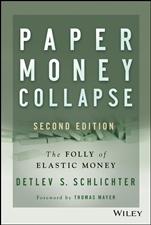
Paper Money Collapse: The Folly of Elastic Money
ISBN 9781118877326
Autor: Detlev S. Schlichter, Thomas Mayer
Wydawca: Wiley
Dostępność: 3-6 tygodni
Cena: 214,20 zł
Przed złożeniem zamówienia prosimy o kontakt mailowy celem potwierdzenia ceny.
ISBN13: |
9781118877326 |
ISBN10: |
1118877322 |
Autor: |
Detlev S. Schlichter, Thomas Mayer |
Oprawa: |
Hardback |
Rok Wydania: |
2014-09-02 |
Numer Wydania: |
2nd Edition |
Ilość stron: |
336 |
Wymiary: |
236x154 |
Tematy: |
KC |
Praise for PAPER MONEY COLLAPSE SECOND EDITION A brilliant treatise on the fundamentals of sound money and the destructive deviations of contemporary Keynesian central banking. Sophisticated, readable, thorough, and persuasive. David Stockman Paper Money Collapse was essential reading when the first edition appeared in 2011 and it is even more essential reading now. Not only has the underlying degree of global monetary instability continued to increase; Detlev Schlichter has now updated his original, excellent tome to incorporate contemporary developments, including the introduction of so–called cryptocurrencies such as bitcoin, and he explores several plausible scenarios for the future of the faltering global monetary order. Readers will benefit from these insights, presented as they are in a highly readable, cogent style. John K. Butler, author of The Golden Revolution and publisher of the Amphora Report investment newsletter A passionate, engaging, and depressing analysis of the approaching fiat money endgame. Kevin Dowd, Durham University Detlev Schlichters book Paper Money Collapse, Second Edition develops a concise, clear, and at the same time deep economic analysis on the current elastic monetary system and why it is essentially incompatible with a free market economy. I strongly recommend this book to anyone interested in financial crises, economic recessions, and the future of capitalism. Jess Huerta de Soto, Professor of Political Economy, King Juan Carlos University (Madrid); author of Money, Bank Credit, and Economic Cycles Stumbling forward under the baleful influence of wishful thinking, the worlds politicians and central bankers are blundering down just the path Detlev set out in his first edition. With the Austrian measure of the UK money supply now increasing by over 12% year on year, I expect Detlevs masterpiece to be increasingly relevant. Steve Baker, Conservative MP for Wycombe, Member of the House of Commons Treasury Select Committee, and a co–founder of the Cobden Centre Detlevs understanding and insight into central bank policy propelled him to being one of the worlds preeminent global bond managers. He cuts through the fog of central bank mystery by providing a clear description of their apparatus and methods. Going beyond the requisite professional skepticism, Detlev has trained his scholarly attention to highlighting the enormity of the potential further damage they may yet wreak on us. Ken Leech, CIO, Western Asset Management Company
Foreword Acknowledgments Prologue: Contra the Mainstream Consensus – What this book is about The Ruling Mainstream Consensus on Money The Growth–versus–inflation Trade Off What This Book Will Show Understanding Our Fiat Money System What is Different from the First Edition? Support from Eminent Economists Notes Part One: The Basics of Money Chapter 1 The Fundamentals of Money and Money Demand The Origin and Purpose of Money An Anthropologist’s Challenge What Gives Money Value? (Almost) Any Quantity of Money Will Do The Demand for Money Are “Sticky” Prices a Problem? Other Functions of Money The Unique Position of the Paper Money Producer The Monetary Asset versus Other Goods Notes Chapter 2 The Fundamentals of Fractional–Reserve Banking The Origin and Basics of Fractional–Reserve Banking Who Owns “Deposited” Money? Exposing Misconceptions about Fractional–Reserve Banking “Free Banking” is Limited Banking Summary of Part One Notes Part Two: The Effects of Money Injections Chapter 3 Money Injections without Credit Markets Even, Instant, and Transparent Money Injection Even and Nontransparent Money Injection Uneven and Nontransparent Money Injection Notes Chapter 4 Money Injections via Credit Markets Consumption, Saving, and Investing Interest Interest Rates are Not Determined by Factor Productivity Money Injection via the Loan Market The Process in More Detail Policy Implications of the Austrian Theory Addendum: Gordon Tullock’s Critique of the Austrian Business Cycle Theory and some words on “forced saving” An Example: U.S. Housing Boom and Bust Summary of Part Two Notes Part Three: Fallacies about the Price Level and Price Level Stabilization Chapter 5 Common Misconceptions Regarding the Price Level The Fallacy that a Stable Price Level Means “Neutral” Money The Fallacy that Hard Money is Unstable Money, Part 1 – History The Fallacy that Hard Money is Unstable Money, Part 2 – Theory Notes Chapter 6 The Policy of Stabilization Problems with Price Index Stabilization Addendum: The “Free Bankers” and the Theory of Immaculate Fractional–Reserve Banking Summary of Part Three Notes Part Four: A History of Paper Money and How We Got to Where We Are Now Chapter 7 A Legacy of Failure Paper Money Experiments 1914 – 2014 – A Century of Monetary Decay Notes Part Five: Beyond the Cycle – Paper Money’s Endgame and The Future of Money Chapter 8 The Beneficiaries of the Paper Money System Paper Money and the Banks Paper Money and the State Paper Money and the Professional Economist Notes Chapter 9 The Intellectual Superstructure of the Present System The Alternative View: Individualism and Laissez–Faire The Mainstream View: Collectivism and Interventionism The Political Appeal of Mainstream Macroeconomics The Myth That Everybody Benefits from “Stimulus” Monetarism as Monetary Interventionism The Savings Glut Theory and the Myth of Underconsumption and Underinvestment Inflationism and International Policy Coordination Notes Chapter 10 Endgames – Inflationary Meltdown or Return to Hard Money? Paper Money Collapse Alternatives: Return to Hard Money A Return to a Gold Standard The Separation of Money and State Bitcoin – Money of No Authority Notes Epilogue: Money, Freedom, and Capitalism About the Author Index
DETLEV S. SCHLICHTER is an independent economist and investment strategist. He spent 19 years as a trader and portfolio manager in international financial markets, including stints at J.P. Morgan, Merrill Lynch, and Western Asset Management. In his career, Detlev has overseen billions in assets for institutional clients around the globe. He is a frequent commentator on economics and financial markets via his website detlevschlichter.com. Detlev lives with his wife and three children in Hampstead, London.
Koszyk
Książek w koszyku: 0 szt.
Wartość zakupów: 0,00 zł
Informacje


Kontakt
Gambit
Centrum Oprogramowania
i Szkoleń Sp. z o.o.
Al. Pokoju 29b/22-24
31-564 Kraków
Siedziba Księgarni
ul. Kordylewskiego 1
31-542 Kraków
+48 12 410 5991
+48 12 410 5987
+48 12 410 5989
Subskrypcje
Administratorem danych osobowych jest firma Gambit COiS Sp. z o.o. Na podany adres będzie wysyłany wyłącznie biuletyn informacyjny.
Autoryzacja płatności

Informacje na temat autoryzacji płatności poprzez PayU.

© Copyright 2012: GAMBIT COiS Sp. z o.o. Wszelkie prawa zastrzeżone.
Projekt i wykonanie: Alchemia Studio Reklamy