


Wydawcy
Katalog tematyczny
- Archeologia (109)
- Ekonomia, finanse, business (13704)
- Filozofia (1445)
- Historia (3040)
- Języki i językoznawstwo (2356)
- Lifestyle, hobby i rozrywka (475)
- Medycyna (9704)
- Nauki humanistyczne (4)
- Nauki o Ziemi i środowisku (2638)
- Nauki ścisłe (20412)
- Nauki społeczne (8486)
- Edukacja (229)
- Kryminologia, opieka spełeczna (284)
- Obronność (10)
- Polityka (1389)
- Psychologia (777)
- Socjologia (410)
- Społeczeństwo i kultura (187)
- Nauki techniczne (13450)
- Prawo (1696)
- Publikacje informacyjne i interdyscyplinarne (1288)
- Religia i wierzenia (917)
- Technika komputerowa (4067)
- Zdrowie, relacje międzyludzkie i rozwój osobisty (657)





Informacje szczegółowe o książce
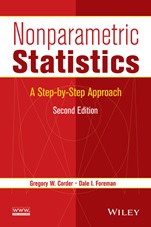
Nonparametric Statistics: A Step–by–Step Approach
ISBN 9781118840313
Autor: Gregory W. Corder, Dale I. Foreman
Wydawca: Wiley
Dostępność: 3-6 tygodni
Cena: 463,05 zł
Przed złożeniem zamówienia prosimy o kontakt mailowy celem potwierdzenia ceny.
ISBN13: |
9781118840313 |
ISBN10: |
1118840313 |
Autor: |
Gregory W. Corder, Dale I. Foreman |
Oprawa: |
Hardback |
Rok Wydania: |
2014-05-23 |
Numer Wydania: |
2nd Edition |
Ilość stron: |
288 |
Wymiary: |
234x156 |
Tematy: |
JC |
Praise for the First Edition "... a very useful resource for courses in nonparametric statistics in which the emphasis is on applications rather than on theory." – CHOICE The Second Edition of Nonparametric Statistics: A Step–by–Step Approach continues to present nonparametric statistical procedures in an accessible manner for readers with backgrounds in the social, behavioral, biological, and physical sciences. Each chapter begins with a general introduction and a list of the chapter′s main learning objectives. A nonparametric procedure is then presented and is followed by context–based examples in a step–by–step fashion. Next, SPSS® screen captures are used to demonstrate how to perform and how to identify the steps in the various procedures. Finally, the authors identify and briefly describe actual examples of corresponding nonparametric tests from diverse fields. In addition, Nonparametric Statistics: A Step–by–Step Approach, Second Edition features: New coverage of the sign test and the Kolmogorov–Smirnov two–sample test, both of which provide a logical and natural progression to statistical power Expanded treatment on basic topics, such as parameters and empirical distribution frequency A multitude of practical examples that enhance and expand the statistical toolset for readers Tables of critical values and solutions to select problems to aid in reader comprehension Supplemental material including online decision trees to better determine the type of statistical test needed as well as narrated videos and screen animations with step–by–step instructions on how to perform the tests using SPSS Nonparametric Statistics: A Step–by–Step Approach, Second Edition is an excellent textbook for upper–undergraduate and beginning graduate students majoring in the physical, social, behavioral, and health sciences as well as secondary education. The book also serves as a valuable reference for applied statisticians and practitioners working in industry and professionals and researchers in the social, behavioral, and health sciences who seek a review of nonparametric methods and their relevant applications.
Preface Chapter 1: Nonparametric Statistics: An Introduction 1.1. Objectives 1.2. Introduction 1.3. The Nonparametric Statistical Procedures Presented In This Book 1.4. Ranking Data 1.5. Ranking Data with Tied Values 1.6. Counts Of Observations 1.7. Summary 1.8. Practice Questions 1.9 Solutions To Practice Questions Chapter 2: Testing Your Data For Normality 2.1. Objectives 2.2. Introduction 2.3. Describing Data and The Normal Distribution 2.4. Computing And Testing Kurtosis And Skewness For Sample Normality 2.4.1. Sample Problem For Examining Kurtosis 2.4.2. Sample Problem For Examining Skewness 2.4.3. Examining Skewness And Kurtosis For Normality Using SPSS 2.5. The Kolmogorov–Smirnov One–Sample Test 2.5.1. Sample Kolmogorov–Smirnov One–Sample Test 2.5.2. Performing The Kolmogorov–Smirnov One–Sample Test Using SPSS 2.6. Summary 2.7. Practice Questions 2.8. Solutions To Practice Questions Chapter 3: Comparing Two Related Samples: The Wilcoxon Signed Ranks Test 3.1. Objectives 3.2. Introduction 3.3. Computing The Wilcoxon Signed Ranks Test Statistic 3.3.1. Sample Wilcoxon Signed Ranks Test For Small Samples 3.3.2. Confidence Interval for the Wilcoxon Signed Ranks Test 3.3.3. Sample Wilcoxon Signed Ranks Test For Large Samples 3.4. Computing the Sign Test 3.4.1. Sample Sign Test For Small Samples 3.4.2. Sample Sign Test For Large Samples 3.5. Performing the Wilcoxon Signed Ranks Test Using SPSS 3.6. Statistical Power 3.7. Examples from the Literature 3.8. Summary 3.9. Practice Questions 3.10. Solutions to Practice Questions Chapter 4: Comparing Two Unrelated Samples: The Mann–Whitney U Test 4.1. Objectives 4.2. Introduction 4.3. Computing the Mann–Whitney U Test Statistic 4.3.1. Sample Mann–Whitney U Test For Small Samples 4.3.3. Confidence Interval for the Difference Between Two Location Parameters 4.3.4. Sample Mann–Whitney U Test For Large Samples 4.4. Computing the Kolmogorov–Smirnov Two–Sample Test Statistic 4.4.1 Sample Kolmogorov–Smirnov Two–Sample Test 4.5. Performing the Mann–Whitney U Test and the Kolmogorov–Smirnov Two–Sample Test Using SPSS 4.6. Examples From The Literature 4.7. Summary 4.8. Practice Questions 4.9. Solutions to Practice Questions Chapter 5: Comparing More Than Two Related Samples: Friedman’s Test 5.1. Objectives 5.2. Introduction 5.3. Computing The Friedman’s Test Statistic 5.3.1. Sample Friedman’s Test (Small Data Samples without Ties) 5.3.2. Sample Friedman’s Test (Small Data Samples with Ties) 5.3.3. Performing The Friedman’s Test Using SPSS 5.3.4. Sample Friedman’s Test (Large Data Samples without Ties) 5.4. Examples From The Literature 5.5. Summary 5.6. Practice Questions 5.7. Solutions to Practice Questions Chapter 6: Comparing More Than Two Unrelated Samples: Kruskal–Wallis H Test 6.1. Objectives 6.2. Introduction 6.3. Computing The Kruskal–Wallis H Test Statistic 6.3.1. Sample Kruskal–Wallis H Test (Small Data Samples) 6.3.2. Performing The Kruskal–Wallis H Test Using SPSS 6.3.3. Sample Kruskal–Wallis H Test (Large Data Samples) 6.4. Examples From The Literature 6.5. Summary 6.6. Practice Questions 6.7. Solutions To Practice Questions Chapter 7: Comparing Variables Of Ordinal Or Dichotomous Scales: Spearman Rank–Order, Point–Biserial, And Biserial Correlations 7.1. Objectives 7.2. Introduction 7.3. The Correlation Coefficient 7.4. Computing The Spearman Rank–Order Correlation Coefficient 7.4.1. Sample Spearman Rank–Order Correlation (Small Data Sample without Ties) 7.4.2. Sample Spearman Rank–Order Correlation (Small Data Sample with Ties) 7.4.3. Performing The Spearman Rank–Order Correlation Using SPSS 7.5. Computing the Point–Biserial and Biserial Correlation Coefficients 7.5.1. Correlation of a dichotomous variable and an interval scale variable. 7.5.2. Correlation of a dichotomous variable and a rank–order variable. 7.5.3. Sample Point–Biserial Correlation (Small Data Samples) 7.5.4. Performing The Point–Biserial Correlation Using SPSS 7.5.5. Sample Point–Biserial Correlation (Large Data Samples) 7.5.6. Sample Biserial Correlation (Small Data Samples) 7.5.7. Performing The Point–Biserial Correlation Using SPSS 7.6. Examples From The Literature 7.7. Summary 7.8. Practice Questions 7.9. Solutions To Practice Questions Chapter 8: Tests For Nominal Scale Data: Chi–Square Tests 8.1. Objectives 8.2. Introduction 8.3. The Chi–Square Goodness–of–Fit Test 8.3.1. Computing The Chi–Square Goodness–of–Fit Test Statistic 8.3.2. Sample Chi–Square Goodness–Of–Fit Test (Category Frequencies Equal) 8.3.3. Sample Chi–Square Goodness–Of–Fit Test (Category Frequencies Not Equal) 8.3.4. Performing The Chi–Squared Goodness–Of–Fit Test Using SPSS 8.4. Chi–Square Test Of Independence 8.4.1. Computing the Chi–Square Test Of Independence 8.4.2. Sample Chi–Square Test Of Independence 8.4.3. Performing The Chi–Square Test Of Independence Using SPSS 8.5. The Fisher Exact Test 8.5.1. Computing the Fisher Exact Test for 2 ´ 2 Tables 8.5.2. Sample Fisher Exact Test 8.5.3. Performing the Fisher Exact Test Using SPSS 8.6. Examples From The Literature 8.7. Summary 8.8. Practice Questions 8.9. Solutions To Practice Questions Chapter 9: Test For Randomness: Runs Test 9.1. Objectives 9.2. Introduction 9.3. The Runs Test For Randomness 9.3.1. Sample Runs Test (Small Data Samples) 9.3.2. Performing The Runs Test Using SPSS 9.3.3. Sample Runs Test (Large Data Samples) 9.3.4. Sample Runs Test Referencing A Custom Value 9.3.5. Performing The Runs Test For A Custom Value Using SPSS 9.4. Examples From The Literature 9.5. Summary 9.6. Practice Questions 9.7. Solutions To Practice Questions Appendix A: SPSS at a Glance A.1. Introduction A.2. Opening SPSS A.3. Inputting Data A.4. Analyzing Data A.5. The SPSS Output Appendix B: Tables of Critical Values Table B.1: The Normal Distribution Table B.2: Chi–Squared Distribution Table B.3: Critical Values for the Wilcoxon Signed Rank Test Statistics, T. Table B.4: Critical Values for the Mann–Whitney U Test Statistic. Table B.5: Critical Values for the Friedman Test Statistic, F r. Table B.6: The Critical Values for the Kruskal–Wallis H Test Statistic. Table B.7: Critical Values for the Spearman Rank–Order Correlation Coefficient, r s . Table B.8: Critical Values for the Pearson Product–Moment Correlation Coefficient, r. Table B.9: Factorials. Table B.10: Critical Values for the Runs Test for Randomness.
Greg W. Corder is Adjunct Instructor in the Department of Physics and Astronomy at James Madison University. He is also Adjunct Instructor of graduate education at Mary Baldwin College. Dale I. Foreman is Professor Emeritus in the School of Education and Human Development at Shenandoah University.
Koszyk
Książek w koszyku: 0 szt.
Wartość zakupów: 0,00 zł
Informacje


Kontakt
Gambit
Centrum Oprogramowania
i Szkoleń Sp. z o.o.
Al. Pokoju 29b/22-24
31-564 Kraków
Siedziba Księgarni
ul. Kordylewskiego 1
31-542 Kraków
+48 12 410 5991
+48 12 410 5987
+48 12 410 5989
Subskrypcje
Administratorem danych osobowych jest firma Gambit COiS Sp. z o.o. Na podany adres będzie wysyłany wyłącznie biuletyn informacyjny.
Autoryzacja płatności

Informacje na temat autoryzacji płatności poprzez PayU.

© Copyright 2012: GAMBIT COiS Sp. z o.o. Wszelkie prawa zastrzeżone.
Projekt i wykonanie: Alchemia Studio Reklamy