


Wydawcy
Katalog tematyczny
- Archeologia (109)
- Ekonomia, finanse, business (13704)
- Filozofia (1445)
- Historia (3040)
- Języki i językoznawstwo (2356)
- Lifestyle, hobby i rozrywka (475)
- Medycyna (9704)
- Nauki humanistyczne (4)
- Nauki o Ziemi i środowisku (2638)
- Nauki ścisłe (20412)
- Nauki społeczne (8486)
- Edukacja (229)
- Kryminologia, opieka spełeczna (284)
- Obronność (10)
- Polityka (1389)
- Psychologia (777)
- Socjologia (410)
- Społeczeństwo i kultura (187)
- Nauki techniczne (13450)
- Prawo (1696)
- Publikacje informacyjne i interdyscyplinarne (1288)
- Religia i wierzenia (917)
- Technika komputerowa (4067)
- Zdrowie, relacje międzyludzkie i rozwój osobisty (657)





Informacje szczegółowe o książce
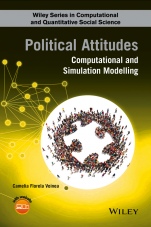
Political Attitudes: Computational and Simulation Modelling
ISBN 9781118833148
Autor: Camelia Florela Voinea
Wydawca: Wiley
Dostępność: 3-6 tygodni
Cena: 324,45 zł
Przed złożeniem zamówienia prosimy o kontakt mailowy celem potwierdzenia ceny.
ISBN13: |
9781118833148 |
ISBN10: |
1118833147 |
Autor: |
Camelia Florela Voinea |
Oprawa: |
Hardback |
Rok Wydania: |
2016-08-05 |
Ilość stron: |
352 |
Wymiary: |
228x161 |
Tematy: |
JP |
Computational Modeling of Political Attitudes
Camelia Florela Voinea, Department of Political Science, International Relations and Security Studies, University of Bucharest, Bucharest, Romania
Political Science has traditionally employed empirical research and analytical resources to understand, explain and predict political phenomena. One of the long–standing criticisms against empirical modeling targets the static perspective provided by the model–invariant paradigm. In political science research, this issue has a particular relevance since political phenomena prove sophisticated degrees of context–dependency whose complexity could be hardly captured by traditional approaches. To cope with the complexity challenge, a new modeling paradigm was needed. This book is concerned with this challenge. Moreover, the book aims to reveal the power of computational modeling of political attitudes to reinforce the political methodology in facing two fundamental challenges: political culture modeling and polity modeling. The book argues that an artificial polity model as a powerful research instrument could hardly be effective without the political attitude and, by extension, the political culture computational and simulation modeling theory, experiments and practice.
This book:
Summarizes the state of the art in the computational modeling of political attitudes, with illustrations and examples featured throughout. Explores the different approaches to computational modeling and how the complexity requirements of political science should determine the direction of research and evaluation methods. Addresses the newly emerging discipline of computational political science. Discusses modeling paradigms, agent–based modeling and simulation, and complexity–based modeling. Discusses model classes in the fundamental areas of voting behavior and decision–making, collective action, ideology and partisanship, emergence of social uprisings and civil conflict, international relations, allocation of public resources, polity and institutional function, operation, development and reform, political attitude formation and change in democratic societies.
This book is ideal for students who need a conceptual and operational description of the political attitude computational modeling phases, goals and outcomes in order to understand how political attitudes could be computationally modeled and simulated. Researchers, Governmental and international policy experts will also benefit from this book.
Preface
Acknowledgements
Part 1: Social and Political Attitude Modeling
Chapter 1: Attitudes: Brief History of the Concept
Chapter 2: Computational Modeling in Social and Political Attitude Research
Part 2: Social and Political Influence Models of Attitude Change
Chapter 3: Voting Choice Computer Simulation Model (McPhee, 1963)
Chapter 4: Community Referendum Model (Abelson and Bernstein, 1963)
Part 3: The Role of Physical Space in Political Attitude Modeling
Chapter 5: Social Impact Theory and Model (Latané, 1981)
Chapter 6: Dynamic Social Impact Theory and Model (Nowak, Szamrej and Latané, 1990)
Part 4: Political Attitudes in Collective Behaviors and Collective Action Modeling
Chapter 7: Culture Dissemination Model (Axelrod, 1997)
Chapter 8: Diversity Survival Model (Huckfeldt, Johnson and Sprague, 2004)
Chapter 9: Political Contagion (Johnson, 1999)
Part 5: Multidimensional Spatial Models
Chapter 10: System Dynamics Modeling Paradigm
Chapter 11: Multidimensional Attitude Change Models (Woelfel and Saltiel, 1978)
Part 6: Political Cognition Modeling
Chapter 12: JQP Model (Kim, Lodge and Taber, 2010)
Chapter 13: Political Attitude Strength Simulation Model, PASS, (Kottonau, 2002)
Part 7: Computational and Simulation Modeling of Ideology
Chapter 14: Dynamical Political Polarization Model (Baldassari and Bearman, 2007)
Chapter 15: Ideological Landscapes Model (Lorenz, 2014)
Chapter 16: Complex Integrative Models of Political Ideology (Homer–Dixon et al., 2013)
Part 8: Polity Modeling
Chapter 17: Polity Instability Models of Ethnic and Nationalist Insurgence (Cederman and Girardin, 2007)
Chapter 18: Polity Re–Construction Model (Sakamoto and Endo, 2015)
Chapter 19: MASON RebeLand Model (Cioffi–Revilla and Rouleau, 2010)
Chapter 20: Compartmental Model (Lang and De Sterck, 2012)
Epilogue
Chapter 21: Shaping New Science
References
Index
Koszyk
Książek w koszyku: 0 szt.
Wartość zakupów: 0,00 zł
Informacje


Kontakt
Gambit
Centrum Oprogramowania
i Szkoleń Sp. z o.o.
Al. Pokoju 29b/22-24
31-564 Kraków
Siedziba Księgarni
ul. Kordylewskiego 1
31-542 Kraków
+48 12 410 5991
+48 12 410 5987
+48 12 410 5989
Subskrypcje
Administratorem danych osobowych jest firma Gambit COiS Sp. z o.o. Na podany adres będzie wysyłany wyłącznie biuletyn informacyjny.
Autoryzacja płatności

Informacje na temat autoryzacji płatności poprzez PayU.

© Copyright 2012: GAMBIT COiS Sp. z o.o. Wszelkie prawa zastrzeżone.
Projekt i wykonanie: Alchemia Studio Reklamy