


Wydawcy
Katalog tematyczny
- Archeologia (109)
- Ekonomia, finanse, business (13704)
- Filozofia (1445)
- Historia (3040)
- Języki i językoznawstwo (2356)
- Lifestyle, hobby i rozrywka (475)
- Medycyna (9704)
- Nauki humanistyczne (4)
- Nauki o Ziemi i środowisku (2638)
- Nauki ścisłe (20412)
- Nauki społeczne (8486)
- Nauki techniczne (13450)
- Prawo (1696)
- Publikacje informacyjne i interdyscyplinarne (1288)
- Religia i wierzenia (917)
- Technika komputerowa (4067)
- Zdrowie, relacje międzyludzkie i rozwój osobisty (657)



Informacje szczegółowe o książce
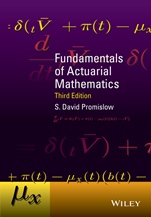
Fundamentals of Actuarial Mathematics
ISBN 9781118782460
Autor: S. David Promislow
Wydawca: Wiley
Dostępność: 3-6 tygodni
Cena: 355,95 zł
Przed złożeniem zamówienia prosimy o kontakt mailowy celem potwierdzenia ceny.
ISBN13: |
9781118782460 |
ISBN10: |
1118782461 |
Autor: |
S. David Promislow |
Oprawa: |
Hardback |
Rok Wydania: |
2014-12-26 |
Numer Wydania: |
3rd Edition |
Ilość stron: |
552 |
Wymiary: |
250x169 |
Tematy: |
KFFN |
Fundamentals of Actuarial Mathematics provides a comprehensive coverage of both the deterministic and stochastic models of life contingencies, risk theory, credibility theory, multi–state models and an introduction to modern mathematical finance. This new edition: Provides an introduction to the mathematics of financial markets, exploring options, risk–neutral evaluation, the fundamental theorem of asset pricing and the Black–Scholes formula. Provides coverage of profit testing. Presents more in–depth coverage of continuous–time multi–state theory. Covers all of the syllabus material on the current life contingencies examinations of the Society of Actuaries, Canadian Institute of Actuaries and the Casualty Actuarial Society (SOA–CIA exams MLC, CSA exam LC), as well as much of the material for SOA–CIA exam C, CAS exam 4, and the British Institute of Actuaries exam CT5. Contains a variety of exercises, both computational and theoretical, together with answers, enabling use for self–study. Fundamentals of Actuarial Mathematics, 3rd Edition is the ideal text for students planning for a professional career as actuaries, providing a solid preparation for the modelling examinations of major actuarial associations. It also serves as a highly suitable reference for those wanting a sound introduction to the subject, and for those working in insurance, annuities and pensions.
Preface xvii Acknowledgements xxi Notation index xxiii Part I THE DETERMINISTIC LIFE CONTINGENCIES MODEL 1 1 Introduction and motivation 3 1.1 Risk and insurance 3 1.2 Deterministic versus stochastic models 4 1.3 Finance and investments 5 1.4 Adequacy and equity 5 1.5 Reassessment 6 1.6 Conclusion 6 2 The basic deterministic model 7 2.1 Cash flows 7 2.2 An analogy with currencies 8 2.3 Discount functions 9 2.4 Calculating the discount function 11 2.5 Interest and discount rates 12 2.6 Constant interest 12 2.7 Values and actuarial equivalence 13 2.8 Vector notation 17 2.9 Regular pattern cash flows 18 2.10 Balances and reserves 20 2.10.1 Basic concepts 20 2.10.2 Relation between balances and reserves 22 2.10.3 Prospective versus retrospective methods 23 2.10.4 Recursion formulas 24 2.11 Time shifting and the splitting identity 26 2.11 Change of discount function 27 2.12 Internal rates of return 28 2.13 Forward prices and term structure 30 2.14 Standard notation and terminology 33 2.14.1 Standard notation for cash flows discounted with interest 33 2.14.2 New notation 34 2.15 Spreadsheet calculations 34 Notes and references 35 Exercises 35 3 The life table 39 3.1 Basic definitions 39 3.2 Probabilities 40 3.3 Constructing the life table from the values of q x 41 3.4 Life expectancy 42 3.5 Choice of life tables 44 3.6 Standard notation and terminology 44 3.7 A sample table 45 Notes and references 45 Exercises 45 4 Life annuities 47 4.1 Introduction 47 4.2 Calculating annuity premiums 48 4.3 The interest and survivorship discount function 50 4.3.1 The basic definition 50 4.3.2 Relations between 4.4 Guaranteed payments 53 4.5 Deferred annuities with annual premiums 55 4.6 Some practical considerations 56 4.6.1 Gross premiums 56 4.6.2 Gender aspects 56 4.7 Standard notation and terminology 57 4.8 Spreadsheet calculations 58 Exercises 59 5 Life insurance 61 5.1 Introduction 61 5.2 Calculating life insurance premiums 61 5.3 Types of life insurance 64 5.4 Combined insurance–annuity benefits 64 5.5 Insurances viewed as annuities 69 5.6 Summary of formulas 70 5.7 A general insurance–annuity identity 70 5.7.1 The general identity 70 5.7.2 The endowment identity 71 5.8 Standard notation and terminology 72 5.8.1 Single–premium notation 72 5.8.2 Annual–premium notation 73 5.8.3 Identities 74 5.9 Spreadsheet applications 74 Exercises 74 6 Insurance and annuity reserves 78 6.1 Introduction to reserves 78 6.2 The general pattern of reserves 81 6.3 Recursion 82 6.4 Detailed analysis of an insurance or annuity contract 83 6.4.1 Gains and losses 83 6.4.2 The risk–savings decomposition 85 6.5 Bases for reserves 87 6.6 Nonforfeiture values 88 6.7 Policies involving a return of the reserve 88 6.8 Premium difference and paid–up formulas 90 6.8.1 Premium difference formulas 90 6.8.2 Paid–up formulas 90 6.8.3 Level endowment reserves 91 6.9 Standard notation and terminology 91 6.10 Spreadsheet applications 93 Exercises 94 7 Fractional durations 98 7.1 Introduction 98 7.2 Cash flows discounted with interest only 99 7.3 Life annuities paid 7.3.1 Uniform distribution of deaths 101 7.3.2 Present value formulas 102 7.4 Immediate annuities 104 7.5 Approximation and computation 105 7.6 Fractional period premiums and reserves 106 7.7 Reserves at fractional durations 107 7.8 Standard notation and terminology 109 Exercises 109 8 Continuous payments 112 8.1 Introduction to continuous annuities 112 8.2 The force of discount 113 8.3 The constant interest case 114 8.4 Continuous life annuities 115 8.4.1 Basic definition 115 8.4.2 Evaluation 116 8.4.3 Life expectancy revisited 117 8.5 The force of mortality 118 8.6 Insurances payable at the moment of death 119 8.6.1 Basic definitions 119 8.6.2 Evaluation 120 8.7 Premiums and reserves 122 8.8 The general insurance–annuity identity in the continuous case 123 8.9 Differential equations for reserves 124 8.10 Some examples of exact calculation 125 8.10.1 Constant force of mortality 126 8.10.2 Demoivre’s law 127 8.10.3 An example of the splitting identity 128 8.11 Further approximations from the life table 129 8.12 Standard actuarial notation and terminology 131 Notes and references 132 Exercises 132 9 Select mortality 137 9.1 Introduction 137 9.2 Select and ultimate tables 138 9.3 Changes in formulas 139 9.4 Projections in annuity tables 141 9.5 Further remarks 142 Exercises 142 10 Multiple–life contracts 144 10.1 Introduction 144 10.2 The joint–life status 144 10.3 Joint–life annuities and insurances 146 10.4 Last–survivor annuities and insurances 147 10.4.1 Basic results 147 10.4.2 Reserves on second–death insurances 148 10.5 Moment of death insurances 149 10.6 The general two–life annuity contract 150 10.7 The general two–life insurance contract 152 10.8 Contingent insurances 153 10.8.1 First–death contingent insurances 153 10.8.2 Second–death contingent insurances 154 10.8.3 Moment–of–death contingent insurances 155 10.8.4 General contingent probabilities 155 10.9 Duration problems 156 10.10 Applications to annuity credit risk 159 10.11 Standard notation and terminology 160 10.12 Spreadsheet applications 161 Notes and references 161 Exercises 161 11 Multiple–decrement theory 166 11.1 Introduction 166 11.2 The basic model 166 11.2.1 The multiple–decrement table 167 11.2.2 Quantities calculated from the multiple–decrement table 168 11.3 Insurances 169 11.4 Determining the model from the forces of decrement 170 11.5 The analogy with joint–life statuses 171 11.6 A machine analogy 171 11.6.1 Method 1 172 11.6.2 Method 2 173 11.7 Associated single–decrement tables 175 11.7.1 The main methods 175 11.7.2 Forces of decrement in the associated single–decrement tables 176 11.7.3 Conditions justifying the two methods 177 11.7.4 Other approaches 180 Notes and references 181 Exercises 181 12 Expenses and Profits 184 12.1 Introduction 184 12.2 Effect on reserves 186 12.3 Realistic reserve and balance calculations 187 12.4 Profit measurement 189 12.4.1 Advanced gain and loss analysis 189 12.4.2 Gains by source 191 12.4.3 Profit testing 193 Notes and references 196 Exercises 196 13 Specialized topics 199 13.1 Universal life 199 13.1.1 Description of the contract 199 13.1.2 Calculating account values 201 13.2 Variable annuities 203 13.3 Pension plans 204 13.3.1 DB plans 204 13.3.2 DC plans 206 Exercises 207 Part II THE STOCHASTIC LIFE CONTINGENCIES MODEL 209 14 Survival distributions and failure times 211 14.1 Introduction to survival distributions 211 14.2 The discrete case 212 14.3 The continuous case 213 14.3.1 The basic functions 214 14.3.2 Properties of µ 214 14.3.3 Modes 215 14.4 Examples 215 14.5 Shifted distributions 216 14.6 The standard approximation 217 14.7 The stochastic life table 219 14.8 Life expectancy in the stochastic model 220 14.9 Stochastic interest rates 221 Notes and references 222 Exercises 222 15 The stochastic approach to insurance and annuities 224 15.1 Introduction 224 15.2 The stochastic approach to insurance benefits 225 15.2.1 The discrete case 225 15.2.2 The continuous case 226 15.2.3 Approximation 226 15.2.4 Endowment insurances 227 15.3 The stochastic approach to annuity benefits 229 15.3.1 Discrete annuities 229 15.3.2 Continuous annuities 231 15.4 Deferred contracts 233 15.5 The stochastic approach to reserves 233 15.6 The stochastic approach to premiums 235 15.6.1 The equivalence principle 235 15.6.2 Percentile premiums 236 15.6.3 Aggregate premiums 237 15.6.4 General premium principles 240 15.7 The variance of r L 241 15.8 Standard notation and terminology 243 Notes and references 244 Exercises 244 16 Simplifications under level benefit contracts 248 16.1 Introduction 248 16.2 Variance calculations in the continuous case 248 16.2.1 Insurances 249 16.2.2 Annuities 249 16.2.3 Prospective losses 249 16.2.4 Using equivalence principle premiums 249 16.3 Variance calculations in the discrete case 250 16.4 Exact distributions 252 16.4.1 The distribution of Z 252 16.4.2 The distribution of Y 252 16.4.3 The distribution of L 252 16.4.4 The case where T is exponentially distributed 253 16.5 Some non–level benefit examples 254 16.5.1 Term insurance 254 16.5.2 Deferred insurance 254 16.5.3 An annual premium policy 255 Exercises 256 17 The minimum failure time 259 17.1 Introduction 259 17.2 Joint distributions 259 17.3 The distribution of T 261 17.3.1 The general case 261 17.3.2 The independent case 261 17.4 The joint distribution of ( T,J ) 261 17.4.1 The distribution function for ( T,J ) 261 17.4.2 Density and survival functions for ( T,J ) 264 17.4.3 The distribution of J 265 17.4.4 Hazard functions for ( T,J ) 266 17.4.5 The independent case 266 17.4.6 Nonidentifiability 268 17.4.7 Conditions for the independence of T and J 269 17.5 Other problems 270 17.6 The common shock model 271 17.7 Copulas 273 Notes and references 276 Exercises 276 Part III ADVANCED STOCHASTIC MODELS 279 18 An introduction to stochastic processes 281 18.1 Introduction 281 18.2 Markov chains 283 18.2.1 Definitions 283 18.2.2 Examples 284 18.3 Martingales 286 18.4 Finite–state Markov chains 287 18.4.1 The transition matrix 287 18.4.2 Multi–period transitions 288 18.4.3 Distributions 288 18.4.4 Limiting distributions 289 18.4.5 Recurrent and transient states 290 18.5 Introduction to continuous time processes 293 18.6 Poisson processes 293 18.6.1 Waiting times 295 18.6.2 Nonhomogeneous Poisson processes 295 18.7 Brownian motion 295 18.7.1 The main definition 295 18.7.2 Connection with random walks 296 18.7.3 Hitting times 297 18.7.4 Conditional distributions 298 18.7.5 Brownian motion with drift 299 18.7.6 Geometric Brownian motion 299 Notes and references 299 Exercises 300 19 Multi–state models 304 19.1 Introduction 304 19.2 The discrete–time model 305 19.2.1 Non–stationary Markov Chains 305 19.2.2 Discrete–time multi–state insurances 307 19.2.3 Multi–state annuities 310 19.3 The continuous–time model 311 19.3.1 Forces of transition 311 19.3.2 Path–by–path 19.3.3 Numerical approximation 317 19.3.4 Stationary continuous time processes 318 19.3.5 Some methods for non–stationary processes 320 19.3.6 Extension of the common shock model 321 19.3.7 Insurance and annuity applications in continuous time 322 19.4 Recursion and differential equations for multi–state reserves 324 19.5 Profit testing in multi–state models 327 19.6 Semi–Markov models 328 Notes and references 328 Exercises 329 20 Introduction to the Mathematics of Financial Markets 333 20.1 Introduction 333 20.2 Modelling prices in financial markets 333 20.3 Arbitrage 334 20.4 Option contracts 337 20.5 Option prices in the one–period binomial model 339 20.6 The multi–period binomial model 342 20.7 American options 346 20.8 A general financial market 348 20.9 Arbitrage–free condition 351 20.10 Existence and uniqueness of risk neutral measures 353 20.10.1 Linear algebra background 353 20.10.2 The space of contingent claims 353 20.10.3 The Fundamental theorem of asset pricing completed 357 20.11 Completeness of markets 358 20.12 The Black–Scholes–Merton formula 361 20.13 Bond markets 364 20.13.1 Introduction 364 20.13.2 Extending the notion of conditional expectation 366 20.13.3 The arbitrage–free condition in the bond market 367 20.13.4 Short–rate modelling 368 20.13.5 Forward prices and rates 370 20.13.6 Observations on the continuous time bond market 371 Notes and references 372 Exercises 373 Part IV RISK THEORY 375 21 Compound distributions 377 21.1 Introduction 377 21.2 The mean and variance of S 379 21.3 Generating functions 380 21.4 Exact distribution of S 381 21.5 Choosing a frequency distribution 381 21.6 Choosing a severity distribution 383 21.7 Handling the point mass at 0 384 21.8 Counting claims of a particular type 385 21.8.1 One special class 385 21.8.2 Special classes in the Poisson case 386 21.9 The sum of two compound Poisson distributions 387 21.10 Deductibles and other modifications 388 21.10.1 The nature of a deductible 388 21.10.2 Some calculations in the discrete case 389 21.10.3 Some calculations in the continuous case 390 21.10.4 The effect on aggregate claims 392 21.10.5 Other modifications 393 21.11 A recursion formula for S 393 21.11.1 The positive–valued case 393 21.11.2 The case with claims of zero amount 397 Notes and references 398 Exercises 398 22 Risk assessment 403 22.1 Introduction 403 22.2 Utility theory 403 22.3 Convex and concave functions: Jensen’s inequality 406 22.3.1 Basic definitions 406 22.3.2 Jensen’s inequality 407 22.4 A general comparison method 408 22.5 Risk measures for capital adequacy 412 22.5.1 The general notion of a risk measure 412 22.5.2 Value–at–risk 412 22.5.3 Tail value–at–risk 413 22.5.4 Distortion risk measures 416 Notes and references 417 Exercises 417 23 Ruin models 420 23.1 Introduction 420 23.2 A functional equation approach 422 23.3 The martingale approach to ruin theory 424 23.3.1 Stopping times 424 23.3.2 The optional stopping theorem and its consequences 425 23.3.3 The adjustment coefficient 428 23.3.4 The main conclusions 431 23.4 Distribution of the deficit at ruin 433 23.5 Recursion formulas 434 23.5.1 Calculating ruin probabilities 434 23.5.2 The distribution of D ( u ) 436 23.6 The compound Poisson surplus process 438 23.6.1 Description of the process 438 23.6.2 The probability of eventual ruin 439 23.6.3 The value of Ψ ( 0 ) 440 23.6.4 The distribution of D ( 0 ) 440 23.6.5 The case when X is exponentially distributed 440 23.7 The maximal aggregate loss 441 Notes and references 445 Exercises 445 24 Credibility theory 449 24.1 Introductory material 449 24.1.1 The nature of credibility theory 449 24.1.2 Information assessment 449 24.2 Conditional expectation and variance with respect to another random variable 453 24.2.1 The random variable E ( X | Y ) 453 24.2.2 Conditional variance 455 24.3 General framework for Bayesian credibility 457 24.4 Classical examples 459 24.5 Approximations 462 24.5.1 A general case 462 24.5.2 The B̈uhlman model 463 24.5.3 B̈uhlman–Straub Model 464 24.6 Conditions for exactness 465 24.7 Estimation 469 24.7.1 Unbiased estimators 469 24.7.2 Calculating Var( X ) in the credibility model 470 24.7.3 Estimation of the B̈ulhman parameters 470 24.7.4 Estimation in the B̈ulhman–Straub model 472 Notes and References 473 Exercises 473 Appendix A review of probability theory 477 A.1 Sample spaces and probability measures 477 A.2 Conditioning and independence 479 A.3 Random variables 479 A.4 Distributions 480 A.5 Expectations and moments 481 A.6 Expectation in terms of the distribution function 482 A.7 Joint distributions 483 A.8 Conditioning and independence for random variables 485 A.9 Moment generating functions 486 A.10 Probability generating functions 487 A.11 Some standard distributions 489 A.11.1 The binomial 489 A.11.2 The Poisson 489 A.11.3 The negative binomial and geometric distributions 490 A.11.4 The Continuous uniform 491 A.11.5 The normal distribution 491 A.11.6 The gamma and exponential distributions 493 A.11.7 The lognormal distribution 494 A.11.8 The Pareto distribution 495 A.12 Convolution 495 A.12.1 The discrete case 495 A.12.2 The continuous case 497 A.12.3 Notation and remarks 499 A.13 Mixtures 499 Answers to exercises 501 References 517 Index 000
Koszyk
Książek w koszyku: 0 szt.
Wartość zakupów: 0,00 zł
Informacje


Kontakt
Gambit
Centrum Oprogramowania
i Szkoleń Sp. z o.o.
Al. Pokoju 29b/22-24
31-564 Kraków
Siedziba Księgarni
ul. Kordylewskiego 1
31-542 Kraków
+48 12 410 5991
+48 12 410 5987
+48 12 410 5989
Subskrypcje
Administratorem danych osobowych jest firma Gambit COiS Sp. z o.o. Na podany adres będzie wysyłany wyłącznie biuletyn informacyjny.
Autoryzacja płatności

Informacje na temat autoryzacji płatności poprzez PayU.

© Copyright 2012: GAMBIT COiS Sp. z o.o. Wszelkie prawa zastrzeżone.
Projekt i wykonanie: Alchemia Studio Reklamy