


Wydawcy
Katalog tematyczny
- Archeologia (109)
- Ekonomia, finanse, business (13704)
- Filozofia (1445)
- Historia (3040)
- Języki i językoznawstwo (2356)
- Lifestyle, hobby i rozrywka (475)
- Medycyna (9704)
- Nauki humanistyczne (4)
- Nauki o Ziemi i środowisku (2638)
- Nauki ścisłe (20412)
- Nauki społeczne (8486)
- Nauki techniczne (13450)
- Prawo (1696)
- Publikacje informacyjne i interdyscyplinarne (1288)
- Religia i wierzenia (917)
- Technika komputerowa (4067)
- Zdrowie, relacje międzyludzkie i rozwój osobisty (657)





Informacje szczegółowe o książce
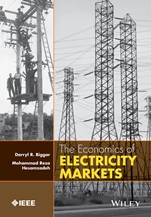
The Economics of Electricity Markets
ISBN 9781118775752
Autor: Darryl R. Biggar, Mohammad Reza Hesamzadeh
Wydawca: Wiley
Dostępność: 3-6 tygodni
Cena: 515,55 zł
Przed złożeniem zamówienia prosimy o kontakt mailowy celem potwierdzenia ceny.
ISBN13: |
9781118775752 |
ISBN10: |
1118775759 |
Autor: |
Darryl R. Biggar, Mohammad Reza Hesamzadeh |
Oprawa: |
Hardback |
Rok Wydania: |
2014-09-05 |
Ilość stron: |
432 |
Wymiary: |
251x167 |
Tematy: |
HB |
With the transition to liberalized electricity markets in many countries, the shift to more environmentally sustainable forms of power generation and increasing penetration of electric vehicles and smart appliances, a fundamental understanding of the economic principles underpinning the electricity industry is vital. Using clarity and precision, the authors successfully explain economic theory of all liberalized electricity market types from a cross–disciplinary engineering and policy perspective. No prior engineering knowledge or economics expertise is assumed in introducing key ideas such as nodal pricing, optimal dispatch and efficient pricing or in extending those models to areas including investment, risk management and the handling of contingencies. Key features: Comprehensively covers the principles of all liberalized electricity market types, including the US, Europe, New Zealand and Australia. Provides up to date coverage of research and policy issues, including design of financial transmission rights, modeling of market power, problems of regional pricing, and design of distribution pricing to facilitate Smart Grid. Spans introductory material to cutting–edge thinking on risk–management and short–run dispatch. Supports independent learning and teaching with worked examples and problems, enabling the reader to test and further deepen their understanding, whilst also promoting their insight and intuition. Solutions to problems and figures are hosted on a companion website. This ground–breaking text is an indispensable resource for the next generation of engineers, economists and policy–makers in or preparing to enter the electricity sector. Graduate students in electrical engineering and economics will benefit from the breadth of material and detailed, economically precise presentation.
Contents Preface Part I: Introduction to economic concepts Chapter I–1: Introduction to micro–economics I–1.1 Economic objectives I–1.2 Introduction to constrained optimisation I–1.3 Demand and consumers’ surplus I–1.4 Supply and producers’ surplus I–1.5 Achieving optimal short–run outcomes using competitive markets I–1.6 Smart markets I–1.7 Longer–run decisions by producers and consumers I–1.8 Monopoly I–1.9 Oligopoly I–1.10 Summary of Chapter I–1 Part II: Introduction to electricity networks and electricity markets Chapter II–1: Introduction to electric power systems II–1.1 DC circuit concepts II–1.2 AC circuit concepts II–1.3 Reactive power II–1.4 The elements of an electric power system II–1.5 Electricity generation II–1.6 Electricity transmission and distribution networks II–1.7 Physical limits on networks II–1.8 Electricity consumption II–1.9 Does it make sense to distinguish electricity producers and consumers? II–1.10 Summary of Chapter II–1 Chapter II–2: Electricity industry market structure and competition II–2.1 Tasks performed in an efficient electricity industry II–2.2 Electricity industry reforms II–2.3 Approaches to reform of the electricity industry II–2.4 Other key roles in a market–oriented electric power system II–2.5 An overview of liberalised electricity markets II–2.6 An overview of the Australian National Electricity Market II–2.7 The pros and cons of electricity market reform II–2.8 Summary of Chapter II–2 Part III: Optimal dispatch: The efficient use of generation, consumption and network resources Chapter III–1: Efficient short–term operation of an electricity industry with no network constraints III–1.1 The cost of generation III–1.2 A simple stylized representation of a generator III–1.3 Optimal dispatch of generation with inelastic demand III–1.4 Optimal dispatch of both generation and load assets III–1.5 Symmetry in the treatment of generation and load III–1.6 The benefit function III–1.7 Non–convexities in production – minimum operating levels III–1.8 Efficient dispatch of energy–limited resources III–1.9 Efficient dispatch in the present of ramp–rate constraints III–1.10 Start–up costs and the unit–commitment decision III–1.11 Summary of Chapter III–1 Chapter III–2: Achieving efficient use of generation and load resources using a market mechanism in an industry with no network constraints III–2.1 Decentralisation, competition, and market mechanisms III–2.2 Achieving optimal dispatch through competitive bidding III–2.3 Variation in wholesale market design III–2.4 Day–ahead versus real–time markets III–2.5 Price controls and rationing III–2.6 Time–varying demand, the load–duration curve and the price–duration curve III–2.7 Summary of Chapter III–2 Chapter III–3: Representing network constraints III–3.1 Representing networks mathematically III–3.2 Net injections, power flows and the DC load flow model III–3.3 The matrix of power transfer distribution factors III–3.4 Distribution factors for radial networks III–3.5 Constraint equations and the set of feasible injections III–3.6 Summary of Chapter III–3 Chapter III–4: Efficient dispatch of generation and consumption resources in the presence of network congestion III–4.1 Optimal dispatch with network constraints III–4.2 Optimal dispatch in a radial network III–4.3 Optimal dispatch in a two–node network III–4.4 Optimal dispatch in a three–node meshed network III–4.5 Optimal dispatch in a four–node network III–4.6 Properties of Nodal Prices with a Single Binding Constraint III–4.7 How many independent nodal prices exist? III–4.8 The Merchandising Surplus, Settlement Residues and the Congestion Rents III–4.9 Network losses III–4.10 Summary of Chapter III–4 Chapter III–5: Efficient network operation III–5.1 Efficient operation of DC interconnectors III–5.2 Optimal network switching III–5.3 Summary of Chapter III–5 Part IV: Efficient investment in generation and consumption assets Chapter IV–1: Efficient investment in generation and consumption assets IV–1.1 The optimal generation investment problem IV–1.2 The optimal level of generation capacity with downward sloping demand IV–1.3 The optimal mix of generation capacity with downward sloping demand IV–1.4 The optimal mix of generation with inelastic demand IV–1.5 Screening curve analysis IV–1.6 Buyer–side investment IV–1.7 Summary of Chapter IV–1 Chapter IV–2: Market–based investment in electricity generation IV–2.1 Decentralised generation investment decisions IV–2.2 Can we trust competitive markets to deliver an efficient level of investment in generation? IV–2.3 Price caps, reserve margins and capacity payments IV–2.4 Time–averaging of network charges and generation investment IV–2.5 Summary of Chapter IV–2 Part V: Handling contingencies: Efficient dispatch in the very short run Chapter V–1: Efficient operation of the power system in the very short–run V–1.1 Introduction to contingencies V–1.2 Efficient handling of contingencies V–1.3 Preventive and corrective actions V–1.4 Satisfactory and secure operating states V–1.5 Optimal dispatch in the very short–run V–1.6 Operating the power system ex ante as though certain contingencies have already happened V–1.7 Examples of optimal short–run dispatch V–1.8 Optimal short–run dispatch using a competitive market V–1.9 Summary of Chapter V–1 Chapter V–2: Frequency–based dispatch of balancing services V–2.1 The intra–dispatch interval dispatch mechanism V–2.2 Frequency–based dispatch of balancing services V–2.3 Implications of ignoring network constraints when handling contingencies V–2.4 Procurement of frequency–based balancing services V–2.5 Summary of Chapter V–2 Part VI: Managing Risk Chapter VI–1: Managing inter–temporal price risks VI–1.1 Introduction to forward markets and standard hedge contracts VI–1.2 The construction of a perfect hedge – the theory VI–1.3 The construction of a perfect hedge – specific cases VI–1.4 Hedging by customers VI–1.5 The role of the trader VI–1.6 Inter–temporal hedging and generation investment VI–1.7 Summary of Chapter VI–1 Chapter VI–2: Managing inter–locational price risk VI–2.1 The role of the merchandising surplus in facilitating inter–locational hedging VI–2.2 Inter–locational transmission rights: CapFTRs VI–2.3 Inter–locational transmission rights: Fixed–Volume FTRs VI–2.4 Inter–locational hedging and transmission investment VI–2.5 Summary of Chapter VI–2 Part VII: Market Power Chapter VII–1: Market power in electricity markets VII–1.1 An introduction to market power in electricity markets VII–1.2 How do generators exercise market power? Theory VII–1.3 How do generators exercise market power? Practice VII–1.4 The incentive to exercise market power: The importance of the residual demand curve VII–1.5 The incentive to exercise market power: The impact of the hedge position of a generator VII–1.6 The exercise of market power by loads and vertical integration VII–1.7 Is the exercise of market power necessary to stimulate generation investment? VII–1.8 The consequences of the exercise of market power VII–1.9 Summary of Chapter VII–1 Chapter VII–2: Market Power and Network Congestion VII–2.1 The exercise of market power by a single generator in a radial network VII–2.2 The exercise of market power by a single generator in a meshed network VII–2.3 The exercise of market power by a portfolio of generators VII–2.4 The effect of transmission rights on market power VII–2.5 Summary of Chapter VII–2 Chapter VII–3: Detecting, Modelling and Mitigating Market Power VII–3.1 Approaches to assessing market power VII–3.2 Detecting the exercise of market power through the examination of market outcomes in the past VII–3.3 Simple indicators of market power VII–3.4 Modelling of market power VII–3.5 Policies to reduce market power VII–3.6 Summary of Chapter VII–3 Part VIII: Network Regulation and Investment Chapter VIII–1: Efficient investment in network assets VIII–1.1 Efficient AC network investment VIII–1.2 Financial implications of network investment VIII–1.3 Efficient investment in a radial network VIII–1.4 Efficient investment in a two–node network VIII–1.5 Coordination of generation and network investment in practice VIII–1.6 Summary of Chapter VIII–1 Part IX: Contemporary issues Chapter IX–1: Regional pricing and its problems IX–1.1 An introduction to regional pricing IX–1.2 Regional pricing without constrained–on and constrained–off payments IX–1.3 Regional pricing with constrained–on and constrained–off payments IX–1.4 Nodal pricing for generators / regional pricing for consumers IX–1.5 Summary of Chapter IX–1 Chapter IX–2: The Smart Grid and Efficient Pricing of Distribution Networks IX–2.1 Efficient pricing of distribution networks IX–2.2 Decentralisation of the dispatch task IX–2.3 Retail tariff structures and the incentive to mis–represent local production and consumption IX–2.4 Incentives for investment in controllable embedded generation IX–2.5 Retail tariff structures IX–2.6 Declining demand for network services and increasing returns to scale IX–2.7 Summary of Chapter IX–2 Part X: Appendix Chapter X–1: Nomenclature Chapter X–2: References
Dr Biggar is Australia’s leading expert on the economics of wholesale electricity markets and the economics of public utility regulation. Since 2002 he has provided economic advice primarily to the Australian Energy Regulator and the Australian Competition and Consumer Commission. He has also provided advice to other government agencies including the Australian Energy Markets Operator, the Australian Energy Markets Commission, and the New Zealand Electricity Authority. He has published a number of papers in academic journals in the economics of electricity markets and the economics of public utility regulation and regularly provides training courses in these areas to government agencies and industry. He has a particular interest in the assessment of market power in wholesale electricity markets and in matters related to wholesale market design. Dr Hesamzadeh is assistant professor in electric power systems division of the school of electrical engineering at KTH Royal Institute of Technology in Stockholm, Sweden. Dr Hesamzadeh is a world leader in the modelling of market power in wholesale electricity markets, particularly in the context of transmission planning. His special fields of interests include Power Systems Planning and Design, Economics of Wholesale Electricity Markets, and Mathematical Modelling and Computing. Hesamzadeh is currently working towards his Docent degree in Electricity Markets at KTH.
Koszyk
Książek w koszyku: 0 szt.
Wartość zakupów: 0,00 zł
Informacje


Kontakt
Gambit
Centrum Oprogramowania
i Szkoleń Sp. z o.o.
Al. Pokoju 29b/22-24
31-564 Kraków
Siedziba Księgarni
ul. Kordylewskiego 1
31-542 Kraków
+48 12 410 5991
+48 12 410 5987
+48 12 410 5989
Subskrypcje
Administratorem danych osobowych jest firma Gambit COiS Sp. z o.o. Na podany adres będzie wysyłany wyłącznie biuletyn informacyjny.
Autoryzacja płatności

Informacje na temat autoryzacji płatności poprzez PayU.

© Copyright 2012: GAMBIT COiS Sp. z o.o. Wszelkie prawa zastrzeżone.
Projekt i wykonanie: Alchemia Studio Reklamy