


Wydawcy
Katalog tematyczny
- Archeologia (109)
- Ekonomia, finanse, business (13704)
- Filozofia (1445)
- Historia (3040)
- Języki i językoznawstwo (2356)
- Lifestyle, hobby i rozrywka (475)
- Medycyna (9704)
- Nauki humanistyczne (4)
- Nauki o Ziemi i środowisku (2638)
- Nauki ścisłe (20412)
- Nauki społeczne (8486)
- Edukacja (229)
- Kryminologia, opieka spełeczna (284)
- Obronność (10)
- Polityka (1389)
- Psychologia (777)
- Socjologia (410)
- Społeczeństwo i kultura (187)
- Nauki techniczne (13450)
- Prawo (1696)
- Publikacje informacyjne i interdyscyplinarne (1288)
- Religia i wierzenia (917)
- Technika komputerowa (4067)
- Zdrowie, relacje międzyludzkie i rozwój osobisty (657)





Informacje szczegółowe o książce
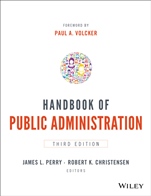
Handbook of Public Administration
ISBN 9781118775554
Autor: James L. Perry, Robert K. Christensen
Wydawca: Wiley
Dostępność: 3-6 tygodni
Cena: 564,90 zł
Przed złożeniem zamówienia prosimy o kontakt mailowy celem potwierdzenia ceny.
ISBN13: |
9781118775554 |
ISBN10: |
1118775554 |
Autor: |
James L. Perry, Robert K. Christensen |
Oprawa: |
Paperback |
Rok Wydania: |
2015-04-07 |
Numer Wydania: |
3rd Edition |
Ilość stron: |
848 |
Wymiary: |
236x192 |
Tematy: |
JP |
PRAISE FOR HANDBOOK OF PUBLIC ADMINISTRATION
"Public administration in today′s era of governance faces big challenges, including leadership competency, accountability, evidence–based policy delivery, and public trust. The third edition of the Handbook of Public Administration provides much–needed coverage of the theory and practice to help address these contemporary concerns. It is a must–read for anyone involved in public administration at the local, national, and global levels."
Dr. Soonhee Kim, professor, Public Management, KDI School of Public Policy and Management, Republic of Korea
"The third edition of this handbook will become a classic. Perry and Christensen rightly assume that ′public administration′ is not static but instead a dynamic verb, which they conjugate actively as in governing, building, developing, sharpening, embracing, becoming, enacting, advancing, tracking, and professionalizing. By doing this, academic and practitioner activism become two sides of the same public sector coin."
Prof. Dr. Geert Bouckaert, professor, Faculty of Social Sciences, KU Leuven Instituut voor de Overheid – Public Governance Institute, Belgium; and president, International Institute of Administrative Sciences (IIAS)
"I benefited enormously from the first edition of this book as a student: it offered the best overview of a complex field. Almost twenty years later things have grown considerably more complex, reflected by a mix of new forms of governance, greater skepticism toward the state, and new technologies. The new Handbook is up to the task of helping both the student and scholar understand this world indeed, it reclaims its status as the best overview of the field."
Dr. Donald P. Moynihan, professor, Public Affairs, Robert M. La Follette School of Public Affairs, University of Wisconsin–Madison; and president–elect, Public Management Research Association (PMRA)
"This is a book that every public administration student should read. With an elite group of contributors, it offers a comprehensive, advanced, balanced, and state–of–the–art coverage on how to become competent administrators and build effective public enterprises in achieving public purposes in the 21st century. A book full of treasures!"
Dr. Kaifeng Yang, professor, Askew School of Public Administration and Policy, Florida State University; and International Adjunct Professor, Renmin University of China
"From matters of governing and building infrastructures for accountability to leading, managing, and professionalizingthe practice of public administration, this terrific book will more than satisfy its readers from both the world of practice as well as academe."
Dr. Walter D. Broadnax, distinguished professor, Public Administration and International Affairs, The Maxwell School, Syracuse University
"Edited by distinguished scholars, this Handbook provides comprehensive coverage of major research topics with up–to–date information about theory and evidence. It is an indispensable guide to the scope and practice of public administration, and it is essential reading for all of those interested in how public organizations work."
Dr. Lotte Bøgh Andersen, professor, Department of Political Science and Government, Aarhus University, Danish Institute of Governmental Research
"The new edition of the Handbook of Public Administration will serve as an essential source for public administration courses and as a key starting–point for new research in the field."
Dr. Steve Kelman, Weatherhead Professor of Public Management, Kennedy School of Government, Harvard University; and editor, International Public Management Journal
Foreword xvii
Paul A. Volcker
Preface xxi
James L. Perry and Robert K. Christensen
The Editors xxvii
The Contributors xxxi
Acknowledgments xlvii
PART ONE: GOVERNING FOR COLLECTIVE ACTION 1
1 Governing in an Age of Transformation 5
Donald F. Kettl
The Changing Environment 6
Transformation 11
From the Administrative State to Stateless Administration 19
Summary 21
2 The Changing Character of the American IntergovernmentalSystem 23
Laurence J. O Toole Jr.
Knowledge about Effective Practice 25
Implications 35
Summary 36
3 Governance in an Era of Partnerships 38
Barbara C. Crosby, Melissa M. Stone, and John M. Bryson
Clarifying Terms 40
The Environment and Its Effects on Collaborations 42
Environmental Effects on a Collaboration s GovernanceProcesses and Structures 47
Implications 51
Summary 53
4 Governing in a Global Context 55
Jonathan G. S. Koppell
Organizational Responses to Globalization 56
Public Administration in the Age of Globalization 63
Implications of Transnational Organization Design for PublicAdministration and Management 68
Summary 69
PART TWO: BUILDING INFRASTRUCTURES FOR ACCOUNTABILITY73
5 Understanding How Public Law Reinforces AdministrativeResponsibility 77
Phillip J. Cooper
Contemporary Challenges and Classic Issues 78
Classic Conceptions and Contemporary Governance 81
Public Law Responsibility in Different Forms in Today sContext 83
Law s Meaning at Two Critically Important Levels:Effective Practice and Legitimacy 89
Summary 95
6 Advancing Good Government through Fighting Corruption97
Milena I. Neshkova and Allan Rosenbaum
Definition, Forms, and Consequences of Corruption 99
Theories of Corruption 101
Empirical Evidence on Corruption 107
Strategies for Reducing Corruption 111
Summary 118
7 Using Transparency to Reinforce Responsibility andResponsiveness 120
Gregory A. Porumbescu and Tobin Im
Knowledge about Effective Practice 121
Research Findings and Evidence about Effective Practice 124
Judgments about Effective Practice Grounded in AdministrativeExperience 130
Implications 134
Summary 135
8 Using Public Participation to Enhance Citizen Voice andPromote Accountability 137
Tina Nabatchi, Jack Alexander Becker, and MattLeighninger
Understanding Accountability 138
Understanding Public Participation 140
Summary 150
PART THREE: IMPLEMENTING POLICY USING TOOLS OF COLLECTIVEACTION 153
9 Developing Effective Relations with Legislatures157
Anne M. Khademian and Fatima Sparger Sharif
The Context of Legislative Liaison Work 159
Structural and Procedural Elements of Managing LegislativeRelations 163
Strategic and Tactical Elements of Managing LegislativeInitiatives: No Surprises 170
Summary 179
10 Designing Effective Programs 180
Michael Howlett, Ishani Mukherjee, and Jeremy Rayner
Components of Public Policy and Effective Program Design 181
Policy Programs and Policy Design: A Short History 184
Principles for Designing Programs: Policy–Program Linkages (I)187
Principles for Designing Programs: Program–Measure Linkages (II)191
Summary 195
11 Using Grants to Achieve Public Purposes 197
Sean Nicholson–Crotty
Scope and Mechanisms of the Grant–in–Aid System 198
The Politics of Grant Distribution 201
Managing Federal Grants–in–Aid 204
Summary 212
12 Contracting in Pursuit of Public Purposes 215
Zachary S. Huitink, David M. Van Slyke, and Trevor L.Brown
Fundamentals 217
Outlook 231
Conclusion 233
Summary 234
13 Coproducing Public Services with Service Users,Communities, and the Third Sector 235
Tony Bovaird and Elke Loeffler
What We Know about Effective Practice in Coproduction 238
Implications 247
Summary 249
14 Advancing Public Good through Entrepreneurship251
Wolfgang Bielefeld
Knowledge about Effective Practice 252
Research Findings 255
Implications 268
Summary 269
PART FOUR: MANAGING FOR PUBLIC PERFORMANCE 271
15 Leading Public Organizations Strategically 275
Richard M. Walker, Chan Su Jung, and Gong–Rok Kim
Knowledge about Effective Strategy Content Practices 277
Research Findings 280
Implications 288
Summary 291
16 Managing Effective Collaborations 293
Michael McGuire and Chris Silvia
Collaborative Public Management 295
Managing Awareness 298
Managing Boundaries 300
Managing Constraints 302
Managing Deliberations 305
Managing External Constituencies 307
Summary 309
17 Tracking the Quality of Services 312
Harry P. Hatry
The Brief History and Limitations of Service Quality Measurement313
Need for Multiple Types of Performance Indicators 314
Sources of Data and Data Collection Procedures 316
Improving the Usefulness of Performance Measurement Systems320
Uses for Service Quality Information 328
Problems in Performance Measurement 329
Role of Ad Hoc Program Evaluations 330
Summary 331
18 Evaluating the Performance of Public Programs333
Kathryn E. Newcomer
Context for Evaluation of Government Performance 335
Evaluation Practice in the Twentieth–First Century 339
Using Evaluation to Improve Performance 347
Summary 351
19 Motivating Employees Using Public Service 353
Wouter Vandenabeele and Nina Mari Van Loon
Theories and Evidence about Public Service Motivation 354
Research Findings and Evidence 358
Implications and Application: Harnessing the Power of PublicService Motivation 363
Summary 365
20 Realizing the Promise of Diversity 366
David W. Pitts and Sarah E. Towne
Defining and Understanding Organizational Diversity 367
Frameworks for Understanding Organizational Diversity and WorkOutcomes 369
Strategies for Managing Organizational Diversity 373
Evolving Research on Diversity and Inclusion 376
Future Directions for Research and Practice 379
Summary 381
21 Understanding and Overcoming Resistance to OrganizationalChange 382
Sergio Fernandez
Resistance to Change 383
Sources of Resistance to Change 386
Overcoming Resistance to Change 392
Summary 396
PART FIVE: DEVELOPING EFFECTIVE ADMINISTRATIVE SYSTEMS399
22 Performance Budgeting 403
Alfred Tat–Kei Ho
Performance Budgeting Practices around the World 404
Institutional and Organizational Constraints on PerformanceBudgeting Practices 407
Implications for Performance Budgeting Design and Practices411
Summary 414
23 Designing and Administering Revenue Systems 416
Yilin Hou
Government Revenues 417
Reliable Revenue Systems 418
Patterns and Trends of Revenue Systems 419
Evaluation Criteria of Revenue Systems 419
Recent Research and Empirical Evidence about the Criteria423
Revenue System Administration 427
Improving Current Systems 429
Summary 434
24 Managing E–Government 436
M. Jae Moon and Eric W. Welch
Advances in Theories and E–Government Studies 437
Advances in E–Government Practice 443
Moving toward E–Governance for Open, Collaborative, andIntegrative Government 450
Critical Success Factors for the Management of E–Government453
Summary 455
25 Designing Social Media Strategies and Policies456
Ines Mergel
Distinguishing Types of Social Media Tools 459
Current Social Media Practices in the Public Sector 461
Designing a Social Media Strategy and Policy 462
Managerial Challenges for Implementing Social Media in thePublic Sector 467
Summary 468
26 Compensating Public Sector Employees 469
Jared J. Llorens
The Unique Context of Public Sector Compensation 470
The Case of the US Federal Government 472
Challenges for Practice and Research 481
Practical Guidance for Public Managers and Policymakers 482
Summary 484
PART SIX: SHARPENING THE PUBLIC ADMINISTRATOR S SKILLSET 487
27 Enacting Collective Leadership in a Shared–Power World489
Sonia M. Ospina and Erica Gabrielle Foldy
Collective Leadership and Democratic Governance: What We Know490
Enacting Collective Leadership: What Research Tells Us 495
Enacting Collective Leadership inside Organizations 495
Enacting Collective Leadership in Complex, Shared–PowerEnvironments 497
Enacting Collective Leadership in Large Collaborative Networks499
Implications: Convergences and Cornerstones of CollectiveLeadership 502
Summary 506
28 Negotiating for the Public Good 508
Lisa Blomgren Amsler
What to Negotiate: Problems and Context 509
When to Negotiate and When Not To 509
Why Negotiate: Empirical Evidence on Practice 510
How to Negotiate: Tools and Skills to Prepare for and InitiateNegotiation 511
Principled or Interest–Based Negotiation and Positional or HardBargaining 519
How Not to Negotiate and How to Recognize Hard Bargaining524
Summary 526
29 Becoming and Being an Effective Collaborator 528
Rosemary O Leary
Knowledge about Effective Practice 529
Common Themes in the Literature 530
Implications for Applying This Knowledge to PublicAdministration Practice 541
Summary 545
30 Communicating Effectively 546
James L. Garnett
Applying Knowledge about Effective Communication Practice547
Implications and Lessons from Hard Knocks Experience 559
Summary 562
31 Developing Intrapersonal Skills 564
Maria P. Aristigueta and Robert B. Denhardt
Intrapersonal and Interpersonal Skills 565
Developing Intrapersonal Skills 567
Practical Advice for Developing Intrapersonal Skills 573
Summary 577
PART SEVEN: PROFESSIONALIZING PUBLIC ADMINISTRATION PRACTICE579
32 Embracing Ethical Principles for Public Action583
Brian N. Williams
Reexamining the Historical Meaning of Public Service 585
How Best to Guard the Guardians? 588
Emerging Opportunities to Embrace Ethical Principles in PublicAction: A View from Below 591
Out of Darkness and into the Light: Implications for ConsistentEthical Actions 594
Conclusion 596
Summary 597
33 Understanding the Obligations of Codes of Ethics598
Liza Ireni–Saban
Codes of Ethics as Markers of Public Administration ProfessionalIdentity 600
Measuring the Effectiveness of Codes of Ethics in PublicAdministration 605
Assessing the Effective Implementation of Codes of Ethics inPublic Administration 607
Comparative Analysis of Codes of Ethics Implementation Efforts608
Summary 614
34 Understanding Your Liability as a Public Administrator616
Stephanie P. Newbold
Knowledge about Effective Practice 620
Implications 632
Summary 633
35 Effective Governance, Effective Administrators636
James L. Perry and Robert K. Christensen
What Distinguishes Effective Governance? 637
What Makes an Effective Public Administrator? 643
Public Administration as a Profession 648
References 650
Index 747
Koszyk
Książek w koszyku: 0 szt.
Wartość zakupów: 0,00 zł
Informacje


Kontakt
Gambit
Centrum Oprogramowania
i Szkoleń Sp. z o.o.
Al. Pokoju 29b/22-24
31-564 Kraków
Siedziba Księgarni
ul. Kordylewskiego 1
31-542 Kraków
+48 12 410 5991
+48 12 410 5987
+48 12 410 5989
Subskrypcje
Administratorem danych osobowych jest firma Gambit COiS Sp. z o.o. Na podany adres będzie wysyłany wyłącznie biuletyn informacyjny.
Autoryzacja płatności

Informacje na temat autoryzacji płatności poprzez PayU.

© Copyright 2012: GAMBIT COiS Sp. z o.o. Wszelkie prawa zastrzeżone.
Projekt i wykonanie: Alchemia Studio Reklamy