


Wydawcy
Katalog tematyczny
- Archeologia (109)
- Ekonomia, finanse, business (13704)
- Filozofia (1445)
- Historia (3040)
- Języki i językoznawstwo (2356)
- Lifestyle, hobby i rozrywka (475)
- Medycyna (9704)
- Chirurgia (272)
- Inne gałęzie medycyny (1871)
- Medycyna kliniczna (4187)
- Medycyna niekonwencjonalna (14)
- Medycyna przedkliniczna (269)
- Medycyna, ogólnie (1740)
- Medyczne służby pomocnicze (745)
- Studia medyczne (16)
- Weterynaria (548)
- Nauki humanistyczne (4)
- Nauki o Ziemi i środowisku (2638)
- Nauki ścisłe (20412)
- Nauki społeczne (8486)
- Nauki techniczne (13450)
- Prawo (1696)
- Publikacje informacyjne i interdyscyplinarne (1288)
- Religia i wierzenia (917)
- Technika komputerowa (4067)
- Zdrowie, relacje międzyludzkie i rozwój osobisty (657)





Informacje szczegółowe o książce
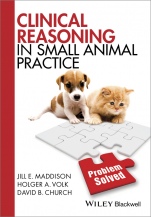
Clinical Reasoning in Small Animal Practice
ISBN 9781118741757
Autor: Jill E. Maddison, Holger A. Volk, David B. Church
Wydawca: Wiley
Dostępność: 3-6 tygodni
Cena: 213,15 zł
Przed złożeniem zamówienia prosimy o kontakt mailowy celem potwierdzenia ceny.
ISBN13: |
9781118741757 |
ISBN10: |
1118741757 |
Autor: |
Jill E. Maddison, Holger A. Volk, David B. Church |
Oprawa: |
Paperback |
Rok Wydania: |
2015-05-08 |
Ilość stron: |
278 |
Wymiary: |
242x172 |
Tematy: |
MZ |
Clinical Reasoning in Small Animal Medicine presents a revolutionary approach to solving clinical problems. As a veterinarian, especially as a student or new graduate, a ten minute consultation in a busy small animal practice can be a daunting task. By guiding you to think pathophysiologically, this book will help solve clinical problems as efficiently as possible. The authors set out a structured approach with easy to remember rules which can be applied to most clinical signs small animals present with. This reduces the need to remember long lists of differentials and avoids the potential of getting trapped by a perceived obvious diagnosis. The book will help to unlock your potential to solve clinical problems. It also provides a logical rationale for choosing diagnostic tests or treatments which can be clearly communicated to the owner.
Written by internationally renowned clinicians and educators in clinical reasoning, key features of the book include:
An easy to remember and logical approach to solving a wide range of clinical problems encountered in small animal medicine and neurology
An invaluable resource for every level of learner, from student to experienced practitioner
Flowcharts and key step markers throughout help illustrate the decision making process
Clinical inductive reasoning offers you the ability to solve cases more efficiently, resulting in better treatment and care for pets and happier owners. Clinical Reasoning in Small Animal Medicine will help turn a terrifying case into a manageable one!
Dr Jill E. Maddison BVSc, DipVetClinStud, PhD, FACVSc, MRCVS is Director of Professional Development, Extra Mural Studies and General Practice at The Royal Veterinary College, UK. Jill is actively involved in undergraduate teaching at the RVC in the areas of clinical problem solving and inductive clinical reasoning in small animal medicine and clinical pharmacology for veterinary students and nurses. She has published over 60 refereed papers in veterinary and medical journals and has been invited to speak at numerous international CPD meetings. In April 2012 she became the chair of the WSAVA Continuing Education (CE) Committee which facilitates CE for veterinarians in developing countries. Jill has been responsible for programming the clinical CPD streams at The London Vet Show since its launch in 2009.
Professor Holger A. Volk DVM, PGCAP, DipECVN, PhD, FHEA, MRCVS is Clinical Director of the Small Animal Referral Hospital and Professor of Veterinary Neurology and Neurosurgery at the Royal Veterinary College, UK. He is a Recognised RCVS and European Specialist in Veterinary Neurology, and President of the European College of Veterinary Neurology from 2014–2016. He is fascinated by and involved in facilitating learning for any type or level of learners. He is a frequent speaker at national and international meetings, is section editor of multiple basic and clinical veterinary science journals and is widely published in scholarly journals.
Professor David B. Church BVSc, PhD, MACVSc, FHEA, MRCVS is the Vice Principal for Learning and the Student Experience at The Royal Veterinary College, UK. He is the author of numerous scientific articles and book chapters and has an ongoing interest in relevant continuing education for practitioners and in particular the value of the problem–oriented approach to small animal medicine.
The veterinary profession has been in need of this book for many decades. The book is written in a down to earth style that shows an appreciation of the working environment and priorities of clinicians, making it a practical guide to efficient and effective clinical decision making.
In this age of information, where answers come easily, it is more important than ever to ask the right questions. Problem–based inductive clinical reasoning is structured as a series of pertinent and timely questions from which the right answers are readily sourced as they are required.
Speaking personally, I ve used problem–based inductive clinical reason as expounded in this text to manage small companion animals as a novice veterinarian, an experienced general veterinary practitioner, a resident in small animal medicine, a practicing specialist in small animal medicine, a veterinary educator and a veterinary service manager and I have never found it to be inadequate to the situation. I m very glad that now I have a name to put to it and a reference for it!
I find that the method can be adapted to any clinical circumstance. I find that it complements the practice and teaching of Evidence–Based Veterinary Medicine, encouraging a working knowledge of applied physiology and a deep understanding of pathophysiology on which to base sourcing of current pertinent information from the recent veterinary literature.
Veterinary practice involves many stressors and being at a loss as to how to solve a case need not be one such stressor when problem–based inductive clinical reasoning is practiced. The book not only describes problem–based inductive clinical reasoning and its application to specific problems but guides the reader in learning and applying the method in the work place. For those who choose to make use of his book as it is intended, once the habit of problem–based inductive clinical reasoning is formed its practice can be expected to reduce cognitive load and improve clinical efficiency.
This book will be valuable to:
Novice veterinarians aiming to bridge the gap between their undergraduate curriculum and the patients they are now faced with when they are lacking in experience of clinical case load. Experienced general practitioners wanting to reignite their practice of small animal medicine and improve their competence and confidence. Veterinary educators needing to train veterinary students in a manner that will enable them to make the transition from student to clinical professional without undue anxiety. Practice owners seeking to improve time management, professional communication and work place efficiency while assisting their veterinary staff in conveying an air of relaxed competence.Sue Bennett BSc BVMS MACVSc (Medicine of Cats) FACVSc (Small Animal Medicine)
Lecturer in Small Animal Medicine, Murdoch University Veterinary Hospital, Australia
Koszyk
Książek w koszyku: 0 szt.
Wartość zakupów: 0,00 zł
Informacje


Kontakt
Gambit
Centrum Oprogramowania
i Szkoleń Sp. z o.o.
Al. Pokoju 29b/22-24
31-564 Kraków
Siedziba Księgarni
ul. Kordylewskiego 1
31-542 Kraków
+48 12 410 5991
+48 12 410 5987
+48 12 410 5989
Subskrypcje
Administratorem danych osobowych jest firma Gambit COiS Sp. z o.o. Na podany adres będzie wysyłany wyłącznie biuletyn informacyjny.
Autoryzacja płatności

Informacje na temat autoryzacji płatności poprzez PayU.

© Copyright 2012: GAMBIT COiS Sp. z o.o. Wszelkie prawa zastrzeżone.
Projekt i wykonanie: Alchemia Studio Reklamy