


Wydawcy
Katalog tematyczny
- Archeologia (109)
- Ekonomia, finanse, business (13704)
- Filozofia (1445)
- Historia (3040)
- Języki i językoznawstwo (2356)
- Lifestyle, hobby i rozrywka (475)
- Medycyna (9704)
- Nauki humanistyczne (4)
- Nauki o Ziemi i środowisku (2638)
- Geografia (299)
- Nauki o Ziemi (1661)
- Geologia (414)
- Hydrologia (237)
- Meteorologia i klimatologia (114)
- Paleontologia (33)
- Wulkanologia i sejsmologia (44)
- Planowanie przestrzenne (53)
- Środowisko (607)
- Nauki ścisłe (20412)
- Nauki społeczne (8486)
- Nauki techniczne (13450)
- Prawo (1696)
- Publikacje informacyjne i interdyscyplinarne (1288)
- Religia i wierzenia (917)
- Technika komputerowa (4067)
- Zdrowie, relacje międzyludzkie i rozwój osobisty (657)





Informacje szczegółowe o książce
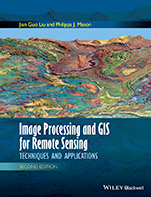
Image Processing and GIS for Remote Sensing: Techniques and Applications
ISBN 9781118724200
Autor: Jian Guo Liu, Philippa J. Mason
Wydawca: Wiley
Dostępność: 3-6 tygodni
Cena: 431,55 zł
Przed złożeniem zamówienia prosimy o kontakt mailowy celem potwierdzenia ceny.
ISBN13: |
9781118724200 |
ISBN10: |
1118724208 |
Autor: |
Jian Guo Liu, Philippa J. Mason |
Oprawa: |
Hardback |
Rok Wydania: |
2016-03-18 |
Numer Wydania: |
2nd Edition |
Ilość stron: |
472 |
Wymiary: |
249x188 |
Tematy: |
RB |
Following the successful publication of the 1st edition in 2009, the 2nd edition maintains its aim to provide an application–driven package of essential techniques in image processing and GIS, together with case studies for demonstration and guidance in remote sensing applications. The book therefore has a 3 in 1 structure which pinpoints the intersection between these three individual disciplines and successfully draws them together in a balanced and comprehensive manner.
The book conveys in–depth knowledge of image processing and GIS techniques in an accessible and comprehensive manner, with clear explanations and conceptual illustrations used throughout to enhance student learning. The understanding of key concepts is always emphasised with minimal assumption of prior mathematical experience.
The book is heavily based on the authors own research. Many of the author–designed image processing techniques are popular around the world. For instance, the SFIM technique has long been adopted by ASTRIUM for mass–production of their standard Pan–sharpen imagery data. The new edition also includes a completely new chapter on subpixel technology and new case studies, based on their recent research.
Essential Image Processing and GIS for Remote Sensing 11
Overview of the Book 11
Part I. Image Processing 13
Chapter 1 Digital image and display 14
1.1 What is a digital image? 14
1.2 Digital image display 15
1.2.1 Monochromatic display 15
1.2.2 Tristimulus colour theory and RGB (red, green, blue) colour display 16
1.2.3 Pseudo colour display 18
1.3 Some key points 20
1.4 Questions 20
Chapter 2 Point operations (Contrast enhancement) 21
2.1 Histogram modification and look up table (LUT) 21
2.2 Linear contrast enhancement (LCE) 24
2.3 Logarithmic and Exponential contrast enhancement 26
2.31 Logarithmic contrast enhancement 26
2.32 Exponential contrast enhancement 27
2.4 Histogram equalisation (HE) 28
2.5 Histogram matching (HM) and Gaussian stretch 29
2.6 Balance contrast enhancement technique (BCET) 30
2.7 Clipping in contrast enhancement 33
2.8 Tips for interactive contrast enhancement 33
2.9 Questions 34
Chapter 3 Algebraic Operations (Multi–image point operations) 36
3.1 Image addition 36
3.2 Image subtraction (Differencing) 37
3.3 Image multiplication 38
3.4 Image division (Ratio) 39
3.5 Index derivation and supervised enhancement 42
3.5.1 Vegetation Indices 43
3.5.2 Iron oxide ratio index 43
3.5.3 TM clay (hydrated) mineral ratio index 44
3.6 Standardization and Logarithmic Residual 45
3.7 Simulated reflectance 46
3.7.1 Analysis of solar radiation balance and simulated irradiance 46
3.7.2 Simulated spectral reflectance image 47
3.7.3 Calculation of weights 49
3.7.4 Example: ATM simulated reflectance colour composite 50
3.7.5 Comparison with ratio and logarithmic residual techniques 51
3.8 Summary 52
3.9 Questions 53
Chapter 4 Filtering and neighbourhood processing 54
4.1 Fourier Transform: understanding filtering in image frequency 54
4.2 Concepts of convolution for image filtering 57
4.3 Low pass filters (smoothing) 58
4.4 High pass filters (edge enhancement) 63
4.4.1 Gradient filters 64
4.4.2 Laplacian filters 66
4.4.3 Edge sharpening filters 67
4.5 Local contrast enhancement 68
∗4.6 FFT selective and adaptive filtering 69
4.6.1 FFT selective filtering 71
4.6.2 FFT adaptive filtering 73
4.7 Summary 76
4.7 Questions 76
Chapter 5 RGB–IHS Transformation 78
5.1 Colour co–ordinate transformation 78
5.2 IHS decorrelation stretch 81
5.3 Direct decorrelation stretch technique 82
5.4 Hue RGB (HRGB) colour composites 86
∗5.5 Derivation of RGB–IHS and IHS–RGB transformation based on 3D geometry of the RGB colour cube 88
5.5.1 Derivation of RGB–IHS transformation 88
5.5.2 Derivation of IHS–RGB transformation 89
∗5.6 Mathematical proof of DDS and its properties 90
5.6.1 Mathematical proof of DDS 90
5.6.2 The properties of DDS 91
5.7 Summary 93
5.8 Questions 94
Chapter 6 Image Fusion Techniques 95
6.1 RGB–IHS transformation as a tool for data fusion 95
6.2 Brovey transform (intensity modulation) 96
6.3 Smoothing Filter based Intensity Modulation 98
6.3.1 The principle of SFIM 98
6.3.2 Merits and limitation of SFIM 99
6.3.3 An example of SFIM Pan–sharpen of Landsat–8 OLI image 101
6.4 Summary 103
6.5 Questions 103
Chapter 7 Principal Component Analysis (PCA) 104
7.1 Principle of the PCA 104
7.2 Principal component (PC) images and PC colour composition 107
7.3 Selective PCA (SPCA) for PC colour composition 110
7.3.1 Dimensionality and colour confusion reduction 111
7.3.2 Spectral contrast mapping 111
7.3.3 FPCS spectral contrast mapping 112
7.4 Decorrelation stretch 113
7.5 Physical property orientated coordinate transformation and Tasselled Cap Transformation 114
7.6 Statistic methods for band Selection 116
7.6.1 Review of Chavez′s and Sheffield′s methods 117
7.6.2 Index of three–dimensionality 117
7.7 Remarks 118
7.8 Questions 119
Chapter 8 Image classification 120
8.1 Approaches of statistical classification 120
8.2 Unsupervised classification (iterative clustering) 121
8.2.1 Iterative clustering algorithms 121
8.2.2 Feature space iterative clustering 123
8.2.3 Seed selection 124
8.2.4 Cluster splitting along PC1 125
8.3 Supervised classification 127
8.31 Generic algorithm of supervised classification 127
8.3.2 Spectral Angle Mapping Classification 127
8.4 Decision rules: dissimilarity functions 128
8.5 Post–classification processing: smoothing and accuracy assessment 130
8.5.1 Class smoothing process 130
8.5.2 Classification accuracy assessment 131
8.6 Summary 134
8.7 Questions 135
Chapter 9 Image Geometric Operations 136
9.1 Image geometric deformation 136
9.1.1 Platform flight coordinates, sensor status and imaging position 136
9.1.2 Earth rotation and curvature 138
9.2 Polynomial deformation model and image warping co–registration 139
9.2.1 Derivation of deformation model 140
9.2.2 Pixel DN re–sampling 141
9.3 Ground control point (GCP) selection and automation of image co–registration 142
9.3.1 Manual and semi–automatic GCP selection 142
9.3.2 Automatic image co–registration 143
9.4 Summary 144
9.5 Questions 145
Chapter 10 Introduction to interferometric synthetic aperture radar (InSAR) technique 146
10.1 The principle of a radar interferometer 146
10.2 Radar interferogram and DEM 148
10.3 Differential InSAR (DInSAR) and deformation measurement 151
10.4 Multi–temporal coherence image and random change detection 154
10.5 Spatial decorrelation and ratio coherence technique 157
10.6 Fringe smoothing filter 160
10.7 Summary 161
10.8 Questions 162
Chapter 11 Subpixel technology and its applications 163
11.1 Phase correlation algorithm 163
11.2 Phase correlation scanning for pixel–wise disparity estimation 168
11.2.1 Disparity estimation by phase correlation scanning 168
11.2.2 The median shift propagation (MSP) technique for disparity refinement 169
11.3 Pixel–wise image co–registration 171
11.3.1 Basic procedure of pixel–wise image co–registration using phase correlation 172
11.3.2 An example of pixel–wise image co–registration 172
11.3.3 Limitations 173
11.3.4 Pixel–wise image co–registration based SFIM Pan–sharpen 175
11.4 Very narrow baseline stereo matching and 3D data generation 177
11.4.1 The principle of stereo vision 177
11.4.2 Wide baseline vs. narrow baseline stereo 178
11.4.3 Narrow baseline stereo–matching using phase correlation 178
11.4.4 Accuracy assessment and application examples 179
11.5 Ground motion/deformation detection and estimation 183
11.5 Summary 185
Part II. Geographical Information Systems 187
Chapter 12 Geographical Information Systems 187
12.1 Introduction 187
12.2 Software tools 188
12.3 GIS, cartography and thematic mapping 188
12.4 Standards, interoperability and metadata 189
12.5 GIS and the Internet 190
Chapter 13 Data Models and Structures 191
13.1 Introducing spatial data in representing geographic features 191
13.2 How are spatial data different from other digital data? 191
13.3 Attributes and measurement scales 191
13.4 Fundamental data structures 192
13.5 Raster data 193
13.5.1 Data quantisation and storage 194
13.5.2 Spatial variability 195
13.5.3 Representing spatial relationships 196
13.5.4 The effect of resolution 196
13.5.5 Representing surface phenomena 197
13.6 Vector data 197
13.6.1 Vector Data Models 198
13.6.2 Representing logical relationships through geometry and feature definition 198
13.6.3 Extending the vector data model 203
13.6.4 Representing surfaces 206
13.7 Data conversion between models and structures 208
13.7.1 Vector to raster conversion (rasterisation) 209
13.7.2 Raster to vector conversion (vectorisation) 211
13.8 Summary 213
13.9 Questions 213
Chapter 14 Defining a coordinate space 214
14.1 Introduction 214
14.2 Datums and projections 214
14.2.1 Describing and measuring the earth 214
14.2.2 Measuring height: the geoid 216
14.2.3 Coordinate systems 216
14.2.4 Datums 217
14.2.5 Geometric distortions and projection models 218
14.2.6 Major Map Projections 221
14.2.7 Projection Specification 224
14.3 How coordinate information is stored and accessed 225
14.4 Selecting appropriate coordinate systems 226
14.5 Questions 227
Chapter 15 Operations 228
15.1 Introducing operations on spatial data 228
15.2 Map algebra concepts 229
15.2.1 Working with Null data 229
15.2.2 Logical and conditional processing 230
14.2.3 Other types of operator 230
15.3 Local operations 232
15.3.1 Primary operations 232
15.3.2 Unary operations 232
15.3.3 Binary operations 235
15.3.4 N–ary operations 237
15.4 Neighbourhood operations 237
15.4.1 Local neighbourhood 237
15.4.2 Extended neighbourhood 244
15.5 Vector equivalents to raster map algebra 245
15.6 Automating GIS functions 247
15.7 Summary 248
14.7 Questions 248
Chapter 16 Extracting information from point data: geostatistics 249
16.1 Introduction 249
16.2 Understanding the data 249
16.2.1 Histograms 249
15.2.2 Spatial autocorrelation 250
16.2.3 Variograms 251
16.2.4 Underlying Trends and Natural Barriers 253
16.3 Interpolation 254
16.3.1 Selecting sample size 254
16.3.2 Interpolation methods 255
16.3.3 Deterministic interpolators 256
16.3.4 Stochastic interpolators 261
16.4 Summary 264
16.5 Questions 264
Chapter 17 Representing and Exploiting Surfaces 266
17.1 Introduction 266
17.2 Sources and uses of surface data 266
17.2.1 Digital Elevation Models 266
17.2.2 Vector surfaces and objects 268
17.2.3 Uses of Surface Data 269
17.3 Visualising surfaces 270
17.3.1 Visualising in two dimensions 270
17.3.2 Visualising in three dimensions 273
17.4 Extracting surface parameters 277
17.4.1 Slope: gradient and aspect 277
17.4.2 Curvature 279
17.4.3 Surface topology: drainage networks and watersheds 282
17.4.4 Viewshed 285
17.4.5 Calculating volume 286
17.5 Summary 287
17.6 Questions 287
Chapter 18 Decision support and uncertainty 288
18.1 Introduction 288
18.2 Decision Support 288
18.3 Uncertainty 289
18.3.1 Criterion uncertainty 290
18.3.2 Threshold uncertainty 290
18.3.3 Decision rule uncertainty 291
18.4 Risk and hazard 291
18.5 Dealing with Uncertainty in GIS Based Spatial Analysis 292
18.5.1 Error Assessment (Criterion Uncertainty) 292
18.5.2 Fuzzy Membership (Threshold and Decision Rule Uncertainty) 293
18.5.3 Multi–Criteria Decision Making (Decision Rule Uncertainty) 294
18.5.4 Error Propagation and Sensitivity analysis (Decision Rule Uncertainty) 295
18.5.5 Result Validation (Decision Rule Uncertainty) 296
18.6 Summary 297
18.7 Key Questions 297
Chapter 19 Complex problems and multi–criterion evaluation 298
19.1 Introduction 298
19.2 Different approaches and models 299
19.2.1 Knowledge–driven (conceptual) 299
19.2.2 Data–driven (empirical) 299
19.2.3 Data–driven (neural–network) 300
19.3 Evaluation criteria 300
19.4 Deriving weighting coefficients 301
19.4.1 Rating 302
19.4.2 Ranking 302
19.4.3 Pairwise Comparison 303
19.5 Multi–criteria combination methods 305
19.5.1 Boolean logical combination 306
19.5.2 Index–overlay and algebraic combination 306
19.5.3 Weights of evidence modelling based on Bayesian Probability theory 306
19.5.4 Belief and Dempster–Shafer theory 308
19.5.5 Weighted factors in Linear Combination (WLC) 310
19.5.6 Fuzzy logic 313
19.5.7 Vectorial Fuzzy Modeling 314
19.6 Summary 316
19.7 Questions 316
Part III. Remote Sensing Applications 318
Chapter 20 Image Processing and GIS Operation Strategy 318
20.1 General image processing strategy 319
20.1.1 Preparation of basic working dataset 320
20.1.2 Image processing 323
20.1.3 Image interpretation and map composition 327
20.2 Remote sensing based GIS projects: from images to thematic mapping 329
20.3 An example of thematic mapping based on optimal visualisation and interpretation of multi–spectral satellite imagery 330
20.3.1 Background information 330
20.3.2 Image enhancement for visual observation 332
20.3.3 Data capture and image interpretation 333
20.3.4 Map composition 336
20.4 Summary 338
Chapter 21 Thematic Teaching Case Studies in SE Spain 339
21.1 Thematic information extraction (1): Gypsum natural outcrop mapping and quarry change assessment 339
21.1.1 Data preparation and general visualisation 339
21.1.2 Gypsum enhancement and extraction based on spectral analysis 340
21.1.3 Gypsum quarry changes during 1984–2000 343
21.1.4 Summary of the case study 345
21.1.5 Questions 345
21.2 Thematic information extraction (2): Spectral enhancement and mineral mapping of epithermal gold alteration, and iron–ore deposits in ferroan dolomite 346
21.2.1 Image datasets and data preparation 346
21.2.2 ASTER image processing and analysis for regional prospectivity 348
21.2.3 ATM image processing and analysis for target extraction 351
21.2.4 Summary 353
21.2.5 Questions 354
21.3 Remote sensing and GIS: evaluating vegetation and landuse change in the Nijar Basin, SE Spain. 357
21.3.1 Introduction 357
21.3.2 Data Preparation 359
21.3.3 Highlighting vegetation 359
21.3.4 Highlighting plastic greenhouses 361
21.3.5 Identifying change between different dates of observation 364
21.3.6 Summary 366
21.3.7 Questions 367
21.3.8 References 367
21.4 Applied remote sensing and GIS: a combined interpretive tool for regional tectonics, drainage and water resources in the Andarax basin 368
21.4.1 Introduction 368
21.4.2 Geological & hydrological setting 368
21.4.3 Case study objectives 369
21.4.5 Landuse and vegetation 371
21.4.6 Lithological enhancement and discrimination 374
21.4.7 Structural enhancement and interpretation 378
21.4.8 Summary 384
21.4.8 Questions 385
21.4.9 References 385
Chapter 22 Research Case Studies 386
22.1 Vegetation change in the Three Parallel Rivers region, Yunnan Province, China 386
22.1.1 Introduction 386
22.1.2 The study area and data 386
22.1.3 NDVI Difference Red, Green and Intensity (NDVI–D–RGI) composite 387
22.1.4 Data processing 389
22.1.5 Interpretation of regional vegetation changes 391
22.1.6 Summary 396
22.1.7 References 397
22.2 GIS modelling of earthquake damage zones using satellite imagery and DEM data 399
22.2.1 Introduction 399
22.2.2 The models 403
22.2.3 Derivation of input variables 405
22.2.4 Earthquake Damage Zone Modelling and Assessment 417
22.2.5 Summary 422
22.2.6 References 423
22.3 Predicting landslides using fuzzy geohazard mapping; an example from Piemonte, north–west Italy 426
22.3.1 Introduction 426
22.3.2 The study area 427
22.3.3 A holistic GIS based approach to landslide hazard assessment 431
22.3.4 Summary 436
22.3.6 Questions 437
22.3.7 References 437
22.4 Land surface change detection in a desert area in Algeria using multi–temporal ERS SAR coherence images 441
22.4.1 The study area 441
22.4.2 Coherence image processing and evaluation 442
22.4.3 Image visualisation & interpretation for change detection 443
22.4.4 Summary 448
22.4.5 References 449
Chapter 23 Industrial Case Studies 451
23.1 Multi–criteria assessment of mineral prospectivity, in SE Greenland 451
23.1.1 Introduction and objectives 451
23.1.2 Area description 451
23.1.3 Litho–tectonic context why the project s concept works 453
23.1.4 Mineral Deposit Types Evaluated 454
23.1.5 Data preparation 454
23.1.6 Multi–criteria spatial modeling 464
23.1.7 Summary 467
23.1.8 Questions 468
23.1.9 Acknowledgements 468
23.1.10 References 468
23.2 Water resource exploration in Somalia 470
23.2.1 Introduction 470
23.2.2 Data Preparation 471
23.2.3 Preliminary geological enhancements and target area identification 472
23.2.4 Discrimination potential aquifer lithologies using ASTER spectral indices 476
23.2.5 Summary 482
23.2.6 Questions 483
23.2.7 References 483
Part 4 Summary 484
Chapter 24 Concluding remarks 484
24.1 Image processing 484
24.2 Geographic Information Systems 487
24.3 Final remarks 491
Appendix A: Imaging Sensor Systems and Remote Sensing Satellites 492
A.1 Multi–spectral sensing 492
A.2 Broad band multi–spectral sensors 494
A.2.1 Digital camera 495
A.2.2 Across–track Mechanical Scanner 495
A.2.3 Along–track Push–broom Scanner 496
A.3 Thermal sensing and thermal infrared (TIR) sensors 497
A.4 Hyper–spectral sensors (Imaging spectrometers) 499
A.5 Passive microwave sensors 499
A.6 Active sensing: Synthetic Aperture Radar (SAR) imaging systems 500
Appendix B: Online resources for information, software and data 508
B.1 Software proprietary, low cost and free (shareware): 508
B.2 Information and technical information on standards, best practice, formats, techniques and various publications: 508
B.3 Data sources including online satellite imagery from major suppliers, DEM data plus GIS maps and data of all kinds: 509
References 510
General References 510
Image Processing 510
GIS 510
Remote Sensing 511
Part–I References and Further Reading 511
Part–II References and Further Reading 517
Index 524
Jian Guo Liu received a Ph.D. in 1991 in remote sensing and image processing from Imperial College London, UK and an M.Sc. in 1982 in remote sensing and geology from China University of Geosciences, Beijing, China. He is a Reader in remote sensing in the Department of Earth Science and Engineering, Imperial College London. His current research activities include: sub–pixel technology for image registration, DEM generation and change detection; image processing techniques for data fusion, filtering and InSAR; and GIS multi–data modelling for geohazard studies.
Philippa J Mason completed a BSc in Geology at Southampton University in 1987, an MSc in Remote Sensing at University College London in 1993 and a PhD in 1998 at Imperial College London. She is a lecturer in remote sensing & GIS at Imperial College London and a consultant in geological remote sensing and image interpretation. Her research interests include the application of geospatial sciences to geohazards, tectonic geomorphology, spectral geology and mineral exploration.
Koszyk
Książek w koszyku: 0 szt.
Wartość zakupów: 0,00 zł
Informacje


Kontakt
Gambit
Centrum Oprogramowania
i Szkoleń Sp. z o.o.
Al. Pokoju 29b/22-24
31-564 Kraków
Siedziba Księgarni
ul. Kordylewskiego 1
31-542 Kraków
+48 12 410 5991
+48 12 410 5987
+48 12 410 5989
Subskrypcje
Administratorem danych osobowych jest firma Gambit COiS Sp. z o.o. Na podany adres będzie wysyłany wyłącznie biuletyn informacyjny.
Autoryzacja płatności

Informacje na temat autoryzacji płatności poprzez PayU.

© Copyright 2012: GAMBIT COiS Sp. z o.o. Wszelkie prawa zastrzeżone.
Projekt i wykonanie: Alchemia Studio Reklamy