


Wydawcy
Katalog tematyczny
- Archeologia (109)
- Ekonomia, finanse, business (13704)
- Filozofia (1445)
- Historia (3040)
- Języki i językoznawstwo (2356)
- Lifestyle, hobby i rozrywka (475)
- Medycyna (9704)
- Chirurgia (272)
- Inne gałęzie medycyny (1871)
- Medycyna kliniczna (4187)
- Medycyna niekonwencjonalna (14)
- Medycyna przedkliniczna (269)
- Medycyna, ogólnie (1740)
- Historia medycyny (3)
- Lekarze, sprawy zawodowe (8)
- Medycyna, aspekty prawne (10)
- Służba zdrowia (36)
- Wyposażenie medyczne (157)
- Zdrowie publiczne (460)
- Medyczne służby pomocnicze (745)
- Studia medyczne (16)
- Weterynaria (548)
- Nauki humanistyczne (4)
- Nauki o Ziemi i środowisku (2638)
- Nauki ścisłe (20412)
- Nauki społeczne (8486)
- Nauki techniczne (13450)
- Prawo (1696)
- Publikacje informacyjne i interdyscyplinarne (1288)
- Religia i wierzenia (917)
- Technika komputerowa (4067)
- Zdrowie, relacje międzyludzkie i rozwój osobisty (657)





Informacje szczegółowe o książce
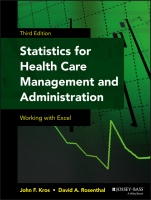
Statistics for Health Care Management and Administration: Working with Excel
ISBN 9781118712658
Autor: John F. Kros, David A. Rosenthal
Wydawca: Wiley
Dostępność: 3-6 tygodni
Cena: 530,25 zł
Przed złożeniem zamówienia prosimy o kontakt mailowy celem potwierdzenia ceny.
ISBN13: |
9781118712658 |
ISBN10: |
111871265X |
Autor: |
John F. Kros, David A. Rosenthal |
Oprawa: |
Paperback |
Rok Wydania: |
2016-02-16 |
Numer Wydania: |
3rd Edition |
Ilość stron: |
560 |
Wymiary: |
232x179 |
Tematy: |
MBN |
An Up–To–Date, Essential Resource for Understanding and Applying Statistical Analysis Techniques in Health Care
Thoroughly revised and updated, the third edition of Statistics for Health Care Management and Administration offers an invaluable resource for students of health care administration and public health. The book shows how to apply quantitative methods in health administration, health policy, public health, health information management, and nursing. The authors focus on the major data and analysis techniques that make use of Excel, the spreadsheet software that is most commonly used in the health care workplace.
The third edition contains new content on proportions, ANOVA, linear regression, chi–squares, and much more. The authors offer step–by–step instructions in the latest version of Excel and include numerous annotated screenshots that make examples easy to follow and comprehend.
Statistics for Health Care Management and Administration gives students the information and tools they need to:
Acquire and comprehend the basics of statistics using the power of Excel Master various tests including probability, regression, and many more Transform test results into practical information that is grounded in sound analysis Understand the implications of unfolding legislation and other developments such as payment for quality and penalties for readmissionsStatistics for Health Care Management and Administration introduces health care students to statistical analysis as it is applied in a workplace context.
Preface
Introducing Excel
So How Did We Get to Here?
Intended Level of the Textbook
Textbook Organization
Leading by Example(s)
Acknowledgments
About the Authors
Part 1
Chapter 1: Statistics and Excel
1.1 How This Book Differs from Other Statistics Texts
1.2 Statistical Applications in Health Policy and Health Administration
Exercises for Section 1.2
1.3 What Is the Big Picture ?
1.4 Some Initial Definitions
Exercises for Section 1.4
1.5 Five Statistical Tests
Exercises for Section 1.5
Key Terms
Chapter 2: Excel as a Statistical Tool
2.1 The Basics
Exercises for Section 2.1
2.2 Working and Moving Around in a Spreadsheet
Exercises for Section 2.2
2.3 Excel Functions
Exercises for Section 2.3
2.4 The =IF() Function
Exercises for Section 2.4
2.5 Excel Graphs
Exercises for Section 2.5
2.6 Sorting a String of Data
Exercise for Section 2.6
2.7 The Data Analysis Pack
2.8 Functions That Give Results in More Than One Cell
Exercises for Section 2.8
2.9 The Dollar Sign ($) Convention for Cell References
Key Terms
Chapter 3: Data Acquisition: Sampling and Data Preparation
3.1 The Nature of Data
Exercises for Section 3.1
3.2 Sampling
Exercises for Section 3.2
3.3 Data Access and Preparation
Exercises for Section 3.3
3.4 Missing Data
Key Terms
Chapter 4: Data Display: Descriptive Presentation, Excel Graphing Capability
4.1 Creating, Displaying, and Understanding Frequency Distributions
Exercises for Section 4.1
4.2 Using the Pivot Table to Generate Frequencies of Categorical Variables
Exercises for Section 4.2
4.3 A Logical Extension of the Pivot Table: Two Variables
Exercises for Section 4.3
Key Terms
Chapter 5: Basic Concepts of Probability
5.1 Some Initial Concepts and Definitions
Exercises for Section 5.1
5.2 Marginal Probabilities, Joint Probabilities, and Conditional Probabilities
Exercises for Section 5.2
5.3 Binomial Probability
Exercises for Section 5.3
5.4 The Poisson Distribution
Exercises for Section 5.4
5.5 The Normal Distribution
Key Terms
Chapter 6: Measures of Central Tendency and Dispersion: Data Distributions
6.1 Measures of Central Tendency and Dispersion
Exercises for Section 6.1
6.2 The Distribution of Frequencies
Exercises for Section 6.2
6.3 The Sampling Distribution of the Mean
Exercises for Section 6.3
6.4 Mean and Standard Deviation of a Discrete Numerical Variable
Exercises for Section 6.4
6.5 The Distribution of a Proportion
Exercises for Section 6.5
6.6 The t Distribution
Exercises for Section 6.6
Key Terms
Part 2
Chapter 7: Confidence Limits and Hypothesis Testing
7.1 What Is a Confidence Interval?
Exercises for Section 7.1
7.2 Calculating Confidence Limits for Multiple Samples
Exercises for Section 7.2
7.3 What Is Hypothesis Testing?
Exercises for Section 7.3
7.4 Type I and Type II Errors
Exercises for Section 7.4
7.5 Selecting Sample Sizes
Exercises for Section 7.5
Key Terms
Chapter 8: Statistical Tests for Categorical Data
8.1 Independence of Two Variables
Exercises for Section 8.1
8.2 Examples of Chi–Square Analyses
Exercises for Section 8.2
8.3 Small Expected Values in Cells
Exercises for Section 8.3
Key Terms
Chapter 9: t Tests for Related and Unrelated Data
9.1 What Is a t Test?
Exercises for Section 9.1
9.2 A t Test for Comparing Two Groups
Exercises for Section 9.2
9.3 A t Test for Related Data
Exercises for Section 9.3
Key Terms
Chapter 10: Analysis of Variance
10.1 One–Way Analysis of Variance
Exercises for Section 10.1
10.2 ANOVA for Repeated Measures
Exercises for Section 10.2
10.3 Factorial Analysis of Variance
Exercises for Section 10.3
Key Terms
Chapter 11:Simple Linear Regression
11.1 Meaning and Calculation of Linear Regression
Exercises for Section 11.1
11.2 Testing the Hypothesis of Independence
Exercises for Section 11.2
11.3 The Excel Regression Add–In
Exercises for Section 11.3
11.4 The Importance of Examining the Scatterplot
11.5 The Relationship Between Regression and the t Test
Exercises for Section 11.5
Key Terms
Chapter 12: Multiple Regression: Concepts and Calculation
12.1 Introduction
Exercises for Section 12.1
Key Terms
Chapter 13: Extensions of Multiple Regression
13.1 Dummy Variables in Multiple Regression
Exercises for Section 13.1
13.2 The Best Regression Model
Exercises for Section 13.2
13.3 Correlation and Multi–colinearity
Exercises for Section 13.3
13.4 Nonlinear Relationships
Exercises for Section 13.4
Key Terms
Chapter 14: Analysis with a Dichotomous Categorical Dependent Variable
14.1 Introduction to the Dichotomous Dependent Variable
14.2 An Example with a Dichotomous Dependent Variable: Traditional Treatments
Exercises for Section 14.2
14.3 Logit for Estimating Dichotomous Dependent Variables
Exercises for Section 14.3
14.4 A Comparison of Ordinary Least Squares, Weighted Least Squares, and Logit
Exercises for Section 14.4
Key Terms
Appendix A: Multiple Regression and Matrices
An Introduction to Matrix Math
Addition and Subtraction of Matrices
Multiplication of Matrices
Matrix Multiplication and Scalars
Finding the Determinant of a Matrix
Matrix Capabilities of Excel
Explanation of Excel Output Displayed with Scientific Notation
Using the b Coefficients to Generate Regression Results
Calculation of All Multiple Regression Results
Exercises for Appendix A
References
Index
JOHN F. KROS, PHD, is the Vincent K. McMahon Distinguished Professor of Business in the Marketing and Supply Chain Management Department in the College of Business at East Carolina University.
DAVID A. ROSENTHAL, PHD, is Professor and Chair of Health Care Management at Baptist Memorial College of Health Sciences.
Koszyk
Książek w koszyku: 0 szt.
Wartość zakupów: 0,00 zł
Informacje


Kontakt
Gambit
Centrum Oprogramowania
i Szkoleń Sp. z o.o.
Al. Pokoju 29b/22-24
31-564 Kraków
Siedziba Księgarni
ul. Kordylewskiego 1
31-542 Kraków
+48 12 410 5991
+48 12 410 5987
+48 12 410 5989
Subskrypcje
Administratorem danych osobowych jest firma Gambit COiS Sp. z o.o. Na podany adres będzie wysyłany wyłącznie biuletyn informacyjny.
Autoryzacja płatności

Informacje na temat autoryzacji płatności poprzez PayU.

© Copyright 2012: GAMBIT COiS Sp. z o.o. Wszelkie prawa zastrzeżone.
Projekt i wykonanie: Alchemia Studio Reklamy