


Wydawcy
Katalog tematyczny
- Archeologia (109)
- Ekonomia, finanse, business (13704)
- Filozofia (1445)
- Historia (3040)
- Języki i językoznawstwo (2356)
- Lifestyle, hobby i rozrywka (475)
- Medycyna (9704)
- Nauki humanistyczne (4)
- Nauki o Ziemi i środowisku (2638)
- Nauki ścisłe (20412)
- Nauki społeczne (8486)
- Nauki techniczne (13450)
- Budownictwo lądowe (1045)
- Chemia przemysłowa (2258)
- Elektronika i telekomunikacja (3287)
- Energetyka (1122)
- Inne nauki stosowane (363)
- Inżynieria biochemiczna (507)
- Inżynieria transportu (232)
- Mechanika i materiały (3316)
- Nauka o środowisku (321)
- Rolnictwo (507)
- Technika, ogólnie (475)
- Prawo (1696)
- Publikacje informacyjne i interdyscyplinarne (1288)
- Religia i wierzenia (917)
- Technika komputerowa (4067)
- Zdrowie, relacje międzyludzkie i rozwój osobisty (657)





Informacje szczegółowe o książce
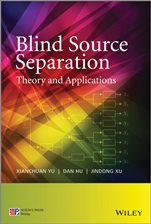
Blind Source Separation: Theory and Applications
ISBN 9781118679845
Autor: Xianchuan Yu, Dan Hu, Jindong Xu
Wydawca: Wiley
Dostępność: 3-6 tygodni
Cena: 675,15 zł
Przed złożeniem zamówienia prosimy o kontakt mailowy celem potwierdzenia ceny.
ISBN13: |
9781118679845 |
ISBN10: |
1118679849 |
Autor: |
Xianchuan Yu, Dan Hu, Jindong Xu |
Oprawa: |
Hardback |
Rok Wydania: |
2014-03-18 |
Ilość stron: |
392 |
Wymiary: |
247x174 |
Tematy: |
TJ |
Blind source separation is a relatively new signal processing method combining artificial neural networks, statistical information processing and information theory. It has tremendous potential in applications such as processing of speech, image, and biomedical signals. The technique excels in signal extraction, enhancement, denoising, model reduction and classification problems. This book provides an overview of the basics of blind source separation along with important solutions and algorithms. Applications are also covered in–depth, including image feature extraction, remote sensing image fusion, mixed–pixel decomposition of SAR images, image object recognition, fMRI medical image processing, geochemical and geophysical data mining, mineral resources prediction and geo–anomalies information recognition. Given the multidisciplinary nature of the subject the book has been written in an accessible style so as to appeal to readers from very different backgrounds. • Gives a systematic exploration of both classic and contemporary algorithms in blind source separation with practical case studies • Written by an expert team with innovations in blind source separation and its applications in natural science • Codes for most of the algorithms mentioned in the book available from the author This book is aimed at graduate students and researchers engaged in the areas of signal processing, data mining, image processing and recognition, computational geosciences, computational life sciences, and other field sciences.
About the Authors xiii Preface xv Acknowledgements xvii Glossary xix 1 Introduction 1 1.1 Overview of Blind Source Separation 1 1.2 History of BSS 4 1.3 Applications of BSS 8 1.4 Contents of the Book 10 References 11 Part I BASIC THEORY OF BSS 2 Mathematical Foundation of Blind Source Separation 19 2.1 Matrix Analysis and Computing 19 2.2 Foundation of Probability Theory for Higher–Order Statistics 28 2.3 Basic Concepts of Information Theory 33 2.4 Distance Measure 37 2.5 Solvability of the Signal Blind Source Separation Problem 40 Further Reading 41 3 General Model and Classical Algorithm for BSS 43 3.1 Mathematical Model 43 3.2 BSS Algorithm 46 References 51 4 Evaluation Criteria for the BSS Algorithm 53 4.1 Evaluation Criteria for Objective Functions 53 4.2 Evaluation Criteria for Correlations 57 4.3 Evaluation Criteria for Signal–to–Noise Ratio 57 References 58 Part II INDEPENDENT COMPONENT ANALYSIS AND APPLICATIONS 5 Independent Component Analysis 61 5.1 History of ICA 61 5.2 Principle of ICA 65 5.3 Chapter Summary 82 References 83 6 Fast Independent Component Analysis and Its Application 85 6.1 Overview 85 6.2 FastICA Algorithm 89 6.3 Application and Analysis 92 6.4 Conclusion 118 References 119 7 Maximum Likelihood Independent Component Analysis and Its Application 121 7.1 Overview 121 7.2 Algorithms for Maximum Likelihood Estimation 123 7.3 Application and Analysis 130 7.4 Chapter Summary 133 References 133 8 Overcomplete Independent Component Analysis Algorithms and Applications 135 8.1 Overcomplete ICA Algorithms 135 8.2 Applications and Analysis 139 8.3 Chapter Summary 143 References 144 9 Kernel Independent Component Analysis 145 9.1 KICA Algorithm 145 9.2 Application and Analysis 147 9.3 Concluding Remarks 149 References 152 10 Natural Gradient Flexible ICA Algorithm and Its Application 153 10.1 Natural Gradient Flexible ICA Algorithm 153 10.2 Application and Analysis 156 10.3 Chapter Summary 166 References 166 11 Non–negative Independent Component Analysis and Its Application 167 11.1 Non–negative Independent Component Analysis 168 11.2 Application and Analysis 169 11.3 Chapter Summary 182 References 182 12 Constraint Independent Component Analysis Algorithms and Applications 183 12.1 Overview 183 12.2 CICA Algorithm 185 12.3 Application and Analysis 189 12.4 Chapter Summary 196 References 196 13 Optimized Independent Component Analysis Algorithms and Applications 199 13.1 Overview 199 13.2 Optimized ICA Algorithm 200 13.3 Application and Analysis 205 13.4 Chapter Summary 221 References 222 14 Supervised Learning Independent Component Analysis Algorithms and Applications 225 14.1 Overview 225 14.2 Mathematical Model 226 14.3 Principles of SL–ICA 227 14.4 SL–ICA Implementation Process 230 14.5 The Experiment 230 14.6 Chapter Summary 239 Appendix 14.A Polarization Channel SAR Images of Beijing and the Decomposition Results using SL–ICA 239 References 242 Part III ADVANCES AND APPLICATIONS OF BSS 15 Non–negative Matrix Factorization Algorithms and Applications 247 15.1 Introduction 247 15.2 NMF Algorithms 251 15.3 Applications and Analysis 276 15.4 Chapter Summary 309 References 310 16 Sparse Component Analysis and Applications 313 16.1 Overview 314 16.2 Linear Clustering SCA (LC–SCA) 321 16.3 Plane Clustering SCA (PC–SCA) 332 16.4 Over–Complete SCA Based on Plane Clustering (PCO–SCA) 336 16.5 Blind Image Separation Based on Wavelets and SCA (WL–SCA) 340 16.6 New BSS Algorithm Based on Feedback SCA 343 16.7 Remote Sensing Image Classification Based on SCA 351 16.8 Chapter Summary 357 References 357 Index 361
Xianchuan Yu , Beijing Normal University, P. R. China Dan Hu , Beijing Normal University, P. R. China Jindong Xu , Beijing Normal University, P. R. China
Koszyk
Książek w koszyku: 0 szt.
Wartość zakupów: 0,00 zł
Informacje


Kontakt
Gambit
Centrum Oprogramowania
i Szkoleń Sp. z o.o.
Al. Pokoju 29b/22-24
31-564 Kraków
Siedziba Księgarni
ul. Kordylewskiego 1
31-542 Kraków
+48 12 410 5991
+48 12 410 5987
+48 12 410 5989
Subskrypcje
Administratorem danych osobowych jest firma Gambit COiS Sp. z o.o. Na podany adres będzie wysyłany wyłącznie biuletyn informacyjny.
Autoryzacja płatności

Informacje na temat autoryzacji płatności poprzez PayU.

© Copyright 2012: GAMBIT COiS Sp. z o.o. Wszelkie prawa zastrzeżone.
Projekt i wykonanie: Alchemia Studio Reklamy