


Wydawcy
Katalog tematyczny
- Archeologia (109)
- Ekonomia, finanse, business (13704)
- Filozofia (1445)
- Historia (3040)
- Języki i językoznawstwo (2356)
- Lifestyle, hobby i rozrywka (475)
- Medycyna (9704)
- Nauki humanistyczne (4)
- Nauki o Ziemi i środowisku (2638)
- Nauki ścisłe (20412)
- Nauki społeczne (8486)
- Nauki techniczne (13450)
- Prawo (1696)
- Publikacje informacyjne i interdyscyplinarne (1288)
- Religia i wierzenia (917)
- Technika komputerowa (4067)
- Zdrowie, relacje międzyludzkie i rozwój osobisty (657)





Informacje szczegółowe o książce
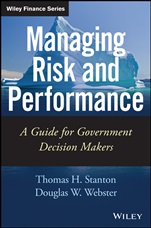
Managing Risk and Performance: A Guide for Government Decision Makers
ISBN 9781118658147
Autor: Thomas Stanton, Douglas W. Webster
Wydawca: Wiley
Dostępność: 3-6 tygodni
Cena: 354,90 zł
Przed złożeniem zamówienia prosimy o kontakt mailowy celem potwierdzenia ceny.
ISBN13: |
9781118658147 |
ISBN10: |
1118658140 |
Autor: |
Thomas Stanton, Douglas W. Webster |
Oprawa: |
Hardback |
Rok Wydania: |
2014-03-25 |
Ilość stron: |
336 |
Wymiary: |
237x152 |
Tematy: |
KM |
Risk management is critical for government agencies Avoid catastrophe and create opportunity with risk management strategies for government agencies Successfully managing risk in government agencies allows policy makers and government managers to establish the sound policies and organizational cohesion required to mitigate risks and increase agency productivity. Faced with the challenges of widespread budget cuts, political turmoil, and increased scrutiny from congressional committees and oversight bodies, government leaders must embrace and implement sound risk management practices to avoid potentially embarrassing missteps and the erosion of public trust. Managing Risk and Performance: A Guide for Government Decision Makers is a comprehensive professional resource that will inform and empower you to: Understand and appreciate the need for sound risk management by Government Decision Makers Consider and assess the major types of risk that could prevent your agency from achieving its mission Build a risk management process and agency protocols that help stakeholders understand the nature of risk–reward tradeoffs and their consequences in major decisions This book directly addresses the unique obstacles faced by government agencies in attempting to identify, assess, and ultimately mitigate the vast and disparate risks that threaten them. Stanton and Webster bring their decades of collective government agency and private sector risk management experience to the fore and provide you with real–world insights and instructions for successful risk management within government agencies. The four main sections of the book address critical risk management concepts as they specifically apply to government agencies, including: Building a risk management team that bridges silos within an organization Understanding Enterprise Risk Management (ERM) for government agencies Government risk management in times of crisis Risk management successes and failures from the financial crisis In the experience of the editors of Managing Risk and Performance: A Guide for Government Decision Makers , who are officers of the Association of Federal Enterprise Risk Management (AFERM), government agencies are increasingly following the lead of private companies in adopting risk management, and ERM in particular. This book is intended to help readers build and cultivate the necessary risk management strategies before , rather than after, their agencies experience a potentially painful lesson.
Foreword Preface Part One: Introduction and Overview Chapter 1 Managing Risk of Federal Agencies and their Programs Through Enterprise Risk Management (ERM) (Thomas H. Stanton) I. Risk Management as an Essential Part of Federal Management II. Risk Management as an Integral Part of Good Decision–making III. The Unique Challenges of Managing a Government Agency IV. Establishing Effective Risk Management V. Managing Risk in Government Agencies: Overview of the Book References Chapter 2 The Need for Effective Risk Management (Douglas W. Webster) I. Defining Risk II. The Source of Uncertainty: Change III. Risk and Reward IV. The Risk Management Process V. The Essence of Organizational Success: Stakeholder Value VI. The Role of Information Technology (IT) in Risk Management VII. The Importance of Organizational Change Management VIII. Pulling It All Together IX. Conclusion References Chapter 3 Introduction to Risk Management for Government Managers (Thomas H. Stanton) I. Fitting Risk Management into an Organization II. Promising Practices in Risk Management III. Observations about Risk Management in Government: What Works and What Doesn’t VI. Conclusion References Chapter 4 Risk Management and Challenges of Managing in the Public Sector (Paul L. Posner and Thomas H. Stanton) I. Unique Risk Management Challenges of Public Programs II. Third Party Governance: The Challenge of Managing Risk Across Organizational III. Goal–Setting, Accountability, and Prioritization of Risks: Special Challenges Facing Government Managers IV. Concluding Observations References Chapter 5 Creating and Keeping Your Options Open – It’s Fundamental (Brian Barnier) The Real World is Rarely Simple and Stable Systems Set the Stage Managing More Easily – Options in Time Examples of Options in Time in Practice Conclusion Key Points References Part Two: Moving Towards ERM Chapter 6 Introduction to Enterprise Risk Management (ERM) for Government Managers (Douglas W. Webster) I. Shortcomings of Traditional Risk Management II. The impact of managing risk within silos—a case study III. The Maturation of Traditional Risk Management into ERM IV. Key Principles of ERM V. What ERM is Not VI. The Payoff VII. Summary References Chapter 7 Implementation of Enterprise Risk Management at the Office of Federal Student Aid of the U.S. Department of Education (Fred Anderson and Cynthia Vitters) I. Overview of FSA II. Initial Implementation of ERM at FSA III. Initial Activities and Challenges in Implementing ERM at FSA IV. Expanding the ERM Program – A Change in FSA’s Business Model V. Key Considerations and Challenges When Implementing the Expanded ERM Program at FSA VI. Conclusion References Acknowledgments Chapter 8 Integrating ERM into Strategic Planning and Resource Management (Jeffrey Stagnitti) I. Context II. ERM and Strategy III. ERM and Resource Management IV. Conclusion Chapter 9 Building ERM (Enterprise Risk Management) into Agency Processes and Culture (John Fraser) I. Building a shared understanding of risks through conversations II. The Key ERM Techniques III. Improved Decision Making and Prioritization IV. Conclusion References For Further Reading Appendix: Hydro One Inc. Enterprise Risk Management Policy Part Three: Special Topics in Risk Management and Response Chapter 10 Risk Management and the Dynamics of Downsizing (Thomas H. Stanton) I. Dynamics of Protracted Budget Controversy and the Risk and Uncertainty this Creates II. Long–Term Budget Cuts and the Risks they Create III. The Role of Risk Management in Reducing Chances of a Major Mishap IV. Strengthening the Ability of Agencies to Make Better Decisions to Deal with Budget Uncertainty and Budget Cuts V. Conclusion References Chapter 11 Managing Reputational Risk (Gary L. Glickman) I. What is Reputational Risk and What Does it Mean to Government? II. What Determines Reputation and How Can Government Address these Factors? III. External Influences on Reputation IV. Consequences of Reputational Loss for Government Organizations V. Reputational Risk Mitigation VI. Conclusion References Chapter 12 Risk Management and Decision Making Lessons from the Financial Crisis for Federal Managers (Thomas H. Stanton) I. The Financial Crisis: How it Emerged, What Happened, and the Costs II. Decision Making at Firms that Failed: Common Shortcomings III. Decision Making at Firms that Succeeded; The Importance of Culture IV. Lessons in Governance, Risk Management, and Decision Making V. Conclusions References Part Four: Conclusion Chapter 13 Effective Enterprise Risk Management: Mapping the Path Forward (Douglas Webster) I. Recommendations II. Conclusion References For Further Information For Further Reading About the Editors About the Contributors Index
Thomas H. Stanton teaches at Johns Hopkins University. He is President–Elect of the Association of Federal Enterprise Risk Management (AFERM) and a Fellow of the National Academy of Public Administration. Mr. Stanton is a former member of the Federal Senior Executive Service. He holds a Bachelor of Arts degree from the University of California?Davis, a Master of Arts from Yale University, and a Juris Doctor from Harvard Law School and has written extensively on governance and risk management in the financial crisis. Douglas W. Webster is the Founder and President of the Cambio Consulting Group, LLC, and co–founder and past President of the Association of Federal Enterprise Risk Management (AFERM). He served as Chief Financial Officer of the U.S. Department of Labor in 2008?2009 and has 20 years of experience consulting to over two dozen federal and state agencies. Dr. Webster received a Bachelor of Science in Engineering from the University of California?Los Angeles, a Master of Science in Systems Management from the University of Southern California, and a Doctorate in business administration from United States International University.
Koszyk
Książek w koszyku: 0 szt.
Wartość zakupów: 0,00 zł
Informacje


Kontakt
Gambit
Centrum Oprogramowania
i Szkoleń Sp. z o.o.
Al. Pokoju 29b/22-24
31-564 Kraków
Siedziba Księgarni
ul. Kordylewskiego 1
31-542 Kraków
+48 12 410 5991
+48 12 410 5987
+48 12 410 5989
Subskrypcje
Administratorem danych osobowych jest firma Gambit COiS Sp. z o.o. Na podany adres będzie wysyłany wyłącznie biuletyn informacyjny.
Autoryzacja płatności

Informacje na temat autoryzacji płatności poprzez PayU.

© Copyright 2012: GAMBIT COiS Sp. z o.o. Wszelkie prawa zastrzeżone.
Projekt i wykonanie: Alchemia Studio Reklamy