


Wydawcy
Katalog tematyczny
- Archeologia (109)
- Ekonomia, finanse, business (13704)
- Filozofia (1445)
- Historia (3040)
- Języki i językoznawstwo (2356)
- Lifestyle, hobby i rozrywka (475)
- Medycyna (9704)
- Nauki humanistyczne (4)
- Nauki o Ziemi i środowisku (2638)
- Nauki ścisłe (20412)
- Nauki społeczne (8486)
- Nauki techniczne (13450)
- Prawo (1696)
- Publikacje informacyjne i interdyscyplinarne (1288)
- Religia i wierzenia (917)
- Technika komputerowa (4067)
- Zdrowie, relacje międzyludzkie i rozwój osobisty (657)





Informacje szczegółowe o książce
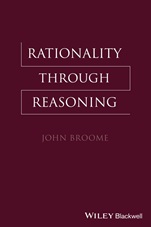
Rationality Through Reasoning
ISBN 9781118656051
Autor: John Broome
Wydawca: Wiley
Dostępność: 3-6 tygodni
Cena: 184,80 zł
Przed złożeniem zamówienia prosimy o kontakt mailowy celem potwierdzenia ceny.
ISBN13: |
9781118656051 |
ISBN10: |
1118656059 |
Autor: |
John Broome |
Oprawa: |
Paperback |
Rok Wydania: |
2013-08-16 |
Ilość stron: |
322 |
Wymiary: |
229x152 |
Tematy: |
HP |
When we believe that we ought to do something, our belief very often motivates us to do it. But how does this happen? Offering a unique theory on the subject, Rationality Through Reasoning argues that it can occur through the process of reasoning, which is a means by which we are able to motivate ourselves. In the course of building his argument about motivation, the author develops a comprehensive account of normativity, rationality and reasoning. His account of reasoning — both theoretical and practical — is principally aimed at showing how reasoning is something we ourselves do, rather than something that happens within us. In addition, the book discusses what distinguishes correct from incorrect reasoning, and argues that we can improve our rationality by means of the activity of correct reasoning. This book presents a theory of rationality and normativity that differs significantly from the majority of existing philosophical thinking. In developing its comprehensive argument, it covers topics that include ought, reasons, responding to reasons, the logic of requirements, the structure of theoretical and practical rationality, the nature and correctness of reasoning, the role of language in reasoning, and much else. Edit
Preface xi 1 Introduction 1 1.1 Motivation 1 1.2 This book 4 Notes 6 2 Ought 8 2.1 The meaning of ‘ought’ 8 2.2 Normative and non–normative oughts 9 2.3 Owned and unowned oughts 12 2.4 Qualifi ed and unqualified oughts 25 Notes 29 3 Objective, Subjective and Prospective Oughts 31 3.1 Sidgwick’s View 31 3.2 The need to decide 34 3.3 Objective and prospective oughts 36 3.4 Valuing prospects 41 3.5 Summary 45 Notes 45 4 Reasons 46 4.1 Introduction and preliminaries 46 4.2 Pro toto reasons 49 4.3 Pro tanto reasons 51 4.4 Most reason 62 4.5 Ownership of reasons 65 5 Responding to Reasons 71 5.1 Rationality and responding to reasons 71 5.2 The quick objection 74 5.3 Attitudinal reasons 75 5.4 Sufficiency of reasons 82 Notes 87 6 Responding to Reason–Beliefs 88 6.1 The Enkratic Condition 88 6.2 Meeting your own standards 91 6.3 Responding correctly to P–beliefs 101 6.4 Conclusion 107 Notes 108 7 Requirements 109 7.1 Two sorts of requirement 109 7.2 Property requirements 110 7.3 Source requirements 116 7.4 Logic for requirements? 119 7.5 Ought 126 Notes 129 8 Conditional Requirements 132 8.1 Application and content 132 8.2 Conditional requirements of rationality 134 Notes 146 Appendix to Chapter 8 148 9 Synchronic Rationality 149 9.1 Introduction and method 149 9.2 Consistency 154 9.3 Deduction 157 9.4 Instrumental Rationality 159 9.5 Enkrasia 170 9.6 Bayesian requirements 175 Notes 175 10 Diachronic Rationality 177 10.1 Persistence of Intention 177 10.2 The rationality of doing as you decide 181 10.3 Diachronic requirements on beliefs 185 Notes 69 10.4 Basing prohibitions and basing permissions 186 Notes 191 11 Rationality and Normativity 192 11.1 The Normative Question 192 11.2 More on rationality and reasons 193 11.3 Is rationality derivatively normative? 197 11.4 Is rationality non–derivatively normative? 204 Notes 205 12 Higher–Order Reasoning 206 12.1 The reasoning process 206 12.2 Reasoning through an intention 210 12.3 Reasoning with judgement–sensitive attitudes 216 12.4 One more point 219 Notes 220 13 First–Order Reasoning 221 13.1 The reasoning process 221 13.2 Necessary and sufficient conditions for reasoning 225 13.3 Operating on contents 231 13.4 Reasoning as activity 235 13.5 Reasoning at the first order 242 13.6 The direction of reasoning 243 13.7 Correct belief reasoning 246 Notes 248 14 Practical Reasoning 250 14.1 Reasoning with attitudes other than beliefs 250 14.2 Correctness 255 14.3 Choosing a means 261 14.4 Hypothesizing 264 Notes 265 15 Explicit Reasoning 267 15.1 Markers 267 15.2 Bayesian and expressivist reasoning 275 15.3 Reasoning with absences 278 15.4 Theoretical and practical reasoning 281 15.5 Intention reasoning with other markers 285 Notes 286 16 Enkratic Reasoning 288 16.1 Enkratic reasoning 288 16.2 Humean objections 291 16.3 Conclusion 294 Notes 294 Bibliography 295 Index 303
John Broome is White’s Professor of Moral Philosophy at the University of Oxford, a fellow of Corpus Christi College, Oxford, and an Adjunct Professor of Philosophy at the Australian National University. He is the author of amongst others Weighing Goods (1991), Ethics Out of Economics (1999), Weighing Lives (2004), and Climate matters (2012).
Koszyk
Książek w koszyku: 0 szt.
Wartość zakupów: 0,00 zł
Informacje


Kontakt
Gambit
Centrum Oprogramowania
i Szkoleń Sp. z o.o.
Al. Pokoju 29b/22-24
31-564 Kraków
Siedziba Księgarni
ul. Kordylewskiego 1
31-542 Kraków
+48 12 410 5991
+48 12 410 5987
+48 12 410 5989
Subskrypcje
Administratorem danych osobowych jest firma Gambit COiS Sp. z o.o. Na podany adres będzie wysyłany wyłącznie biuletyn informacyjny.
Autoryzacja płatności

Informacje na temat autoryzacji płatności poprzez PayU.

© Copyright 2012: GAMBIT COiS Sp. z o.o. Wszelkie prawa zastrzeżone.
Projekt i wykonanie: Alchemia Studio Reklamy