


Wydawcy
Katalog tematyczny
- Archeologia (109)
- Ekonomia, finanse, business (13704)
- Filozofia (1445)
- Historia (3040)
- Języki i językoznawstwo (2356)
- Lifestyle, hobby i rozrywka (475)
- Medycyna (9704)
- Nauki humanistyczne (4)
- Nauki o Ziemi i środowisku (2638)
- Nauki ścisłe (20412)
- Nauki społeczne (8486)
- Nauki techniczne (13450)
- Prawo (1696)
- Publikacje informacyjne i interdyscyplinarne (1288)
- Religia i wierzenia (917)
- Technika komputerowa (4067)
- Zdrowie, relacje międzyludzkie i rozwój osobisty (657)





Informacje szczegółowe o książce
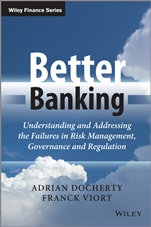
Better Banking: Understanding and Addressing the Failures in Risk Management, Governance and Regulation
ISBN 9781118651308
Autor: Adrian Docherty, Franck Viort
Wydawca: Wiley
Dostępność: 3-6 tygodni
Cena: 260,40 zł
Przed złożeniem zamówienia prosimy o kontakt mailowy celem potwierdzenia ceny.
ISBN13: |
9781118651308 |
ISBN10: |
1118651308 |
Autor: |
Adrian Docherty, Franck Viort |
Oprawa: |
Hardback |
Rok Wydania: |
2013-12-27 |
Ilość stron: |
376 |
Wymiary: |
244x170 |
Tematy: |
KF |
Why did the financial crisis happen? Why did no one see it coming? And how did our banks lose so much of our money? What′s being done to sort out the banking industry? And will it work? These are the questions that industry experts Adrian Docherty and Franck Viort cover in Better Banking: Understanding and Addressing the Failures in Risk Management, Governance and Regulation . They give a clear and thorough run–through of some of the key concepts and developments in banking, to enable the reader to understand better this vital yet perilous industry. Without excessive detail or jargon, they explain the most important issues in risk management, regulation and governance and build a comprehensive description of how failings in these areas resulted in the current financial crisis. In order to make the diagnosis clear, the authors illustrate their descriptions with a series of informative case studies. The book revolves around a critique of the current regulatory developments, which the authors feel will be ineffective in fixing the structural flaws in banking. Crucially, and as the title of the book suggests, they set out their own series of proposals to contribute to the development of a better, safer and more effective banking industry. Docherty and Viort′s book fills an important gap in the literature on banking and its role in the current financial crisis. It is at once a history, a primer, a critique and a manifesto. It does not take sides but works through a constructive diagnosis towards ideas that could lead to major improvements in the quality and stability of the financial world. Better Banking: Understanding and Addressing the Failures in Risk Management, Governance and Regulation is a technical yet accessible book that seeks to engage interested readers of all kinds –– students, professionals, bankers and regulators but also politicians and the broader audience of citizens outside the banking industry, who are keen to inform themselves and understand what needs to be done to avoid a repeat of this crisis.
Acknowledgements xi 1 Introduction 1 1.1 Overview and Objectives 1 1.2 Quick Start Guide to Banking Concepts and Regulation 4 2 The Global Financial Crisis 7 2.1 From Deregulation to dotcom Crash 7 2.2 The Seeds of a Crisis 9 2.3 “Why Didn’t Anyone See This Coming?” 14 2.4 The Beginnings of a Crisis 17 2.5 The Crisis Intensifies 20 2.6 Meltdown: The Lehman Bankruptcy 21 2.7 Massive Intervention Internationally 23 2.8 Sovereign Crises 29 2.9 Aftershocks and Skeletons in the Cupboard 32 2.10 Who is to Blame? 34 3 Methodologies and Foundations 37 3.1 How do Banks Make or Lose Money? 37 3.2 What’s a Bank Worth? Key Issues in Accounting for Banks 41 3.3 What is Risk? 47 3.4 What is an RWA? 55 3.5 What is Capital? 61 3.5.1 Regulatory Capital 63 3.5.2 Hybrid Capital 65 3.5.3 Economic Capital and Ratings Capital 66 3.5.4 Cost–of–Capital and Return–on–Capital 66 3.5.5 Capital in a Stress Scenario 67 3.5.6 Bail–in Capital 67 3.6 What are Liquidity and Funding? 68 3.6.1 Concepts 68 3.6.2 Liquidity Management and Liquidity Risk 69 3.6.3 Interbank Funding, the Money Markets and Central Bank Support 72 3.6.4 Deposit Guarantee Schemes 76 3.6.5 Securitisation 77 3.6.6 Covered Bonds 81 3.6.7 Liquidity Stress Tests 83 3.7 What is a Derivative? 84 3.8 Mark–to–Market and Procyclicality 90 3.9 Role of Regulation, Supervision and Support 96 3.10 Ratings Agencies and Credit Ratings 101 3.10.1 Moody’s Bank Methodology 104 3.10.2 S&P’s Bank Methodology 104 3.10.3 Structured Finance Ratings 105 3.10.4 Use of Ratings in Regulation and Investment Policy 107 3.11 Analysts, Investors and Financial Communication 109 4 Regulation of the Banking Industry 113 4.1 The Relevance of Bank Regulation and Supervision 113 4.2 Regulation and Supervision of the Banking Industry Prior to “Basel I” 113 4.3 The Basel Capital Accord aka “Basel I” 117 4.3.1 Definition of Capital 118 4.3.2 Deductions Regime 119 4.3.3 Risk–Weighting Approach 120 4.3.4 Ratio of Capital to Risk Weighted Assets 121 4.3.5 Modifications to Basel I 121 4.3.6 Impact of Basel I 122 4.4 Basel II 122 4.4.1 Objectives of Basel II 123 4.4.2 The Three–Pillar Approach 123 4.4.3 Pillar 1: Minimum Capital Requirements 124 4.4.4 Pillar 2: Supervisory Review 130 4.4.5 Pillar 3: Market Discipline 132 4.4.6 Capital Calibration 133 4.4.7 Capital Supply and Mix 135 4.4.8 Implementation of Basel II 136 4.4.9 Critique of Basel II 137 4.5 Basel III 141 4.5.1 Definition of Capital 142 4.5.2 Deductions 143 4.5.3 Risk–Weighted Assets 145 4.5.4 Minimum Capital Levels 147 4.5.5 Leverage Ratio 150 4.5.6 Liquidity and Funding 152 4.5.7 Derivatives Risk Management 155 4.5.8 Implementation and Transition 156 4.5.9 National Versions of Basel III 157 4.5.10 Major Achievements of Basel III: Top Five 158 4.5.11 Major Issues with Basel III: Top Five 161 4.6 Resolution Regimes 163 4.7 Other Current Regulatory Workstreams 171 5 Case Studies 175 5.1 RBS 176 5.2 Dexia 179 5.3 HBOS 184 5.4 HSBC 189 5.5 Bear Stearns 192 5.6 Merrill Lynch 196 5.7 AIG 200 5.8 JP Morgan 207 5.9 Barclays 213 5.10 UBS 217 5.11 Northern Rock 221 5.12 Bankia–BFA 223 5.13 Australia 228 5.14 Canada 233 5.15 Summary of “Lessons Learned” from the Case Studies 236 6 Objectives and Design Principles 239 6.1 Free Market versus State Capitalism 240 6.2 Are There Alternatives to Banks? 242 6.3 Benefi ts and Limitations of Finance 250 6.4 How Much Risk Can We Tolerate? 251 6.5 The Role of Regulation and Supervision 254 6.6 The Role of “the Market” 256 6.7 Conclusions: Proposed Objectives and Design Criteria 258 7 A Blueprint for “Basel IV” 259 7.1 Risk Management 261 7.1.1 Valuation Approaches 261 7.1.2 Role of Internal Risk Assessments 263 7.1.3 Putting Risk Management at the Heart of Banking 263 7.1.4 Role of Risk Benchmarks 266 7.1.5 Assets Don’t Have Risk, Institutions Do 266 7.1.6 Risk Disclosure 267 7.2 The Guardian Angel 269 7.2.1 Key Aspects of the Guardian Angel Model 271 7.2.2 Creating the Supervisory Elite 273 7.2.3 Paying the Bill 273 7.2.4 Cross–Border Issues 274 7.2.5 The Role of Macroprudential Regulation 275 7.3 Human Capital 275 7.3.1 Competence and Incompetence in the Banking Industry 276 7.3.2 Compensation 279 7.3.3 Culture 285 7.4 Governance 287 7.4.1 How Does Governance Work in Theory? 287 7.4.2 Improving Governance of Banks 289 7.4.3 The Centurion Approach 290 7.5 Capital 291 7.5.1 The Role of “Capital” 292 7.5.2 Principles–Based Solvency Regulations 292 7.5.3 Need for Capital 293 7.5.4 Supply of Capital 293 7.5.5 Role of “Hybrid” Capital 294 7.5.6 Life without Capital Ratios 296 7.5.7 Minimum Capital Standards 297 7.5.8 Disclosure of Capital Assessment 298 7.5.9 Resolution of Failed Banks 298 7.6 Liquidity and Funding 299 7.6.1 Liquidity 299 7.6.2 Funding 301 7.7 The “Pillar 2” Mindset 303 7.7.1 Putting Scenario Assessment at the Heart of the Risk Management Process 304 7.7.2 Wargaming Instead of Stress Testing 304 7.7.3 Communication of Pillar 2 Findings 308 7.7.4 The Modular Approach to Risk Assessment 309 7.7.5 Risk Appetite and Reverse Stress Testing 310 7.8 Glasnost: Market Discipline and “Pillar 3” 311 7.9 Industry Structure 313 7.9.1 Different Types of Banks 313 7.9.2 Too Big to Fail 319 7.9.3 Cross–Border Issues 321 7.9.4 Ownership Structures 322 8 Challenges 327 8.1 Industry Entrenchment 327 8.2 Human Behaviour 329 8.3 Performance Management for Good Risk Management 332 8.4 Timing 333 8.5 A Positive Challenge: Technological and Social Progress 333 9 What Next? A Call to Arms 335 Glossary & Jargon Lookup 339 Disclaimer Regarding Excerpts from S&P Materials 349 Index 351
Adrian Docherty and Franck Viort have, in aggregate, 40 years of experience serving and advising the financial services sector on strategic issues, in a variety of economic conditions and in many different countries around the world. Their professional focus is on helping to improve the financial management and risk performance of banks and insurance companies. Better Banking is their first book, though their views are regularly quoted in the press and they are frequent presenters at industry conferences. Adrian holds a master’s degree from Cambridge University and lives with his wife, son and daughter in Kent. Franck has a degree from Sciences–Po in Paris and an MBA from the University of Chicago and lives in London with his wife and three daughters.
Koszyk
Książek w koszyku: 0 szt.
Wartość zakupów: 0,00 zł
Informacje


Kontakt
Gambit
Centrum Oprogramowania
i Szkoleń Sp. z o.o.
Al. Pokoju 29b/22-24
31-564 Kraków
Siedziba Księgarni
ul. Kordylewskiego 1
31-542 Kraków
+48 12 410 5991
+48 12 410 5987
+48 12 410 5989
Subskrypcje
Administratorem danych osobowych jest firma Gambit COiS Sp. z o.o. Na podany adres będzie wysyłany wyłącznie biuletyn informacyjny.
Autoryzacja płatności

Informacje na temat autoryzacji płatności poprzez PayU.

© Copyright 2012: GAMBIT COiS Sp. z o.o. Wszelkie prawa zastrzeżone.
Projekt i wykonanie: Alchemia Studio Reklamy