


Wydawcy
Katalog tematyczny
- Archeologia (109)
- Ekonomia, finanse, business (13704)
- Filozofia (1445)
- Historia (3040)
- Języki i językoznawstwo (2356)
- Lifestyle, hobby i rozrywka (475)
- Medycyna (9704)
- Nauki humanistyczne (4)
- Nauki o Ziemi i środowisku (2638)
- Nauki ścisłe (20412)
- Nauki społeczne (8486)
- Nauki techniczne (13450)
- Budownictwo lądowe (1045)
- Chemia przemysłowa (2258)
- Elektronika i telekomunikacja (3287)
- Energetyka (1122)
- Inne nauki stosowane (363)
- Inżynieria biochemiczna (507)
- Inżynieria transportu (232)
- Mechanika i materiały (3316)
- Nauka o środowisku (321)
- Rolnictwo (507)
- Technika, ogólnie (475)
- Prawo (1696)
- Publikacje informacyjne i interdyscyplinarne (1288)
- Religia i wierzenia (917)
- Technika komputerowa (4067)
- Zdrowie, relacje międzyludzkie i rozwój osobisty (657)





Informacje szczegółowe o książce
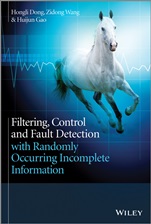
Filtering, Control and Fault Detection with Randomly Occurring Incomplete Information
ISBN 9781118647912
Autor: Hongli Dong, Zidong Wang, Huijun Gao
Wydawca: Wiley
Dostępność: 3-6 tygodni
Cena: 589,05 zł
Przed złożeniem zamówienia prosimy o kontakt mailowy celem potwierdzenia ceny.
ISBN13: |
9781118647912 |
ISBN10: |
1118647912 |
Autor: |
Hongli Dong, Zidong Wang, Huijun Gao |
Oprawa: |
Hardback |
Rok Wydania: |
2013-08-16 |
Ilość stron: |
280 |
Wymiary: |
255x176 |
Tematy: |
TG |
In the context of systems and control, incomplete information refers to a dynamical system in which knowledge about the system states is limited due to the difficulties in modelling complexity in a quantitative way. The well–known types of incomplete information include parameter uncertainties and norm–bounded nonlinearities. Recently, in response to the development of network technologies, the phenomenon of randomly occurring incomplete information has become more and more prevalent. Filtering, Control and Fault Detection with Randomly Occurring Incomplete Information reflects the state–of–the–art of the research area for handling randomly occurring incomplete information from three interrelated aspects of control, filtering and fault detection. Recent advances in networked control systems and distributed filtering over sensor networks are covered, and application potential in mobile robotics is also considered. The reader will benefit from the introduction of new concepts, new models and new methodologies with practical significance in control engineering and signal processing. Key features Establishes a unified framework for filtering, control and fault detection problem for various discrete–time nonlinear stochastic systems with randomly occurring incomplete information Investigates several new concepts for randomly occurring phenomena and proposes a new system model to better describe network–induced problems Demonstrates how newly developed techniques can handle emerging mathematical and computational challenges Contains the latest research results Filtering, Control and Fault Detection with Randomly Occurring Incomplete Information provides a unified yet neat framework for control/filtering/fault–detection with randomly occurring incomplete information. It is a comprehensive textbook for graduate students and is also a useful practical research reference for engineers dealing with control, filtering and fault detection problems for networked systems.
Preface xi Acknowledgments xiii List of Abbreviations xv List of Notations xvii 1 Introduction 1 1.1 Background, Motivations, and Research Problems 2 1.1.1 Randomly Occurring Incomplete Information 2 1.1.2 The Analysis and Synthesis of Nonlinear Stochastic Systems 4 1.1.3 Distributed Filtering over Sensor Networks 5 1.2 Outline 7 2 Variance–Constrained Finite–Horizon Filtering and Control with Saturations 11 2.1 Problem Formulation for Finite–Horizon Filter Design 12 2.2 Analysis of H∞ and Covariance Performances 14 2.2.1 H∞ Performance 14 2.2.2 Variance Analysis 16 2.3 Robust Finite–Horizon Filter Design 19 2.4 Robust H∞ Finite–Horizon Control with Sensor and Actuator Saturations 22 2.4.1 Problem Formulation 23 2.4.2 Main Results 25 2.5 Illustrative Examples 30 2.5.1 Example 1 30 2.5.2 Example 2 33 2.6 Summary 36 3 Filtering and Control with Stochastic Delays and Missing Measurements 41 3.1 Problem Formulation for Robust Filter Design 42 3.2 Robust H∞ Filtering Performance Analysis 45 3.3 Robust H∞ Filter Design 50 3.4 Robust H∞ Fuzzy Control 53 3.4.1 Problem Formulation 53 3.4.2 Performance Analysis 56 3.4.3 Controller Design 57 3.5 Illustrative Examples 59 3.5.1 Example 1 60 3.5.2 Example 2 61 3.5.3 Example 3 67 3.6 Summary 72 4 Filtering and Control for Systems with Repeated Scalar Nonlinearities 73 4.1 Problem Formulation for Filter Design 74 4.1.1 The Physical Plant 74 4.1.2 The Communication Link 75 4.1.3 The Filter 76 4.1.4 The Filtering Error Dynamics 76 4.2 Filtering Performance Analysis 78 4.3 Filter Design 80 4.4 Observer–Based H∞ Control with Multiple Packet Losses 83 4.4.1 Problem Formulation 83 4.4.2 Main Results 87 4.5 Illustrative Examples 89 4.5.1 Example 1 89 4.5.2 Example 2 91 4.5.3 Example 3 94 4.5.4 Example 4 97 4.6 Summary 99 5 Filtering and Fault Detection for Markov Systems with Varying Nonlinearities 101 5.1 Problem Formulation for Robust H∞ Filter Design 102 5.2 Performance Analysis of Robust H∞ Filter 105 5.3 Design of Robust H∞ Filters 109 5.4 Fault Detection with Sensor Saturations and Randomly Varying Nonlinearities 115 5.4.1 Problem Formulation 115 5.4.2 Main Results 118 5.5 Illustrative Examples 122 5.5.1 Example 1 122 5.5.2 Example 2 124 5.5.3 Example 3 127 5.5.4 Example 4 137 5.6 Summary 138 6 Quantized Fault Detection with Mixed Time–Delays and Packet Dropouts 139 6.1 Problem Formulation for Fault Detection Filter Design 140 6.2 Main Results 143 6.3 Fuzzy–Model–Based Robust Fault Detection 150 6.3.1 Problem Formulation 150 6.3.2 Main Results 155 6.4 Illustrative Examples 158 6.4.1 Example 1 158 6.4.2 Example 2 162 6.5 Summary 170 7 Distributed Filtering over Sensor Networks with Saturations 171 7.1 Problem Formulation 171 7.2 Main Results 176 7.3 An Illustrative Example 182 7.4 Summary 187 8 Distributed Filtering with Quantization Errors: The Finite–Horizon Case 189 8.1 Problem Formulation 189 8.2 Main Results 194 8.3 An Illustrative Example 198 8.4 Summary 203 9 Distributed Filtering for Markov Jump Nonlinear Time–Delay Systems 205 9.1 Problem Formulation 205 9.1.1 Deficient Statistics of Markovian Modes Transitions 205 9.1.2 The Network Topology 206 9.1.3 Descriptions of the Target Plant and the Sensor Network 207 9.2 Main Results 211 9.3 An Illustrative Example 220 9.4 Summary 223 10 A New Finite–Horizon H∞ Filtering Approach to Mobile Robot Localization 227 10.1 Mobile Robot Kinematics and Absolute Measurement 227 10.1.1 Kinematic Model 227 10.1.2 Measurement Model with Quantization and Missing Observations 229 10.2 A Stochastic H∞ Filter Design 232 10.3 Simulation Results 242 10.4 Summary 245 11 Conclusions and Future Work 247 11.1 Conclusions 247 11.2 Contributions 249 11.3 Future Work 250 References 253 Index 261
Hongli Dong, Harbin Institute of Technology, China Hongli Dong received the Ph.D. degree in Control Science and Engineering in 2012 from Harbin Institute of Technology, Harbin, China. From July 2009 to January 2010, she was a Research Assistant in the Department of Applied Mathematics, the City University of Hong Kong. From October 2010 to January 2011, she was a Research Assistant in the Department of Mechanical Engineering, the University of Hong Kong. From January 2011 to January 2012, she was a Visiting Scholar in the Department of Information Systems and Computing, Brunel University, London, U.K. She is now a professor with the College of Electrical and Information Engineering, Northeast Petroleum University, Daqing, China, and is currently an Alexander von Humboldt research fellow at the University of Duisburg–Essen, Duisburg, Germany. Dr. Dong′s current research interests include robust control and networked control systems. She is a very active reviewer for many international journals. Zidong Wang, Brunel University, UK Zidong Wang is currently Professor of Dynamical Systems and Computing in the Department of Information Systems and Computing, Brunel University, U.K. From 1990 to 2002, he held teaching and research appointments in universities in China, Germany and the UK. Prof. Wang′s research interests include dynamical systems, signal processing, bioinformatics, control theory and applications. He has published more than 280 papers in refereed international journals. He is a holder of the Alexander von Humboldt Research Fellowship of Germany, the JSPS Research Fellowship of Japan, William Mong Visiting Research Fellowship of Hong Kong. Prof. Wang serves as the Executive Editor for Systems Science and Control Engineering (Taylor and Francis) and an Associate Editor for 11 international journals including five IEEE Transactions. He is a Senior Member of the IEEE, a Fellow of the Royal Statistical Society and a member of the program committee for many international conferences. Huijun Gao, Harbin Institute of Technology, China Huijun Gao received the Ph.D. degree in Control Science and Engineering from Harbin Institute of Technology, China, in 2005. He was a Research Associate with the Department of Mechanical Engineering, The University of Hong Kong, from November 2003 to August 2004. From October 2005 to October 2007, he carried out his postdoctoral research with the Department of Electrical and Computer Engineering, University of Alberta, Canada. Since November 2004, he has been with Harbin Institute of Technology, where he is currently a Professor and Director of the Research Institute of Intelligent Control and Systems. Prof. Gao′s research interests include network–based control, robust control/filter theory, time–delay systems and their engineering applications. He is an Associate Editor for Automatica, IEEE Transactions on Industrial Electronics, IEEE Transactions on Systems Man and Cybernetics, IEEE Transactions on Fuzzy Systems, IEEE Transactions on Circuits and Systems, IEEE Transactions on Control Systems Technology, etc.
Koszyk
Książek w koszyku: 0 szt.
Wartość zakupów: 0,00 zł
Informacje


Kontakt
Gambit
Centrum Oprogramowania
i Szkoleń Sp. z o.o.
Al. Pokoju 29b/22-24
31-564 Kraków
Siedziba Księgarni
ul. Kordylewskiego 1
31-542 Kraków
+48 12 410 5991
+48 12 410 5987
+48 12 410 5989
Subskrypcje
Administratorem danych osobowych jest firma Gambit COiS Sp. z o.o. Na podany adres będzie wysyłany wyłącznie biuletyn informacyjny.
Autoryzacja płatności

Informacje na temat autoryzacji płatności poprzez PayU.

© Copyright 2012: GAMBIT COiS Sp. z o.o. Wszelkie prawa zastrzeżone.
Projekt i wykonanie: Alchemia Studio Reklamy