


Wydawcy
Katalog tematyczny
- Archeologia (109)
- Ekonomia, finanse, business (13704)
- Filozofia (1445)
- Historia (3040)
- Języki i językoznawstwo (2356)
- Lifestyle, hobby i rozrywka (475)
- Medycyna (9704)
- Nauki humanistyczne (4)
- Nauki o Ziemi i środowisku (2638)
- Nauki ścisłe (20412)
- Nauki społeczne (8486)
- Nauki techniczne (13450)
- Budownictwo lądowe (1045)
- Chemia przemysłowa (2258)
- Elektronika i telekomunikacja (3287)
- Energetyka (1122)
- Elektrotechnika (258)
- Energetyka jądrowa (62)
- Energia odnawialna (372)
- Paliwa kopalne (287)
- Przepływ ciepła (10)
- Inne nauki stosowane (363)
- Inżynieria biochemiczna (507)
- Inżynieria transportu (232)
- Mechanika i materiały (3316)
- Nauka o środowisku (321)
- Rolnictwo (507)
- Technika, ogólnie (475)
- Prawo (1696)
- Publikacje informacyjne i interdyscyplinarne (1288)
- Religia i wierzenia (917)
- Technika komputerowa (4067)
- Zdrowie, relacje międzyludzkie i rozwój osobisty (657)





Informacje szczegółowe o książce
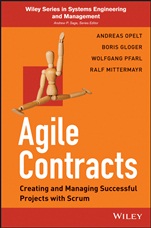
Agile Contracts: Creating and Managing Successful Projects with Scrum
ISBN 9781118630945
Autor: Andreas Opelt, Boris Gloger, Wolfgang Pfarl, Ralf Mittermayr
Wydawca: Wiley
Dostępność: 3-6 tygodni
Cena: 338,10 zł
Przed złożeniem zamówienia prosimy o kontakt mailowy celem potwierdzenia ceny.
ISBN13: |
9781118630945 |
ISBN10: |
1118630947 |
Autor: |
Andreas Opelt, Boris Gloger, Wolfgang Pfarl, Ralf Mittermayr |
Oprawa: |
Paperback |
Rok Wydania: |
2013-06-21 |
Ilość stron: |
304 |
Wymiary: |
237x172 |
Tematy: |
THX |
A methodologically sophisticated, comprehensive approach to applying the Agile fixed-price contract to IT projects while maximizing customer and supplier relationships "Interesting and necessary for IT managers and IT lawyers." Walter J. Jaburek, Dipl.-Ing., Dr. iur., Dr. techn. Approximately 50 percent of software developers use Scrum, an iterative and incremental development method for managing software projects and product or application development, in their work. The benefit of Scrum and other Agile methods is that they can address shifts in a large project that traditional managerial methods cannot. Written by pioneers and leaders in the field of Agile and Scrum, Agile Contracts is the only book dedicated exclusively to the legal, procurement, and project management considerations of Agile contracts. Providing templates, a toolbox, and examples of Agile fixed-price contracts, the book presents an alternative option to fixed-price, time-based, and supply-based contractsreducing the risk for both the supplier and the customer with a contract that offers the possibility of flux and flexible scenarios as a project progresses. Agile Contracts features in-depth chapter coverage of: The Agile Manifesto of 2001 Agility from the perspective of procurement and the software provider The problems with traditional fixed-price contracts and time material contracts What the Agile fixed-price contract is and how it is set up Tendering based on the Agile fixed-price contract How to negotiate an Agile fixed-price contract Special guidelines for the legal framework of an Agile fixed-price contract Adaptable Scope System The Black Swan scenario Contracts and procedures for the featured methodologies Especially applicable within highly structured business organizations, Agile Contracts is a must-read for project managers, agile practitioners, procurement representatives, and IT lawyers.
Preface ix Acknowledgments xiii 1. Agility: What Is That? 1 1.1 The Agile Manifesto of 2001 6 1.2 Agile Development Based on Scrum 11 1.2.1 The Principles of Organization 14 1.2.2 The Process Model 14 1.2.3 Estimation in Scrum 19 1.3 Agility from the Perspective of Procurement 23 1.4 Agility from the Perspective of the Software Provider 25 1.5 The 12 Principles of Agile Software Development 26 1.6 Summary 32 2. The Missing Piece of the Puzzle 33 2.1 The Problems with Traditional Fixed–Price Contracts 37 2.2 The Problems with Time and Materials Contracts 43 2.3 Something New: The Agile Fixed–Price Contract 44 2.4 Summary 45 3. What Is an Agile Fixed–Price Contract? 47 3.1 Existing Approaches 48 3.2 The Agile Fixed–Price Contract 49 3.2.1 How Is an Agile Fixed–Price Contract Set Up? 50 3.3 Summary 71 4. Sample of an Agile Fixed–Price Contract 73 Preamble 74 §1 Definitions and Clarifications of Terms 75 §2 Contract Scope and Hierarchy of Documents 78 §3 Usage Rights 79 §4 Transparency and “Open Books” 79 §5 Acceptance 80 §6 Obligation of Both Parties to Co–Operate 81 §7 Client’s Obligations 84 §8 Escalation to the Steering Board and the Independent Experts 84 §9 Project Period 85 §10 Warranty, Compensation, and Indemnifi cation 86 §11 Limitation of Liability 86 §12 Contractor’s Compensation 87 §13 Force Majeure 87 §14 Secrecy 87 §15 Severability Clause 88 §16 Place of Performance, Jurisdiction, and Applicable Law 88 Appendix A: Commercial Agreements 88 Prices 88 Commercial Approach to the Project 90 Payment Milestones 92 Appendix B: Technical Scope and Process 92 Requirements: Backlog and Vision 92 Process for Development and Approval 93 Changes to the Contract (Exchange for Free) 95 Deliverables and Services 97 Mechanism to Calculate Costs of Future User Stories 98 Appendix C: 12 Principles of Cooperation 101 Appendix D: Quality Standards—Definition of Done 107 5. Tendering Based on an Agile Fixed–Price Contract 109 5.1 Appropriate Tender Content for an Agile Fixed–Price Contract 112 5.2 Requirements for Tendering and Selection 116 5.2.1 Competition 116 5.2.2 Comparability and Transparency 119 5.3 Tendering Steps with a Focus on Agile Fixed Price 122 5.3.1 Internal Goal Setting and Coordination 123 5.3.2 Preparation for the Invitation to Tender 124 5.3.3 Tender 126 5.3.4 Awarding of the Tender 130 5.3.5 Price Optimization Options 132 5.3.6 Project and Contract Management 134 5.3.7 Effort Inherent in the Tendering Process 134 5.4 Summary 134 6. Special Requirements for the Legal Framework of an Agile Fixed–Price Contract 137 6.1 Adaptable System for Scope 139 6.2 Warranty and Damages 140 6.3 Schedule and Milestones 141 6.4 Path of Escalation 142 6.5 Obligations 143 6.6 Summary 143 7. Guideline for the Negotiation of an Agile Fixed–Price Contract 145 7.1 Objectives of the Client 147 7.2 Objectives of the Contractor 148 7.3 Objectives and Bonus Payouts of the People Involved 149 7.4 Strategy for the Project and the Negotiation 151 7.5 Tactics for the Negotiation 152 7.6 Price Determination 155 7.7 Conclusion of the Negotiation and Project Steering 155 7.8 Conclusions 156 8. Advantages and Disadvantages of Agile Fixed–Price Contracts 157 8.1 Detailed Analysis of the Pros and Cons 158 8.1.1 Budget Security 159 8.1.2 Requirement Flexibility 159 8.1.3 Detailed Requirements 160 8.1.4 Negotiating Costs 160 8.1.5 Estimate Security 160 8.1.6 Quality Risk 160 8.1.7 Price Elevation Tendency 161 8.1.8 Probability of Winning a Project Tender 161 8.1.9 Cost Risk 161 8.1.10 Security to Deliver a Project as a Whole 161 8.1.11 Acceptance Efforts 174 8.1.12 Pricing Transparency 174 8.1.13 Progress Transparency 174 8.1.14 Permanent Regulation 174 8.1.15 Securing the Investment 174 8.2 Summary and Overview 182 8.3 Conclusions 184 9. Toolbox for Agile Fixed–Price Contracts 185 9.1 Stimulating Interest Before the Negotiation 186 9.2 Identifying Issues of the Other Party 189 9.3 Establishing Common Language and Experiences 189 9.4 Feature Shoot–out 191 9.5 The Black Swan Scenario 192 9.6 Workshop on Contract Setup 192 9.7 Reports and Metrics 196 9.7.1 KISS Backlog View 196 9.7.2 Focus: There Is a Single Goal! 197 10. Practical Examples 199 10.1 Example 1: Software Integration in a Migration Project 200 10.1.1 Initial Situation 200 10.1.2 Contract and Procedure for Traditional Methodologies 202 10.1.3 Contract and Procedure for Agile Methodologies 213 10.1.4 Contract for Example 1 222 10.2 Example 2: Creating a Software Product 240 10.2.1 Initial Situation 241 10.2.2 Contract and Procedure for a Traditional Fixed–Price Contract 241 10.2.3 Contract and Procedure for a Time and Materials Contract 253 10.2.4 Contract and Procedure for an Agile Fixed–Price Contract 261 10.2.5 Conclusions 268 Appendix: Questions and Answers 271 References 275 Index 279
Andreas Opelt is Vice President for Sales, Product Marketing, and Partner Management at Infonova. Boris Gloger is ranked worldwide among the pioneers of Scrum. He continues to develop practices and set training standards internationally. Wolfgang Pfarl is a trained lawyer and is responsible for the IT procurement at the Austrian Post. Ralf Mittermayr is a partner at BearingPoint and focuses on conceptual design and delivery of complex software solutions to the banking, telecommunications, and supply industries.
“Given what FAR says so eloquently and the Office of Management and Budget (OMB) and Office of Federal Procurement Policy have reaffirmed, it is not surprising that on June 14, 2012, the OMB provided a 25–page memorandum providing guidance to support modular development that specifically addressed the practices and issues raised here. I recommend this book to all members of any integrated product team tasked with IT acquisition and contracting.” ( Computing Reviews , 7 January 2013)
Koszyk
Książek w koszyku: 0 szt.
Wartość zakupów: 0,00 zł
Informacje


Kontakt
Gambit
Centrum Oprogramowania
i Szkoleń Sp. z o.o.
Al. Pokoju 29b/22-24
31-564 Kraków
Siedziba Księgarni
ul. Kordylewskiego 1
31-542 Kraków
+48 12 410 5991
+48 12 410 5987
+48 12 410 5989
Subskrypcje
Administratorem danych osobowych jest firma Gambit COiS Sp. z o.o. Na podany adres będzie wysyłany wyłącznie biuletyn informacyjny.
Autoryzacja płatności

Informacje na temat autoryzacji płatności poprzez PayU.

© Copyright 2012: GAMBIT COiS Sp. z o.o. Wszelkie prawa zastrzeżone.
Projekt i wykonanie: Alchemia Studio Reklamy