


Wydawcy
Katalog tematyczny
- Archeologia (109)
- Ekonomia, finanse, business (13704)
- Filozofia (1445)
- Historia (3040)
- Języki i językoznawstwo (2356)
- Lifestyle, hobby i rozrywka (475)
- Medycyna (9704)
- Nauki humanistyczne (4)
- Nauki o Ziemi i środowisku (2638)
- Nauki ścisłe (20412)
- Nauki społeczne (8486)
- Nauki techniczne (13450)
- Budownictwo lądowe (1045)
- Chemia przemysłowa (2258)
- Elektronika i telekomunikacja (3287)
- Energetyka (1122)
- Inne nauki stosowane (363)
- Inżynieria biochemiczna (507)
- Inżynieria transportu (232)
- Mechanika i materiały (3316)
- Nauka o środowisku (321)
- Rolnictwo (507)
- Technika, ogólnie (475)
- Prawo (1696)
- Publikacje informacyjne i interdyscyplinarne (1288)
- Religia i wierzenia (917)
- Technika komputerowa (4067)
- Zdrowie, relacje międzyludzkie i rozwój osobisty (657)





Informacje szczegółowe o książce
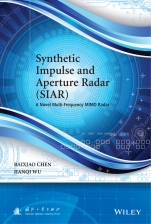
Synthetic Impulse and Aperture Radar (SIAR): A Novel Multi–Frequency MIMO Radar
ISBN 9781118609552
Autor: Baixiao Chen, Jianqi Wu
Wydawca: Wiley
Dostępność: 3-6 tygodni
Cena: 719,25 zł
Przed złożeniem zamówienia prosimy o kontakt mailowy celem potwierdzenia ceny.
ISBN13: |
9781118609552 |
ISBN10: |
1118609557 |
Autor: |
Baixiao Chen, Jianqi Wu |
Oprawa: |
Hardback |
Rok Wydania: |
2014-04-01 |
Ilość stron: |
440 |
Wymiary: |
249x170 |
Tematy: |
TJ |
The Synthetic Impulse and Aperture Radar (SIAR) is a microwave imaging technology capable of seeing through walls made of materials as diverse as drywall, wood, concrete, and brick. There are numerous applications for the SIAR, such as improvised explosive device detection, localization and identification, search and rescue, as well as identification of building inhabitants in combat areas, hostage situations, drug control, and border enforcement.
The technology detects and identifies targets under all–weather conditions during day or night from a potential variety of operational platforms, such as automobiles, umanned airbourne vechicles, helicopters, and a variety of fixed–wing airplanes. The system is capable of remotely generating two– and three–dimensional images of stationary or mobile targets at a large standoff distance while delivering much higher resolution images than any other technology available.
This book systematically discusses the operating principles, signal processing methods, target measurement technology, and experimental results of the SIAR. The authors aim to help readers acquire insight into the concept and principle of the SIAR, differences from a traditional radar, as well as design and development methods.
Written by highly experienced authors with extensive knowledge of the SIAR, the book can be used as a reference for engineering technical personnel and scientific research personnel working in the research of the SIAR, the MIMO radar, the digital radar, or other new types of radar. It can also be a reference for teachers and students in universities who engage in related research work.
About the Authors xiii
Preface xv
Acknowledgments xix
1 Introduction 1
1.1 Development of Modern Radar 1
1.2 Basic Features of SIAR 3
1.3 Four Anti Features of SIAR 4
1.4 Main Types of MIMO Radar 9
1.5 SIAR and MIMO Radar 11
1.6 Organization of This Book 12
References 15
2 Radar Common SignalWaveform and Pulse Compression 17
2.1 Mathematical Form and its Classification of Radar Signal 17
2.2 The Ambiguity Function and Radar Resolution 23
2.3 FM Pulse Signal and its Pulse Compression 38
2.4 Phase Coded Pulse Signal and its Processing 56
2.5 Stepped–Frequency Pulse Signal and its Processing 73
2.6 Orthogonal Waveform 84
2.7 MATLAB® Program List 95
References 102
3 System Design of SIAR 103
3.1 Introduction 103
3.2 Principles of SIAR 104
3.3 Synthesis of Transmit Pulse and Aperture 113
3.4 4D Ambiguity Function of SIAR 120
3.5 Radar Equation of SIAR and its Characteristics 126
3.6 Experimental System of SIAR 133
3.7 Gain and Phase Calibration of SIAR 137
3.8 Experimental Results of SIAR 142
3.9 SIAR with Large Random Sparse Array 145
3.10 Brief Summary 147
3.11 MATLAB® Program List 148
References 152
4 Waveform and Signal Processing of SIAR 155
4.1 Introduction 155
4.2 Waveform and Signal Processing Flow of SIAR 156
4.3 Application of LFM in SIAR 160
4.4 SIAR Performance Analysis of Pulse Compression based on Phased Codes 163
4.5 Pulse–to–Pulse Frequency Code Agility and its Signal Processing Flow 170
4.6 Group–to–Group Frequency Code Agility and its Signal Processing 179
4.7 Brief Summary 180
4.8 MATLAB® Program List 181
Appendix 4A Deductions of Some Equations in This Chapter 185
References 189
5 Long–Time Coherent Integration of SIAR 191
5.1 Introduction 191
5.2 Features and Faults of Long–Time Coherent Integration of SIAR 192
5.3 Long–Time Coherent Integration Based on Motion Compensation and Time–Frequency Analysis 197
5.4 Long–Time Coherent Integration Based on Pulse Synthesis of Stepped Frequency 203
5.5 Computer Simulation 210
5.6 Brief Summary 213
References 213
6 Digital Monopulse Tracking Technique of SIAR 215
6.1 Overview of the Monopulse Tracking Technique 215
6.2 Tracking Processing and Signal Model of SIAR 218
6.3 Precision Measurement of the Target Range 220
6.4 Measurements of the SIAR Target s Direction 230
6.5 Measurement of Doppler Frequency 235
6.6 Brief Summary 238
References 239
7 Coupling and Decoupling between Range and Angle 241
7.1 Introduction 241
7.2 Coupling Influence of Angular Error on Range Measurement 242
7.3 Coupling Influence of Range Quantization Error on Angle Measurement 244
7.4 Range–Angle Coupling Analysis Based on the Fisher Information Matrix 247
7.5 Frequency Code Optimization and Three–Dimensional Decoupling Analysis 249
7.6 Computer Simulation 255
7.7 Brief Summary 256
References 257
8 Target Detection and Tracking in SIAR under Strong Jamming 259
8.1 Introduction 259
8.2 Anti–Jamming Measures of the SIAR System 260
8.3 Adaptive Nulling and Computer Simulation for the Phased Array Radar 261
8.4 Adaptive Nulling and Computer Simulation for SIAR 277
8.5 Target Range Measurement in SIAR Under Active Jamming 281
8.6 Target Direction Measurement in SIAR Under Active Jamming 283
8.7 Performance Analysis of Sidelobe Cancelation in SIAR 285
8.8 Summary 292
8.9 MATLAB® Program List 294
References 296
9 Effects of Array Error on SIAR Tracking Accuracy 297
9.1 Introduction 297
9.2 Effect of Amplitude and Phase of the Array Element on Tracking Accuracy 298
9.3 Influence of Channel Mismatch on Tracking Accuracy 303
9.4 Influence of Orthogonal Channel Imbalance on Tracking Accuracy 312
9.5 Summary 317
References 318
10 Bistatic Synthetic Impulse and Aperture GroundWave Radar Experimental System 319
10.1 Introduction 319
10.2 The Composition and Characteristics of the Test System 321
10.3 The Parameter Design of the Waveform of the Bistatic Synthetic Impulse and Aperture Ground Wave Radar 331
10.4 Working Principles of the Bistatic Synthetic Impulse and Aperture Ground Wave Radar 336
10.5 Sea Clutter Characteristic of the Bistatic HF Ground Wave Radar 347
10.6 Results of Real–Data Processing 359
10.7 Brief Summary 364
References 366
11 Microwave Sparse Array Synthetic Impulse and Aperture Radar 369
11.1 Introduction 369
11.2 Transmit Signal Waveform of MSA–SIAR 370
11.3 The Array and its Optimization of MSA–SIAR 372
11.4 The Signal Pre–processing Method Based on Digital Dechirp Processing 382
11.5 MSA–SIAR Based on IDFT Coherent Synthesis 387
11.6 Spatial Domain Synthetic Bandwidth Method of MSA–SIAR 392
11.7 Summary 400
References 401
Bibliography 405
Index 409
BAIXIAO CHEN, Xidian University, P. R. China
JIANQI WU, Hefei Association for Science and Technology, P. R. China
Koszyk
Książek w koszyku: 0 szt.
Wartość zakupów: 0,00 zł
Informacje


Kontakt
Gambit
Centrum Oprogramowania
i Szkoleń Sp. z o.o.
Al. Pokoju 29b/22-24
31-564 Kraków
Siedziba Księgarni
ul. Kordylewskiego 1
31-542 Kraków
+48 12 410 5991
+48 12 410 5987
+48 12 410 5989
Subskrypcje
Administratorem danych osobowych jest firma Gambit COiS Sp. z o.o. Na podany adres będzie wysyłany wyłącznie biuletyn informacyjny.
Autoryzacja płatności

Informacje na temat autoryzacji płatności poprzez PayU.

© Copyright 2012: GAMBIT COiS Sp. z o.o. Wszelkie prawa zastrzeżone.
Projekt i wykonanie: Alchemia Studio Reklamy