


Wydawcy
Katalog tematyczny
- Archeologia (109)
- Ekonomia, finanse, business (13704)
- Filozofia (1445)
- Historia (3040)
- Języki i językoznawstwo (2356)
- Lifestyle, hobby i rozrywka (475)
- Medycyna (9704)
- Nauki humanistyczne (4)
- Nauki o Ziemi i środowisku (2638)
- Nauki ścisłe (20412)
- Nauki społeczne (8486)
- Nauki techniczne (13450)
- Prawo (1696)
- Publikacje informacyjne i interdyscyplinarne (1288)
- Religia i wierzenia (917)
- Technika komputerowa (4067)
- Zdrowie, relacje międzyludzkie i rozwój osobisty (657)





Informacje szczegółowe o książce
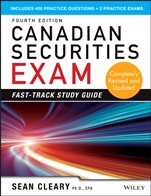
Canadian Securities Exam Fast–Track Study Guide
ISBN 9781118605684
Autor: W. Sean Cleary
Wydawca: Wiley
Dostępność: 3-6 tygodni
Cena: 260,40 zł
Przed złożeniem zamówienia prosimy o kontakt mailowy celem potwierdzenia ceny.
ISBN13: |
9781118605684 |
ISBN10: |
1118605683 |
Autor: |
W. Sean Cleary |
Oprawa: |
Paperback |
Rok Wydania: |
2013-07-26 |
Numer Wydania: |
4th Edition |
Ilość stron: |
384 |
Wymiary: |
277x215 |
Tematy: |
KF |
Preparing for the Canadian Securities Exam just got easier... with the Canadian Securities Exam Fast-Track Study Guide , 4th Edition, from Wiley Whether your career aspirations lie in banking, financial planning, the mutual fund industry or a brokerage, you can't avoid taking the Canadian Securities Exam. But there's a lot of material to know for the day of the examination, and it can be a daunting task to assimilate such a wide body of knowledge. The Wiley Canadian Securities Exam Fast-Track Study Guide is a quick-review tool that covers all the basics you need to know to pass the exam. It presents "quick hits" of the key points, in language that's easy to understand and follow. This concise study aid: summarizes the essential "need-to-know" information highlights important topics features multiple-choice review questions at the end of each chapter makes material easy to read, understand and remember includes 400 sample questions, including multiple-choice chapter review questions and two full practice exams, as well as cross-referencing to the CSC textbook This edition has been completely updated and revised to reflect recent changes to the course and the exams. It features updates throughout, new questions and new practice exams, and it has been restructured for ease of use and comprehension. Don't let the stress and amount of material you need to know for the exam overwhelm you. Prepare yourself with the Canadian Securities Exam Fast-Track Study Guide . It's the perfect quick-review tool to wrap up your studying and help you focus on doing your best on the exam. This text is designed primarily for students who are enrolled in the Canadian Securities Course (CSC)® through CSI Global Education Inc. (CSI)® and who are in the final stages of preparing to write either of their two CSC exams. It should be considered a companion to the CSI materials, not a substitute. CSI does not sponsor or endorse this product .
Acknowledgements vi Introduction: How to Use this Book vii Chapter 1: The Capital Market 1 Introduction 1 Suppliers and Users of Investment Capital 1 The Role of Financial Instruments 4 Financial Markets 5 Chapter 1 Review Questions 8 Chapter 2: The Canadian Securities Industry 11 An Overview of the Canadian Securities Industry 11 The Role of Financial Intermediaries 11 The Canadian Securities Industry 12 Chartered Banks 14 Other Intermediaries 16 Chapter 2 Review Questions 18 Chapter 3: The Canadian Regulatory Environment 21 Regulatory Organizations 21 Arbitration 24 Regulation and Investor Protection 24 The Ethics of Trading 26 Takeovers and Insider Trading 28 Chapter 3 Review Questions 29 Chapter 4: Economic Principles 33 Overview of Economics 33 Measuring the Economy 34 Labour Markets 36 Interest Rates 37 Money and Inflation 38 International Economics 39 Chapter 4 Review Questions 41 Chapter 5: Economic Policy 45 Economic Theories 45 Fiscal Policy 46 Monetary Policy 46 Chapter 5 Review Questions 49 Chapter 6: Fixed–income Securities: Features and Types 53 Overview and Terminology 53 Bond Features 54 Government Securities 56 Corporate Bonds 57 Chapter 6 Review Questions 61 Chapter 7: Fixed–income Securities: Pricing and Trading 67 Bond Pricing Principles 67 The Term Structure of Interest Rates 71 Delivery, Regulation, and Settlement 72 Bond Indexes 73 Chapter 7 Review Questions 74 Chapter 8: Equity Securities: Common and Preferred Shares 79 Introduction 79 Common Shares 79 Preferred Share Characteristics 81 Stock Indices and Averages 87 Chapter 8 Review Questions 89 Chapter 9: Equity Securities: Equity Trading 95 Cash and Margin Accounts 95 Short Sales 97 Equity Transactions 98 Chapter 9 Review Questions 99 Chapter 10: Derivatives 105 Introduction 105 Options 106 Futures and Forwards 112 Rights and Warrants 115 Chapter 10 Review Questions 118 Chapter 11: Financing and Listing Securities 123 Basic Forms of Business Organization 123 The Incorporation Process 125 Government and Corporate Financing 127 The Financing Procedure 130 The Listing Process 133 Chapter 11 Review Questions 135 Chapter 12: Corporations and Their Financial Statements 139 Understanding Financial Statements 139 Statement of Financial Position 139 Statement of Comprehensive Income 143 Other Components 145 Chapter 12 Review Questions 146 Chapter 13: Fundamental and Technical Analysis 151 Overview 151 Fundamental Macroeconomic Analysis 152 Industry Analysis 153 Fundamental Valuation Models 155 Technical Analysis 158 Chapter 13 Review Questions 160 Chapter 14: Company Analysis 165 Fundamental Company Analysis 165 Interpreting Financial Statements 166 Assessing Preferred Share Investment Quality 174 Chapter 14 Review Questions 176 Chapter 15: Introduction to the Portfolio Approach 183 Introduction 183 Risk and Return 183 Portfolio Risk and Return 187 The Portfolio Management Process 189 Chapter 15 Review Questions 191 Chapter 16: The Portfolio Management Process 197 Developing an Asset Mix and Selecting Investment Styles 197 Implementing the Asset Mix 200 Monitoring the Economy, the Markets, the Portfolio, and the Client 201 Evaluating Portfolio Performance 202 Chapter 16 Review Questions 203 Chapter 17: Evolution of Managed and Structured Products 209 Managed versus Structured Products 209 Chapter 17 Review Questions 211 Chapter 18: Mutual Funds: Structure and Regulation 213 Introduction 213 The Structure of Mutual Funds 214 Labour–sponsored Venture Capital Corporations (LSVCCs) 217 Regulation of Mutual Funds 219 Chapter 18 Review Questions 223 Chapter 19: Mutual Funds: Types and Features 227 Types of Mutual Funds 227 Fund Management Styles 229 Redeeming Mutual Fund Units or Shares 229 Comparing Mutual Fund Performance 231 Chapter 19 Review Questions 233 Chapter 20: Segregated Funds and Other Insurance Products 237 Key Features of Segregated Funds 237 Maturity Guarantees and Benefits 238 Fees and Expenses 241 Tax Considerations 242 Regulation 245 Other Insurance Products 247 Chapter 20 Review Questions 247 Chapter 21: Hedge Funds 251 Overview of Hedge Funds 251 Hedge Fund Indexes 253 Benefits and Risks of Hedge Funds 253 Due Diligence 254 Hedge Fund Strategies 255 Funds of Hedge Funds 257 Chapter 21 Review Questions 257 Chapter 22: Exchange–listed Managed Products 261 Closed–end Funds 261 Income Trusts 262 Exchange–traded Funds 263 Chapter 22 Review Questions 264 Chapter 23: Fee–based Accounts 267 Fee–based Accounts 267 Chapter 23 Review Questions 269 Chapter 24: Structured Products 271 Principal Protected Notes (PPNs) 271 Index–linked Guaranteed Investment Certificates (GICs) 272 Split Shares 272 Asset–backed Securities (ABS) 273 Mortgage–backed Securities (MBS) 274 Chapter 24 Review Questions 274 Chapter 25: Canadian Taxation 277 Taxes and Taxation Issues 277 Taxation of Investment Income 278 Tax Deferral Plans 281 Basics of Tax Planning 284 Chapter 25 Review Questions 285 Chapter 26: Working with the Retail Client 289 The Process of Financial Planning 289 Financial Planning Aids 291 Ethics and the Financial Advisor 292 Case Studies 294 Chapter 26 Review Questions 296 Chapter 27: Working with the Institutional Client 299 Who Are Institutional Clients? 299 Suitability Requirements for Institutional Investors 300 Roles and Responsibilities in the Institutional Market 301 Chapter 27 Review Questions 301 CSC Practice Examination #1: Chapters 1–12 319 CSC Practice Examination #2: Chapters 13 –27 341 Answers to Practice Exam #1: Chapters 1–12 363 Answers to Practice Exam #2: Chapters 13 –27 369
Dr. Sean Cleary, Ph.D., CFA, is BMO Professor of Finance and Director of the Master of Finance program at Queen's School of Business, Queen's University. Dr. Cleary holds a Ph.D. in finance from the University of Toronto, and an MBA. He is a Chartered Financial Analyst (CFA) charter holder and a former Board member of both the Toronto CFA Society and the Atlantic Canada CFA Society. He has completed the Professional Financial Planning Course (PFPC), the Canadian Securities Course (CSC), as well as the Investment Funds Institute of Canada (IFIC) Mutual Fund Course. He has been on the faculty at St. Mary's University and the Schulich School of Business, York University, and has taught preparation courses for the Canadian Securities Exam. Dr. Cleary has published numerous articles in the Journal of Finance , the Journal of Financial and Quantitative Analysis , Financial Management , the Journal of Banking and Finance , the Journal of Multinational Financial Management , the Journal of Financial Research , the International Journal of Managerial Finance , the Canadian Investment Review , and the Canadian Journal of Administrative Sciences . He is co-author of the first three editions of Introduction to Corporate Finance (Wiley, 2007, 2010, 2013), as well as numerous other finance textbooks.
Koszyk
Książek w koszyku: 0 szt.
Wartość zakupów: 0,00 zł
Informacje


Kontakt
Gambit
Centrum Oprogramowania
i Szkoleń Sp. z o.o.
Al. Pokoju 29b/22-24
31-564 Kraków
Siedziba Księgarni
ul. Kordylewskiego 1
31-542 Kraków
+48 12 410 5991
+48 12 410 5987
+48 12 410 5989
Subskrypcje
Administratorem danych osobowych jest firma Gambit COiS Sp. z o.o. Na podany adres będzie wysyłany wyłącznie biuletyn informacyjny.
Autoryzacja płatności

Informacje na temat autoryzacji płatności poprzez PayU.

© Copyright 2012: GAMBIT COiS Sp. z o.o. Wszelkie prawa zastrzeżone.
Projekt i wykonanie: Alchemia Studio Reklamy