


Wydawcy
Katalog tematyczny
- Archeologia (109)
- Ekonomia, finanse, business (13704)
- Filozofia (1445)
- Historia (3040)
- Języki i językoznawstwo (2356)
- Lifestyle, hobby i rozrywka (475)
- Medycyna (9704)
- Nauki humanistyczne (4)
- Nauki o Ziemi i środowisku (2638)
- Nauki ścisłe (20412)
- Nauki społeczne (8486)
- Edukacja (229)
- Kryminologia, opieka spełeczna (284)
- Obronność (10)
- Polityka (1389)
- Psychologia (777)
- Socjologia (410)
- Społeczeństwo i kultura (187)
- Nauki techniczne (13450)
- Prawo (1696)
- Publikacje informacyjne i interdyscyplinarne (1288)
- Religia i wierzenia (917)
- Technika komputerowa (4067)
- Zdrowie, relacje międzyludzkie i rozwój osobisty (657)





Informacje szczegółowe o książce
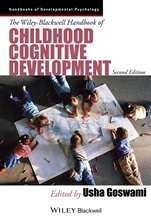
The Wiley–Blackwell Handbook of Childhood Cognitive Development
ISBN 9781118586662
Autor: Usha Goswami
Wydawca: Wiley
Dostępność: 3-6 tygodni
Cena: 197,40 zł
Przed złożeniem zamówienia prosimy o kontakt mailowy celem potwierdzenia ceny.
ISBN13: |
9781118586662 |
ISBN10: |
1118586662 |
Autor: |
Usha Goswami |
Oprawa: |
Paperback |
Rok Wydania: |
2013-11-01 |
Numer Wydania: |
2nd Edition |
Ilość stron: |
816 |
Wymiary: |
246x171 |
Tematy: |
JC |
Few areas of research have yielded more exciting results in recent years than studies on infant and childhood cognition. Reflecting great strides undertaken in this important field, the new edition of The Wiley–Blackwell Handbook of Childhood Cognitive Development presents a thorough and authoritative overview of the latest research on various areas of a child′s cognitive development, including the newest data from cognitive neuroscience. Top scholars in their respective fields have either updated contributions from the first edition by incorporating their latest findings and developments or, in several instances, provided entirely new chapters. Important issues such as categorization, memory, and reasoning are revisited, along with all–new entries on social cognitive development and language. Other topics addressed include moral and symbolic development, pretend play, spatial development, and the historical and contemporary theoretical perspectives that inform cognitive development. The Wiley–Blackwell Handbook of Childhood Cognitive Development , Second Edition, is an invaluable resource on the latest research and theories that shape our understanding of the crucial cognitive development of a child, from infancy to the onset of adolescence.
Acknowledgements x List of Contributors xi Introduction 1 Part I Infancy: The Origins of Cognitive Development 5 1 How Do Infants Reason About Physical Events? 11 Renée Baillargeon, Jie Li, Yael Gertner, and Di Wu 2 Social Cognition and the Origins of Imitation, Empathy, and Theory of Mind 49 Andrew N. Meltzoff 3 Kinds of Agents: The Origins of Understanding Instrumental and Communicative Agency 76 György Gergely 4 Social Cognition and Social Motivations in Infancy 106 Malinda Carpenter 5 Born to Categorize 129 Paul C. Quinn 6 Early Memory Development 153 Patricia J. Bauer, Marina Larkina, and Joanne Deocampo 7 Early Word–Learning and Conceptual Development: Everything Had a Name, and Each Name Gave Birth to a New Thought 180 Sandra R. Waxman and Erin M. Leddon Part II Cognitive Development in Early Childhood 209 8 Development of the Animate–Inanimate Distinction 213 John E. Opfer and Susan A. Gelman 9 Language Development 239 Michael Tomasello 10 Developing a Theory of Mind 258 Henry M. Wellman 11 Pretend Play and Cognitive Development 285 Angeline Lillard, Ashley M. Pinkham, and Eric Smith 12 Early Development of the Understanding and Use of Symbolic Artifacts 312 Judy S. DeLoache Part III Topics in Cognitive Development in Childhood 337 13 Memory Development in Childhood 347 Wolfgang Schneider 14 Causal Reasoning and Explanation 377 Barbara Koslowski and Amy Masnick 15 Inductive and Deductive Reasoning 399 Usha Goswami 16 The Development of Moral Reasoning 420 Larry P. Nucci and Matthew Gingo 17 Spatial Development: Evolving Approaches to Enduring Questions 446 Lynn S. Liben and Adam E. Christensen 18 Children’s Intuitive Physics 473 Friedrich Wilkening and Trix Cacchione 19 What is Scientifi c Thinking and How Does it Develop? 497 Deanna Kuhn 20 Reading Development and Dyslexia 524 Margaret J. Snowling and Silke M. Göbel 21 Children’s Understanding of Mathematics 549 Peter Bryant and Terezinha Nuñes 22 Executive Function in Typical and Atypical Development 574 Philip David Zelazo and Ulrich Müller 23 Language and Cognition: Evidence from Disordered Language 604 Barbara Dodd and Sharon Crosbie 24 The Empathizing–Systematizing (E–S) Theory of Autism: A Cognitive Developmental Account 626 Simon Baron–Cohen Part IV Theories of Cognitive Development 641 25 Piaget’s Theory: Past, Present, and Future 649 Patricia H. Miller 26 Vygotsky and Psychology 673 Harry Daniels 27 Information–Processing Models of Cognitive Development 697 Graeme S. Halford and Glenda Andrews 28 Neuroconstructivism 723 Gert Westermann, Michael S. C. Thomas, and Annette Karmiloff–Smith 29 Individual Differences in Cognitive Development 749 Robert J. Sternberg Index 775
Usha Goswami is Professor of Education at the University of Cambridge and a Fellow of St John′s College, Cambridge. She is also Director of the Centre for Neuroscience in Education, which carries out research into the brain basis of literacy, numeracy, dyslexia, and dyscalculia. Dr Goswami has received numerous awards for her work, including the British Psychology Society Spearman Medal, the Norman Geschwind–Rodin Prize for Dyslexia research, and fellowships from the Leverhulme Trust in the United Kingdom, the National Academy of Education in the United States, and the Alexander von Humboldt Foundation in Germany.
"All these will find the material in this new companion topical and challenging . . The essays are provided with generous and well–chosen lists of further reading, and many of the works will or should be in any well–stocked academic or research library". (Reference Reviews, 2011) "This is an authoritative, comprehensive and cutting–edge account of psychological theory and research on children′s cognitive development from infants to early adolescence. Written by a cast of world leading academics, this handbook provides a single volume resource that covers all the major topics...This second edition reflects the significant developments within the field arising from the latest cognitive neuropsychological research...This handbook brings together such a wealth of material to constitute possibly the single best reference book in its subject area and, as such, should serve as a key text for advanced students, researchers and practitioners." (The Psychologist, May 2011) "Overall, the handbook is a thoughtful and valuable reference work, to which users can refer for an impressive range of research." (Julia Carroll, Journal of Child Psychology and Psychiatry, 44:6) "Though the structure of this book is similar to other volumes in the series, I welcome it with even greater enthusiasm than the rest. While they all summarise and review the latest scientific research in their particular area of child development, research in the field of infant cognition has, in the last few years, completely overturned all previous conceptions. This volume, therefore, not only summarises and updates the literature in its field, but also replaces much of it ... at the moment this book series is the cutting edge ... As with other volumes in the series, all libraries serving postgraduate level studies in psychology and related disciplines should seriously consider acquisition." (Martin Guha, Librarian, Institute of Psychiatry, Reference Reviews, 17 February 2003) "Summing up: Highly recommended. Upper–division undergraduates through faculty and professionals." (K.L. Hartlep, California State University, Bakersfield, Choice, March 2003) "The book is a timely addition to to the literature on infant and child cognitive development... The significant value of this volume lies in the breadth of its coverage and the sheer comprehensiveness of its execution... For academics and researchers in the field of infant and child cognitive development this is an invaluable resource that encompasses the current state of knowledge in this central developmental area." (Mark Tomlinson, Journal of Child and Adolescent Mental Health, 2005, 17(2))
Koszyk
Książek w koszyku: 0 szt.
Wartość zakupów: 0,00 zł
Informacje


Kontakt
Gambit
Centrum Oprogramowania
i Szkoleń Sp. z o.o.
Al. Pokoju 29b/22-24
31-564 Kraków
Siedziba Księgarni
ul. Kordylewskiego 1
31-542 Kraków
+48 12 410 5991
+48 12 410 5987
+48 12 410 5989
Subskrypcje
Administratorem danych osobowych jest firma Gambit COiS Sp. z o.o. Na podany adres będzie wysyłany wyłącznie biuletyn informacyjny.
Autoryzacja płatności

Informacje na temat autoryzacji płatności poprzez PayU.

© Copyright 2012: GAMBIT COiS Sp. z o.o. Wszelkie prawa zastrzeżone.
Projekt i wykonanie: Alchemia Studio Reklamy