


Wydawcy
Katalog tematyczny
- Archeologia (109)
- Ekonomia, finanse, business (13704)
- Filozofia (1445)
- Historia (3040)
- Języki i językoznawstwo (2356)
- Lifestyle, hobby i rozrywka (475)
- Medycyna (9704)
- Nauki humanistyczne (4)
- Nauki o Ziemi i środowisku (2638)
- Nauki ścisłe (20412)
- Nauki społeczne (8486)
- Nauki techniczne (13450)
- Prawo (1696)
- Publikacje informacyjne i interdyscyplinarne (1288)
- Religia i wierzenia (917)
- Technika komputerowa (4067)
- Zdrowie, relacje międzyludzkie i rozwój osobisty (657)





Informacje szczegółowe o książce
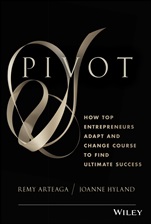
Pivot: How Top Entrepreneurs Adapt and Change Course to Find Ultimate Success
ISBN 9781118559710
Autor: Remy Arteaga, Joanne Hyland
Wydawca: Wiley
Dostępność: 3-6 tygodni
Cena: 214,20 zł
Przed złożeniem zamówienia prosimy o kontakt mailowy celem potwierdzenia ceny.
ISBN13: |
9781118559710 |
ISBN10: |
1118559711 |
Autor: |
Remy Arteaga, Joanne Hyland |
Oprawa: |
Hardback |
Rok Wydania: |
2013-12-06 |
Ilość stron: |
320 |
Wymiary: |
227x177 |
Tematy: |
KM |
Praise for Pivot "This book is both enjoyable and easy to read. Yet, it is packed with explosive ideas and practical steps to help a burgeoning entrepreneur turn a 'failure waiting to happen' into a success. Although totally familiar with the literature, the authors once again prove that while knowledge is valuable, nothing replaces experience. This book will become required reading for all my students." Dr. Robert A. Chernow, Vice Provost for Entrepreneurship and Clinical Professor, Rensselaer Polytechnic Institute "This book takes the reader past the cliché's and myths about innovation, and strikes at the heart of what matters most to make innovation systems work: people, culture, and process. I would recommend this book to those just getting started on their journey, as well as to those already scarred." George W. Coulston, VP, Marketing, Kennametal Inc. "As a long-term corporate entrepreneur, I recommend Pivot as a must-read for executives who are building and sustaining a corporate innovation function. The stories in Pivot reveal organizational paradoxes that undermine successful innovation practices yet often go unexamined. Furthermore, Joanne and Remy deliver proven tools for innovators." Rich Duncombe, Founder, Innovation Catalyst Group former VP/GM, New Business Operation, Hewlett-Packard "Sustainable competitive differentiation requires the D-I-A process; otherwise companies are likely to invest in endless 'science projects.'" Dr. Kate Jackson, Chief Technology Officer, Westinghouse Electric Company "In my 25 years of product development experience, I have found the principles and tools in this book to be the most effective for working on highly uncertain innovative projects." Mike Pickett, VP of Global Strategy Development, Moen "This book is a real inspirational guide for the corporate innovation practitioner. From being skeptical in the beginning of our business creation journey, especially the MTOR part became key in our company as the way to describe projects across our pipeline independent how radical they are our new operating standard. The innovation culture across all businesses evolved to identifying and testing assumptions through validated learning rather than pretending that we have all the answers. This mindset also changed my interactions with top management from traditional project reviews to strategy conversations and active engagement in finding solutions, especially for highly uncertain ventures!" Dr. Thomas Schäfer, Vice President, The Innovation Office, Novozymes A/S
Acknowledgments Introduction: Is There a Better Way? Part One: The Tale of Two Entrepreneurial Worlds Chapter 1: Pedal to the Metal A Little History Traditional Management Tools Fail Entrepreneurs Why Startups Fail Origins of the Pivot Methodology Notes Chapter 2: Innovation is Bringing Discipline to Chaos Plant = Discovery; Pivot = Incubation; Propel = Acceleration Introduction to the D–I–A Model 1 If Only I Knew Then, What I Know Now… Innovation Defined in the Corporate Setting Beyond Invention and Creativity Emerging Management Discipline Innovation Definitions Common Language and Mindset Navigating the Culture Divide It’s ALL About Uncertainty Uncertainty versus Risk Uncertainty Types: Technical, Market, Resource, Organization Innovation Continuum and Uncertainty The ABCs of Innovation Uncertainty Notes Chapter 3: The Corporate Entrepreneur An Examination of the Definition An In–Depth Look at Corporate Entrepreneurship Models Model One: Intrapreneurship Model Two: Arms–Length Approaches – Corporate Venture Capital and External Corporate Incubators Model Three: Internal Venturing – Spin–ins and Spinouts Model Four: New Business Creation – Inside Corporate/R&D or Established Divisions Model Five: Open Innovation Hybrid Approach Model Six: An Innovation Function – Institutionalizing Corporate Entrepreneurship A Brief Look at Academic Research A Look at Corporate Culture Personal Experiences Notes Additional Notes Chapter 4: So, You Want to Be An Entrepreneur? Swinging for the Fences The Academic Side Personal Experiences Notes Chapter 5: Entrepreneur and Corporate Entrepreneur – Framing the Perspectives Comparing Entrepreneurs Differences between Startup Entrepreneurs and Corporate Entrepreneurs Differences in the Operating Contexts Progress in Understanding and Effectively Executing the Two Different Types of Entrepreneurship Notes Part Two: Plant = Discovery – The Business Vision Chapter 6: Discovery–Attractiveness of the Business Opportunity 1 Discovery Principles 2 Discovery and Open Innovation Discovery Progression: Capturing Innovation Opportunities 4 Opportunity Recognition Application Generation and the Business Vision The Discovery Toolkit – In Brief Standard Tools Idea Uncertainty Assessment Tool Opportunity Screening Criteria Opportunity Potential Questions Genesis Pad™ – Opportunity Description: Uncertainty Identification Checklist for Discovery Opportunity Stakeholder Positioning Plant or Discovery Value Pitch Advanced Tools Words of Caution Plant Your Value Pitch – Making the Transition to Incubation with Your Opportunity Concept Notes Chapter 7: Opportunity and the Entrepreneur Opportunity Recognition Technology to Market Opportunity The Challenge for Universities to Commercialize Technologies The Big XYZ The Value Proposition The Positioning Statement Notes Chapter 8: Entrepreneur and Corporate Entrepreneur Perspectives – Pursuit of Opportunities Getting from Idea to Opportunity Attracting Attention Part Three: Pivot = Incubation – The Missing Link Chapter 9: Incubation – Discipline Together with Chaos 1 Incubation Principles 2 Incubation Objectives Incubation Activities and ‘Processes’ Incubation and Living with Chaos – The Learning Plan™ 3 Short, Quick, Inexpensive Learning Loops The Learning Plan Methodology Dimensions of Uncertainty Learning Loop Development Process Initiating a Learning Loop Evaluating Learning Outcomes General Guidelines Notes Chapter 10: Early Market Engagement – Business Concept Options 1 Incubation Progression – Market Learning and Business Model Market Learning 2 Business Model Market Development Considerations Learning versus Product Prototype Market Entry Approach Forget about Finding the Killer Application Be Out There Move from Office to Market Market Development = Market Learning Follow the Long and Winding Road Innovation Roles Building the Team Success Depends on People The Incubation Toolkit – In Brief Standard Tools Learning Plan Uncertainty Identification Checklist for Incubation Technical and Market Concept Testing Approaches Technical and Market Concept Testing Outcomes Genesis Pad – Solution Description Transition Readiness Questions Pivot or Incubation Value Pitch Advanced Tools Learning Approach Value and Coaching Requirements Accelerated Learning to Achieve Faster Results Consistent and Timely Coaching Required Pivot to Your Evolved Value Pitch – Making the Transition to Acceleration with Your Concept Proposal Notes Chapter 11: Business Experiments Knowledge Construction Define Assumptions Define Markets Define CTA & Analytic Define Product Notes Chapter 12: Validated Learning = Knowledge Business Model Start Executing Experiment Execute: Product, Market Group, and Call To Action (CTA) Execute: Assumptions and Analytics Execute: Confidence, Results, and Knowledge Loop Business Plan Notes Chapter 13: Entrepreneur and Corporate Entrepreneur Perspectives – Incubation and Hypothesis–Driven Learning Learning is the Antidote to Uncertainties Learning How to Learn Pivot Startup Methodology and Learning Plan Making the Case for Investment Part Four: Propel = Acceleration – The Business Ramp Up Chapter 14: Acceleration – Courage to Invest 1 Acceleration Principles 2 Moving from Uncertainty to Risk Moving from Experimentation to Development Acceleration and the Phase Gate Process Integrating with Product Development The Acceleration Toolkit Standard Tools Resource and Organization Alignment Plan Market and Technology Development Integration Plan Propel or Acceleration Value Pitch Advanced Tools Propel Your Value Pitch – Making the Transition to Operations with Your Business Plan Notes Chapter 15: Preparing for Growth The Startup Ecosystem University Ecosystems A Time to Scale Notes Chapter 16: Entrepreneur and Corporate Entrepreneur – The Challenges of Growth The Ecosystem The Laws of Diffusion and Resistance Scaling Balancing TMRO About the Companion Website About the Authors About the Academic Contributing Authors Index
Remy Arteaga has more than twenty years' experience in entrepreneurial, innovative, and strategic roles. Remy began his career with GM, where he was part of an internal consulting group, the sole mission of which was to change the way GM did business. There, he developed ideation, customer needs, and competitive analysis business methods that were deployed throughout the company. Following GM, Remy spent several years as an IT consultant before launching his first startup. Over the next 20 years, Remy started up five successful startups in varied industries, from medical devices to software. As COO and founder of Extreme Interactive Media, Inc., he built the company into the top competitor in its media space. In 2007, Remy was named CEO of DualAlign LLC, an Albany, New Yorkbased technology startup focused on computer vision software solutions. Most recently, Remy served as the Program Director of the Entrepreneurship Center at Rensselaer Polytechnic Institute. Joanne Hyland is President of the rInnovation Group (rInnovation) and former Vice President, New Venture Development, at Nortel Networks. As a Founding Partner in rInnovation, Joanne works with major corporations across diverse industries in the U.S., Canada, Denmark, Germany, and elsewhere to link innovation with strategy and to develop systems, leadership and culture capabilities that drive growth and corporate renewal. Joanne speaks regularly on topics related to innovation and corporate entrepreneurship and is/has been a member of the MBA and executive education faculties at Babson College, the Business Institute in Denmark, the Danish Technical University, MIT, Rensselaer Polytechnic Institute, Stanford University, and the Tata Management Training Center. At Nortel Networks, Joanne and her team founded its internal venturing program, a multimillion-dollar investment fund that resulted in twelve business startups, one of which, Bill Me Later®, reached close to a billion-dollar exit in October 2008 when it was bought by eBay/PayPal.
Koszyk
Książek w koszyku: 0 szt.
Wartość zakupów: 0,00 zł
Informacje


Kontakt
Gambit
Centrum Oprogramowania
i Szkoleń Sp. z o.o.
Al. Pokoju 29b/22-24
31-564 Kraków
Siedziba Księgarni
ul. Kordylewskiego 1
31-542 Kraków
+48 12 410 5991
+48 12 410 5987
+48 12 410 5989
Subskrypcje
Administratorem danych osobowych jest firma Gambit COiS Sp. z o.o. Na podany adres będzie wysyłany wyłącznie biuletyn informacyjny.
Autoryzacja płatności

Informacje na temat autoryzacji płatności poprzez PayU.

© Copyright 2012: GAMBIT COiS Sp. z o.o. Wszelkie prawa zastrzeżone.
Projekt i wykonanie: Alchemia Studio Reklamy