


Wydawcy
Katalog tematyczny
- Archeologia (109)
- Ekonomia, finanse, business (13704)
- Filozofia (1445)
- Historia (3040)
- Języki i językoznawstwo (2356)
- Lifestyle, hobby i rozrywka (475)
- Medycyna (9704)
- Nauki humanistyczne (4)
- Nauki o Ziemi i środowisku (2638)
- Nauki ścisłe (20412)
- Nauki społeczne (8486)
- Nauki techniczne (13450)
- Prawo (1696)
- Publikacje informacyjne i interdyscyplinarne (1288)
- Religia i wierzenia (917)
- Technika komputerowa (4067)
- Zdrowie, relacje międzyludzkie i rozwój osobisty (657)





Informacje szczegółowe o książce
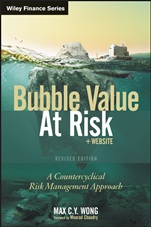
Bubble Value at Risk: A Countercyclical Risk Management Approach
ISBN 9781118550342
Autor: Max C. Y. Wong
Wydawca: Wiley
Dostępność: 3-6 tygodni
Cena: 476,70 zł
Przed złożeniem zamówienia prosimy o kontakt mailowy celem potwierdzenia ceny.
ISBN13: |
9781118550342 |
ISBN10: |
111855034X |
Autor: |
Max C. Y. Wong |
Oprawa: |
Hardback |
Rok Wydania: |
2013-04-12 |
Ilość stron: |
368 |
Wymiary: |
235x153 |
Tematy: |
KF |
"Bubble Value at Risk offers a critical rethinking of some of the deficiencies in the calculation of risk capital. I particularly liked the more applied wisdom scattered throughout the text. Here is a practitioner explaining how things really work, or for that matter, don′t work in the real world. These remarks will definitely open the eyes of the more academic researcher."
Paul Embrechts, Director of RiskLab, ETH Zurich
"Reading Bubble Value at Risk is an intensive master class in risk management. As a busy risk management practitioner, I found Bubble Value at Risk extremely worthwhile in that Wong, with the theoretic detail of an academic but with the intuition of a practitioner, very efficiently surveys the evolution of financial risk management thought since the credit crisis. The book is well written, organized, thought–provoking, and to the point. After constructively critiquing pre–crisis risk management for its conceit that it could precisely model extreme events, Wong pragmatically breaks with risk dogma and introduces the concept of Bubble Value at Risk as a more prudent means of allocating sufficient capital to buffer tail risk in light of the fact that tail risk is inherently unknowable. The book is simply a very good use of time for anyone fighting the guerrilla war with risk."
David P. Belmont, CFA and Chief Risk Officer, Commonfund
"John Maynard Keynes is famous for many things, including this quote on bankers: ′A sound banker, alas, is not one who foresees danger and avoids it, but one who, when he is ruined, is ruined in a conventional way along with his fellows, so that no one can really blame him.′ This quote, originally found in The Consequences to the Banks of the Collapse of Money Values (1931), describes very accurately the robotic use of the Value at Risk concept at many financial institutions. Max Wong skewers the conventional wisdom on Value at Risk in this original book from a very talented and experienced market participant. Mr. Wong illustrates the mathematical problems with Value at Risk with many worked examples and insights from the 2007–2011 credit crisis. He suggests an alternative to the conventional wisdom, ′ Bubble Value at Risk,′ which addresses many of the shortcomings in conventional VaR calculations that were starkly revealed during the credit crisis. We highly recommend this candid and enlightening book to any risk analyst who finds himself surrounded by a large contingent of ′sound bankers.′"
Donald R. van Deventer, PhD, Chairman and Chief Executive Officer, Kamakura Corporation (www.kamakuraco.com), and coauthor of Advanced Financial Risk Management, 2nd Edition
"Wong establishes his reputation as an inventive risk manager with the innovative idea to express expected shortfall (also called expected tail loss, or conditional VaR) in terms of previous price levels. This book also has some interesting ideas on financial regulatory reform and should be attractive to non–quant readers seeking knowledge of the pitfalls of Value at Risk, as it is usually measured."
Professor Carol Alexander, Subject Lead, Finance and Accounting, School of Business, Management and Economics, University of Sussex
About the Author xiii
Foreword xv
Preface xvii
Acknowledgments xxi
PART ONE Background
CHAPTER 1 Introduction 3
1.1 The Evolution of Riskometer 4
1.2 Taleb s Extremistan 6
1.3 The Turner Procyclicality 7
1.4 The Common Sense of Bubble Value–at–Risk (BuVaR) 8
Notes 13
CHAPTER 2 Essential Mathematics 15
2.1 Frequentist Statistics 15
2.2 Just Assumptions 18
2.3 Quantiles, VaR, and Tails 26
2.4 Correlation and Autocorrelation 29
2.5 Regression Models and Residual Errors 35
2.6 Significance Tests 38
2.7 Measuring Volatility 41
2.8 Markowitz Portfolio Theory 45
2.9 Maximum Likelihood Method 48
2.10 Cointegration 50
2.11 Monte Carlo Method 52
2.12 The Classical Decomposition 55
2.13 Quantile Regression Model 58
2.14 Spreadsheet Exercises 62
Notes 64
PART TWO Value at Risk Methodology
CHAPTER 3 Preprocessing 67
3.1 System Architecture 67
3.2 Risk Factor Mapping 70
3.3 Risk Factor Proxies 75
3.4 Scenario Generation 76
3.5 Basic VaR Specification 79
Notes 81
CHAPTER 4 Conventional VaR Methods 83
4.1 Parametric VaR 84
4.2 Monte Carlo VaR 89
4.3 Historical Simulation VaR 93
4.4 Issue: Convexity, Optionality, and Fat Tails 96
4.5 Issue: Hidden Correlation 102
4.6 Issue: Missing Basis and Beta Approach 104
4.7 Issue: The Real Risk of Premiums 106
4.8 Spreadsheet Exercises 107
Notes 108
CHAPTER 5 Advanced VaR Methods 111
5.1 Hybrid Historical Simulation VaR 111
5.2 Hull–White Volatility Updating VaR 113
5.3 Conditional Autoregressive VaR (CAViaR) 114
5.4 Extreme Value Theory VaR 116
5.5 Spreadsheet Exercises 122
Notes 124
CHAPTER 6 VaR Reporting 125
6.1 VaR Aggregation and Limits 125
6.2 Diversification 126
6.3 VaR Analytical Tools 127
6.4 Scaling and Basel Rules 132
6.5 Spreadsheet Exercises 136
Notes 137
CHAPTER 7 The Physics of Risk and Pseudoscience 139
7.1 Entropy, Leverage Effect, and Skewness 140
7.2 Volatility Clustering and the Folly of i.i.d. 144
7.3 Volatility of Volatility and Fat Tails 145
7.4 Extremistan and the Fourth Quadrant 148
7.5 Regime Change, Lagging Riskometer, and Procyclicality 151
7.6 Coherence and Expected Shortfall 154
7.7 Spreadsheet Exercises 156
Notes 156
CHAPTER 8 Model Testing 159
8.1 The Precision Test 159
8.2 The Frequency Back Test 160
8.3 The Bunching Test 163
8.4 The Whole Distribution Test 165
8.5 Spreadsheet Exercises 167
Notes 167
CHAPTER 9 Practical Limitations of VaR 169
9.1 Depegs and Changes to the Rules of the Game 169
9.2 Data Integrity Problems 171
9.3 Model Risk 172
9.4 Politics and Gaming 174
Notes 175
CHAPTER 10 Other Major Risk Classes 177
10.1 Credit Risk (and CreditMetrics) 177
10.2 Liquidity Risk 182
10.3 Operational Risk 187
10.4 The Problem of Aggregation 190
10.5 Spreadsheet Exercises 195
Notes 195
PART THREE The Great Regulatory Reform
CHAPTER 11 Regulatory Capital Reform 199
11.1 Basel I and Basel II 199
11.2 The Turner Review 202
11.3 Revisions to Basel II Market Risk Framework (Basel 2.5) 206
11.4 New Liquidity Framework 211
11.5 The New Basel III 212
11.6 The New Framework for the Trading Book 214
11.7 The Ideal Capital Regime 215
Notes 217
CHAPTER 12 Systemic Risk Initiatives 221
12.1 Soros Reflexivity, Endogenous Risks 221
12.2 CrashMetrics 226
12.3 New York Fed CoVaR 230
12.4 The Austrian Model and BOE RAMSI 233
12.5 The Global Systemic Risk Regulator 238
12.6 Spreadsheet Exercises 240
Notes 241
PART FOUR Introduction to Bubble Value–at–Risk (BuVaR)
CHAPTER 13 Market BuVaR 245
13.1 Why an Alternative to VaR? 245
13.2 Classical Decomposition, New Interpretation 247
13.3 Measuring the Bubble 250
13.4 Calibration 254
13.5 Implementing the Inflator 257
13.6 Choosing the Best Tail–Risk Measure 259
13.7 Effect on Joint Distribution 262
13.8 The Scope of BuVaR 264
13.9 How Good Is the BuVaR Buffer? 265
13.10 The Brave New World 268
13.11 Spreadsheet Exercises 271
Notes 271
CHAPTER 14 Credit BuVaR 273
14.1 The Credit Bubble VaR Idea 273
14.2 Model Formulation 276
14.3 Behavior of Response Function 278
14.4 Characteristics of Credit BuVaR 280
14.5 Interpretation of Credit BuVaR 282
14.6 Spreadsheet Exercises 284
Notes 284
CHAPTER 15 Acceptance Tests 285
15.1 BuVaR Visual Checks 285
15.2 BuVaR Event Timing Tests 297
15.3 BuVaR Cyclicality Tests 304
15.4 Credit BuVaR Parameter Tuning 306
Notes 313
CHAPTER 16 Other Topics 315
16.1 Diversification and Basis Risks 315
16.2 Regulatory Reform and BuVaR 317
16.3 BuVaR and the Banking Book: Response Time as Risk 319
16.4 Can BuVaR Pick Tops and Bottoms Perfectly? 321
16.5 Postmodern Risk Management 321
16.6 Spreadsheet Exercises 323
Note 323
CHAPTER 17 Epilogue: Suggestions for Future Research 325
Note 327
About the Website 329
Bibliography 331
Index 337
Max C.Y. Wong is a specialist in the area of risk modeling and Basel III. He started his career as a derivatives consultant at Credit Suisse First Boston in 1996. During the Asian crisis in 1998 he traded index futures at the open–outcry floor of SIMEX (now SGX). From 2003 to 2011, he worked for Standard Chartered Bank as a risk manager and senior quant. He is currently head of VaR model testing at the Royal Bank of Scotland. He has published papers on VaR models and Basel capital, recently looking at innovative ways to model risk more effectively during crises and to deal with the issues of procyclicality and Black Swan event in our financial system. He has spoken on the subject at various conferences and seminars. He holds a B.Sc. Physics from University of Malaya (1994) and a M.Sc. financial engineering from National University of Singapore (2004). He is an adjunct at Singapore Management University, a member of the editorial board of the Journal of Risk Management in Financial Institutions, and a member of the steering committee of PRMIA Singapore chapter.
Koszyk
Książek w koszyku: 0 szt.
Wartość zakupów: 0,00 zł
Informacje


Kontakt
Gambit
Centrum Oprogramowania
i Szkoleń Sp. z o.o.
Al. Pokoju 29b/22-24
31-564 Kraków
Siedziba Księgarni
ul. Kordylewskiego 1
31-542 Kraków
+48 12 410 5991
+48 12 410 5987
+48 12 410 5989
Subskrypcje
Administratorem danych osobowych jest firma Gambit COiS Sp. z o.o. Na podany adres będzie wysyłany wyłącznie biuletyn informacyjny.
Autoryzacja płatności

Informacje na temat autoryzacji płatności poprzez PayU.

© Copyright 2012: GAMBIT COiS Sp. z o.o. Wszelkie prawa zastrzeżone.
Projekt i wykonanie: Alchemia Studio Reklamy