


Wydawcy
Katalog tematyczny
- Archeologia (109)
- Ekonomia, finanse, business (13704)
- Filozofia (1445)
- Historia (3040)
- Języki i językoznawstwo (2356)
- Lifestyle, hobby i rozrywka (475)
- Medycyna (9704)
- Nauki humanistyczne (4)
- Nauki o Ziemi i środowisku (2638)
- Nauki ścisłe (20412)
- Nauki społeczne (8486)
- Nauki techniczne (13450)
- Prawo (1696)
- Publikacje informacyjne i interdyscyplinarne (1288)
- Religia i wierzenia (917)
- Technika komputerowa (4067)
- Zdrowie, relacje międzyludzkie i rozwój osobisty (657)





Informacje szczegółowe o książce
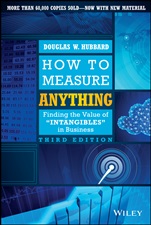
How to Measure Anything: Finding the Value of Intangibles in Business
ISBN 9781118539279
Autor: Douglas W. Hubbard
Wydawca: Wiley
Dostępność: 3-6 tygodni
Cena: 248,85 zł
Przed złożeniem zamówienia prosimy o kontakt mailowy celem potwierdzenia ceny.
ISBN13: |
9781118539279 |
ISBN10: |
1118539273 |
Autor: |
Douglas W. Hubbard |
Oprawa: |
Hardback |
Rok Wydania: |
2014-04-25 |
Numer Wydania: |
3rd Edition |
Ilość stron: |
432 |
Wymiary: |
245x148 |
Tematy: |
KM |
Praise for the second edition of How to Measure Anything: Finding the Value of Intangibles in Business How to Measure Anything was already my favorite book (just ahead of Hubbards second book, The Failure of Risk Management ) and one I actively promote to my students and colleagues. But the Second Edition , improving on the already exquisite first edition, is an achievement of its own. As a physicist and economist, I applied these techniques in several fields for several years. For the first time, somebody wrote together all these concerns on one canvas that is at the same time accessible to a broad audience and applicable by specialists. This book is a must for students and experts in the field of analysis (in general) and decision–making. Dr. JOHAN BRAET, University of Antwerp, Faculty of Applied Economics, Risk Management and Innovation Doug Hubbards book is a marvelous tutorial on how to define sound metrics to justify and manage complex programs. It is a must–read for anyone concerned about mitigating the risks involved with capital planning, investment decisions, and program management. JIM FLYZIK, former Government CIO, White House Technology Advisor and CIO magazine Hall of Fame Inductee Praise for the first editionThe bestselling Business Math book two years in a row! I love this book. Douglas Hubbard helps us create a path to know the answer to almost any question, in business, in science, or in life . . . How to Measure Anything provides just the tools most of us need to measure anything better, to gain that insight, to make progress, and to succeed. PETER TIPPETT, PhD, MD, Chief Technology Officer, CyberTrust, and inventor of the first antivirus software Interestingly written and full of case studies and rich examples, Hubbards book is a valuable resource for those who routinely make decisions involving uncertainty. This book is readable and quite entertaining, and even those who consider themselves averse to statistics may find it highly approachable. Strategic Finance This book is remarkable in its range of measurement applications and its clarity of style. A must–read for every professional who has ever exclaimed, Sure, that concept is important, but can we measure it? Dr. JACK STENNER, cofounder and CEO of MetaMetrics, Inc. Hubbard has made a career of finding ways to measure things that other folks thought were immeasurable. Quality? The value of telecommuting? The benefits of greater IT security? Public image? He says it can be doneand without breaking the bank . . . If youd like to fare better in the project–approval wars, take a look at this book. ComputerWorld
Preface to the Third Edition Acknowledgments About the Author Part I: Measurement The Solution Exists Chapter 1 The Challenge of Intangibles The Alleged Intangibles Yes, I Mean Anything The Proposal: It’s About Decisions A “Power Tools” Approach to Measurement A Guide to the Rest of the Book Chapter 2 An Intuitive Measurement Habit: Eratosthenes, Enrico, and Emily How an Ancient Greek Measured the Size of Earth Estimating: Be Like Fermi Experiments: Not Just for Adults Notes on What to Learn from Eratosthenes, Enrico, and Emily Notes Chapter 3 The Illusion of Intangibles: Why Immeasurables Aren’t The Concept of Measurement The Object of Measurement The Methods of Measurement Economic Objections to Measurement The Broader Objection to the Usefulness of “Statistics” Ethical Objections to Measurement Reversing Old Assumptions Notes Part II: Before You Measure Chapter 4: Clarifying the Measurement Problem Toward a Universal Approach to Measurement The Unexpected Challenge of Defining a Decision If You Understand It, You can Model It Getting the Language Right: What “Uncertainty” and “Risk” Really Mean An Example of a Clarified Decision Notes Chapter 5 Calibrated Estimates: How Much Do You Know Now ? Calibration Exercise Calibration Trick: Bet Money (or Even Just Pretend to) Further Improvements on Calibration Conceptual Obstacles to Calibration The Effects of Calibration Training Notes Chapter 6 Measuring Risk through Modeling How Not to Measure Risk Real Risk Analysis: The Monte Carlo An Example of the Monte Carlo Method and Risk Tools and Other Resources for Monte Carlo Simulations The Risk Paradox and the Need for Better Risk Analysis Notes Chapter 7 Measuring the Value of Information The Chance of Being Wrong and the Cost of Being Wrong: Expected Opportunity Loss The Value of Information for Ranges Beyond Yes/No: Decisions on a Continuum The Imperfect World: The Value of Partial Uncertainty Reduction The Epiphany Equation: How the Value of Information Changes Everything Summarizing Uncertainty, Risk, and Information Value: The First Measurements Notes Part III: Measurement Methods Chapter 8 The Transition: From What to Measure to How to Measure Tools of Observation: Introduction to the Instrument of Measurement Decomposition Secondary Research: Assuming You Weren’t the First to Measure It The Basic Methods of Observation: If One Doesn’t Work, Try the Next Measure Just Enough Consider the Error Choose and Design the Instrument Notes Chapter 9 Sampling Reality: How Observing Some Things Tells Us about All Things Building an Intuition for Random Sampling: The Jelly Bean Example A Little about Little Samples: A Beer Brewer’s Approach Is Are Small Samples Really “Statistically Significant?” When Outliers Matter Most The Easiest Sample Statistics Ever Experiment Seeing Relationships in the Data: An Introduction to Regression Modeling Notes Chapter 10 Bayes: Adding to What You Know Now The Basics and Bayes Using Your Natural Bayesian Instinct Heterogeneous Benchmarking: A "Brand Damage" Application Bayesian Inversion for Ranges: An Overview The Lessons of Bayes Notes PART IV: Beyond the Basics Chapter 11 Preference and Attitudes: The Softer Side of Measurement Observing Opinions, Values, and the Pursuit of Happiness A Willingness to Pay: Measuring Value via Trade–offs Putting It All on the Line: Quantifying Risk Tolerance Quantifying Subjective Trade–offs: Dealing with Multiple Conflicting Preferences Keeping the Big Picture in Mind: Profit Maximization versus Purely Subjective Trade–offs Notes Chapter 12 The Ultimate Measurement Instrument: Human Judges Homo absurdus : The Weird Reasons behind Our Decisions Getting Organized: A Performance Evaluation Example Surprisingly Simple Linear Models How to Standardize Any Evaluation: Rasch Models Removing Human Inconsistency: The Lens Model Panacea or Placebo?: Questionable Methods of Measurement Comparing the Methods Notes Chapter 13 New Measurement Instruments for Management The Twenty–First–Century Tracker: Keeping Tabs with Technology Measuring the World: The Internet as an Instrument Prediction Markets: A Dynamic Aggregation of Opinions Notes Chapter 14 A Universal Measurement Method: Applied Information Economics Bringing the Pieces Together Case: The Value of the System that Monitors Your Drinking Water Case: Forecasting Fuel for the Marine Corps Case: Measuring the Value of ACORD Standards Ideas for Getting Started: A Few Final Examples Summarizing the Philosophy Notes Appendix: Calibration Tests (and Their Answers) Index
DOUGLAS W. HUBBARD is the inventor of Applied Information Economics (AIE), a measurement methodology that has earned him critical praise from The Gartner Group, Giga Information Group, and Forrester Research. He is an internationally recognized expert in the field of decision analysis and challenging measurements and is a popular speaker at numerous conferences. He has written articles for Information Week , CIO Enterprise , and DBMS Magazine . He is the author of The Failure of Risk Management: Why Its Broken and How to Fix It and Pulse: The New Science of Harnessing Internet Buzz to Track Threats and Opportunities.
Koszyk
Książek w koszyku: 0 szt.
Wartość zakupów: 0,00 zł
Informacje


Kontakt
Gambit
Centrum Oprogramowania
i Szkoleń Sp. z o.o.
Al. Pokoju 29b/22-24
31-564 Kraków
Siedziba Księgarni
ul. Kordylewskiego 1
31-542 Kraków
+48 12 410 5991
+48 12 410 5987
+48 12 410 5989
Subskrypcje
Administratorem danych osobowych jest firma Gambit COiS Sp. z o.o. Na podany adres będzie wysyłany wyłącznie biuletyn informacyjny.
Autoryzacja płatności

Informacje na temat autoryzacji płatności poprzez PayU.

© Copyright 2012: GAMBIT COiS Sp. z o.o. Wszelkie prawa zastrzeżone.
Projekt i wykonanie: Alchemia Studio Reklamy